
GLP-1 Decision Guide · Verified May 2, 2026
Is Taking a GLP-1 a Good Idea? An Honest 2026 Decision Guide
Published: · Last reviewed:
Sources: FDA-approved labels for Wegovy injection, Wegovy tablets, Zepbound, Ozempic, Mounjaro, Saxenda, Foundayo, and Rybelsus (DailyMed); CMS Medicare GLP-1 Bridge program documentation; FDA Drug Safety Communications and the April 2026 503B bulks-list proposal; March 2026 Lancet eClinicalMedicine meta-analysis on weight regain; January 2026 FDA labeling action on suicidal-ideation language; Reuters (Wegovy tablets approval, December 22, 2025); Ro pricing page verified May 2026.
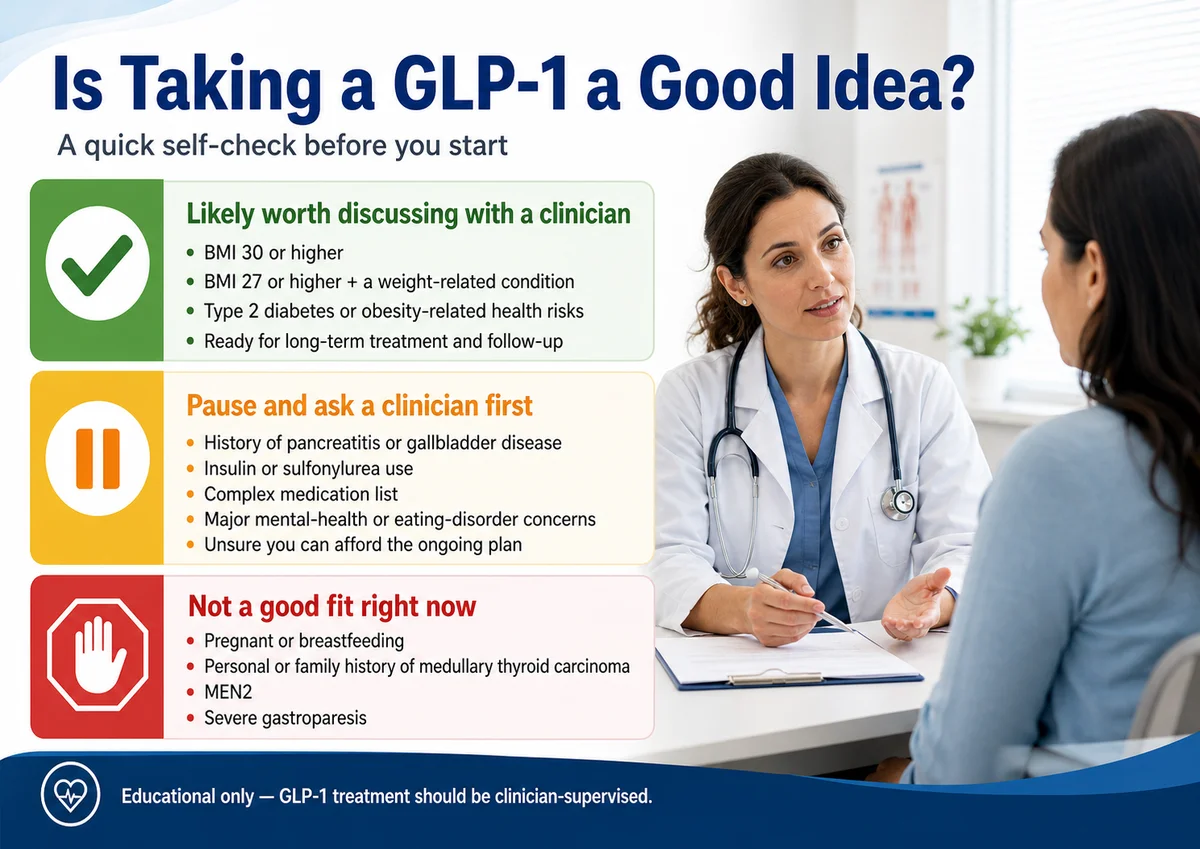
Is taking a GLP-1 a good idea? The short answer: yes — if you fit a clear medical profile and can commit long-term. No — if you only want to drop 10 pounds for a wedding, you have a disqualifying condition, or you can only afford the intro month.
For adults with a BMI of 30 or higher — or 27+ with a weight-related condition like type 2 diabetes, high blood pressure, sleep apnea, or high cholesterol — the FDA-approved evidence is strong but drug-specific. Zepbound’s label shows 15.0% to 20.9% body-weight reduction at 72 weeks. Wegovy tablets show 13.6% at 64 weeks. Foundayo (orforglipron, FDA-approved April 2026) shows up to 11.1% at 72 weeks in adults without type 2 diabetes. It’s not a good idea if you’re pregnant, planning pregnancy, have a personal or family history of medullary thyroid carcinoma or MEN2, or only want a short-term cosmetic change.
Get a real answer in 60 seconds, tailored to your situation.
Take the 60-Second Readiness Score →The Quick Verdict Table — Find Yourself in 30 Seconds
We built this so you don’t have to read 8,000 words to know if this is for you. Find the row that matches your situation:
| Your situation | Verdict | Best next step |
|---|---|---|
| BMI 30+ and you’ve tried diets that didn’t stick | Likely worth discussing | Take the readiness score, then talk to a clinician |
| BMI 27–29 with high blood pressure, type 2 diabetes, or sleep apnea | Strong medical case | Insurance route or FDA-approved brand path |
| You have type 2 diabetes that metformin alone hasn’t fixed | Strongest case | Talk to your doctor or endocrinologist |
| You want to lose 5–10 pounds for appearance | Probably not the right tool | Lifestyle-first approach is the cheaper, lower-risk start |
| Pregnant, planning pregnancy, or breastfeeding | No — do not start | Drug-specific timing varies; ask your clinician |
| Personal or family history of medullary thyroid cancer or MEN2 | Hard no | A different weight-loss path entirely |
| You can only afford one or two months | Not yet | Solve the cost path before starting |
| You’re not sure where you fit | Get the score | Take the 60-second Readiness Score below |
Made up your mind already?
Take the 60-second matching quiz to find your path →✅ What We Actually Verified to Build This Page
Most “should I take a GLP-1” articles cite no sources and get edited once a year. Here’s exactly what we verified, where we got it, and when we’ll recheck it:
| What we verified | Source we checked | Current value | Recheck cadence |
|---|---|---|---|
| Ro Body membership pricing | Ro pricing page | $39 first month; $149/month ongoing; as low as $74/month with annual prepay; medication priced separately | Monthly |
| Ro Foundayo cash-pay pricing | Ro pricing page | $149 first month; $199–$299/month thereafter | Monthly |
| Ro Zepbound KwikPen cash-pay pricing | Ro pricing page | $299 first month; $399–$449/month thereafter | Monthly |
| Ro Wegovy pen cash-pay pricing | Ro pricing page | $199 first month; $199–$349/month thereafter | Monthly |
| Ro Ozempic cash-pay pricing | Ro pricing page | $900–$1,100/month without insurance | Monthly |
| Medicare GLP-1 Bridge dates | CMS.gov | July 1, 2026 – December 31, 2027 for eligible Part D beneficiaries; $50 copay | Monthly |
| Foundayo (orforglipron) label efficacy | DailyMed FDA label | Up to 11.1% at 17.2 mg, 72 weeks, adults without type 2 diabetes; up to 9.6% with type 2 diabetes | Quarterly |
| Zepbound label efficacy | DailyMed FDA label | Study 1: 15.0%, 19.5%, and 20.9% at 72 weeks for 5/10/15 mg | Quarterly |
| Wegovy tablet efficacy and approval | DailyMed FDA label / Reuters | 13.6% at Week 64 (Study 7); FDA approval December 22, 2025 | Quarterly |
| FDA compounded GLP-1 status | FDA.gov | Compounded drugs are not FDA-approved; FDA proposed excluding semaglutide, tirzepatide, liraglutide from 503B bulks list (April 2026) | Monthly |
| 1-year weight regain after stopping | Lancet eClinicalMedicine, March 2026 meta-analysis | About 60% of weight lost regained within 1 year; plateau ~75% over time | Quarterly |
| FDA suicidal ideation labeling | FDA, January 2026 | FDA requested removal of suicidal behavior warning from Wegovy, Saxenda, Zepbound labels | Quarterly |
The RX Index is a pricing intelligence and comparison resource for GLP-1 telehealth providers. We earn affiliate commissions on some links.
Is Taking a GLP-1 a Good Idea? The Plain-English Answer
Answer capsule: Whether taking a GLP-1 is a good idea comes down to three honest buckets: yes if you medically qualify and can commit long-term; maybe if you qualify but have a real friction point like cost or side-effect tolerance; no — or not yet — if you have a disqualifying condition or you only want a short-term cosmetic result. The medication, indication, and your personal circumstances all matter. A blanket yes or no doesn’t exist.
We’ve watched a lot of people overthink this question. Here’s the truth: there are really only three answers.
🟢 Yes, if
You meet medical criteria, you don’t have a disqualifier, you can sustain the cost, and you understand this is a long-term plan — not a 12-week reset.
🟡 Maybe, if
You qualify medically but you’re stuck on one issue — cost, fear of side effects, or uncertainty about long-term commitment. Usually “fix the friction first, then yes.”
🔴 No, or not yet, if
You have a contraindication, you’re pregnant or planning pregnancy, you only want to lose 10 pounds for aesthetic reasons, or finances can’t carry you past month 2.
If you walked away with just those three sentences, you’d already be ahead of most people researching this question.
But the real value isn’t the buckets — it’s knowing which bucket you’re in. That’s what the next section does.
The 7-Factor GLP-1 Readiness Score (Take 60 Seconds, Get a Real Answer)
Answer capsule: The 7-Factor GLP-1 Readiness Score is a personalized self-assessment that evaluates medical fit, contraindications, lifestyle willingness, side-effect tolerance, financial sustainability, and goal alignment. Each factor is weighted based on FDA-labeled criteria, GLP-1 contraindications, current diabetes and obesity treatment guidance, and verified commercial-access factors. You answer 7 questions and get a 0–100 score that maps to one of four verdicts: Strong Fit, Likely Fit, Conditional, or Not a Good Fit Right Now.
This score is a decision aid, not a diagnosis or prescription. Always confirm with a licensed clinician before starting any medication.
How the Score Works
You answer 7 questions. Each is weighted because some factors matter more than others — a medical contraindication is an automatic zero; a lifestyle preference earns partial credit. Your total maps to one of four results.
| Score | Verdict | What it means |
|---|---|---|
| 80–100 | Strong Fit | The medical math, financial math, and lifestyle math all work. Take the next step. |
| 60–79 | Likely Fit | You’re a yes once you fix one or two friction points (usually cost or commitment). |
| 40–59 | Conditional | Possible — but several factors say “have a longer conversation first.” |
| 0–39 or any contraindication | Not a Good Fit Right Now | Either medically inappropriate or wrong tool for your goal. Better paths exist. |
The 7 Factors and How They’re Scored
| # | Factor | Weight | Source basis | Auto-zero or partial credit |
|---|---|---|---|---|
| 1 | Medical eligibility | 15 pts | FDA-labeled BMI/indication criteria for weight-management GLP-1s | BMI 30+ or 27+ with condition = full; under 27 with no condition = partial or zero |
| 2 | Contraindication check | 15 pts | DailyMed/FDA boxed warnings and contraindications | Any formal contraindication = auto-zero entire score |
| 3 | Long-term mindset | 15 pts | Clinical evidence on weight regain after stopping (Lancet meta-analysis, March 2026) | Comfortable with 18+ months = full; want 3 months only = low |
| 4 | Lifestyle willingness | 15 pts | Resistance training and protein intake studies on lean mass preservation | Will commit = full; won’t = zero |
| 5 | Side-effect tolerance | 15 pts | FDA-labeled common adverse reactions (nausea, vomiting, GI symptoms) | Comfortable with monitoring = full; not at all = low |
| 6 | Financial reality | 15 pts | Current 2026 cash-pay and insurance pathway pricing (verified above) | Can sustain ongoing cost 12+ months = full; intro-month-only = zero |
| 7 | Goal fit | 10 pts | FDA labels for chronic weight management vs. cosmetic weight loss | Clinical-need range = full; under 15 lbs aesthetic = near zero |
Interactive: 7-Factor Readiness Score
Take 60 seconds — get your score
Pick the closest option for each question. Your score appears below the form. This is a decision aid, not a diagnosis.
Your score: 0 / 100
Answer all 7 questions to see your verdict.
What to Do With Your Score
- Strong Fit (80–100): Take our matching quiz to find the right provider for your medication preference and budget. Find my path →
- Likely Fit (60–79): Read the cost section below first. Most “Likely Fit” scores become “Strong Fit” once cost is solved.
- Conditional (40–59): Use the doctor visit checklist below and have a real conversation before committing. See the checklist →
- Not a Good Fit (0–39 or any contraindication): Don’t take it personally. Better options exist for your situation. See our 2026 GLP-1 medication comparison or talk to your primary care doctor about alternatives.
We’d rather you skip a GLP-1 you shouldn’t take than convert a bad fit. That’s the whole point.
Who Is Taking a GLP-1 Actually a Good Idea For?
Answer capsule: Taking a GLP-1 is most clearly a good idea for adults with a BMI of 30+, adults with a BMI of 27+ who have a weight-related condition, people with type 2 diabetes who haven’t reached A1C goals on metformin, adults with established cardiovascular disease and obesity (Wegovy is labeled for this), and adults with obesity-related obstructive sleep apnea (Zepbound is labeled for this). Each indication is medication-specific. Not every GLP-1 has every benefit.
There are four situations where the medical case is strongest. If you’re in any of these, the answer is likely yes — pending the disqualifier check in the next section.
Case 1: BMI 30+, or 27+ With a Weight-Related Condition
This is the FDA’s own line for weight-management GLP-1s. If your body mass index is 30 or higher, FDA-approved weight-management GLP-1 or GLP-1/GIP medications like Wegovy, Zepbound, Saxenda, Wegovy tablets, and Foundayo are labeled for chronic weight management. If your BMI is 27 to 29 and you have at least one weight-related condition — high blood pressure, high cholesterol, type 2 diabetes, sleep apnea, or cardiovascular disease — you also qualify under FDA criteria.
Realistic upside in this group, drug by drug: Zepbound’s label reports body-weight reductions of 15.0% to 20.9% at 72 weeks across 5 mg, 10 mg, and 15 mg doses (placebo: 3.1%) in adults without type 2 diabetes. Wegovy tablets show 13.6% at Week 64. Foundayo shows up to 11.1% at 17.2 mg in adults without type 2 diabetes. For a 220-pound person, that’s roughly 25 to 46 pounds, depending on the drug.
Case 2: Type 2 Diabetes, Especially if Metformin Isn’t Enough
GLP-1 medications started as diabetes drugs. In type 2 diabetes, GLP-1 therapy is commonly added when metformin and lifestyle aren’t enough, and the 2026 American Diabetes Association Standards of Care prioritize medication choice based on your other conditions — obesity, cardiovascular disease, kidney disease, heart failure — not just A1C. The bonus: most people in this group also lose meaningful weight.
If you have type 2 diabetes and you’re on metformin only, this is one of the strongest medical cases there is. Talk to your doctor about whether a GLP-1 like Ozempic or Mounjaro fits your full picture.
Case 3: Established Cardiovascular Disease + Obesity
Wegovy is labeled to reduce major adverse cardiovascular events (heart attack, stroke, cardiovascular death) in adults with established cardiovascular disease and obesity or overweight. This is a specific labeled indication, not a class effect. It often unlocks insurance coverage that wasn’t there for “weight loss alone.” If your cardiologist hasn’t mentioned it, ask about it.
Case 4: Obstructive Sleep Apnea + Obesity
Zepbound (tirzepatide) is labeled for moderate-to-severe obstructive sleep apnea in adults with obesity. This is a newer indication that often expands insurance coverage and shifts the medical conversation away from “elective” toward “treating a condition.”
If you’ve been denied coverage for weight loss but you have a sleep apnea diagnosis, this is the angle to pursue. Our deeper guide on the best GLP-1 for sleep apnea walks through the labeled evidence and coverage angles.
Decision point
If you fit one of these four cases and your readiness score landed at 60 or above, the next step is figuring out which GLP-1 path matches your insurance, budget, and medication preference.
Take the 60-second matching quiz →Who Should NOT Take a GLP-1 (4 Hard Stops + Red Flags + One Hard Truth)
Answer capsule: A GLP-1 is not appropriate for people with a personal or family history of medullary thyroid carcinoma or MEN2, anyone with a serious prior allergic reaction to a GLP-1, anyone currently pregnant or planning pregnancy, and anyone with severe gastroparesis. Several other situations — pancreatitis history, gallbladder disease, eating disorder concerns, type 1 diabetes — are red flags that require specialist clearance before starting. People seeking small cosmetic weight loss without a medical indication also fall outside FDA-approved use.
This is where most articles soft-pedal. We won’t.
The 4 Hard Stops (Don’t Self-Start, Period)
Hard Stop 1: Personal or family history of medullary thyroid carcinoma (MTC) or MEN2
Medullary thyroid carcinoma is a rare thyroid cancer. MEN2 (multiple endocrine neoplasia type 2) is a genetic syndrome that raises MTC risk. Every GLP-1 carries a boxed warning — the FDA’s most serious warning label — based on rodent studies showing thyroid C-cell tumors. Whether the same risk applies to humans isn’t fully proven, but the boxed warning means the answer here is no. If your mom, dad, sibling, or grandparent had MTC, ask before doing anything else.
Hard Stop 2: Serious hypersensitivity to a GLP-1
Foundayo’s label and other GLP-1 labels list serious hypersensitivity (severe allergic reaction) as a contraindication. If you’ve had anaphylaxis or a serious allergic reaction to any GLP-1 medication in the past, that class is closed for you.
Hard Stop 3: Pregnant, planning pregnancy, or breastfeeding
Animal studies have shown developmental abnormalities. Drug-specific timing matters: Wegovy’s label uses a 2-month pre-conception discontinuation window. Foundayo’s label says to discontinue when pregnancy is recognized and is not recommended for nursing women. If pregnancy is on your timeline in the next year, ask your clinician about the specific medication’s timing — don’t guess.
A second Foundayo-specific note for reproductive-age readers: Foundayo may reduce the effectiveness of oral hormonal contraceptives. The Foundayo label says users of oral hormonal contraceptives should switch to a non-oral method or add a barrier method for 30 days after starting and for 30 days after each dose escalation.
Hard Stop 4: Severe gastroparesis
GLP-1s slow gastric emptying — that’s part of how they work. If your stomach already empties too slowly, slowing it more can trigger serious problems. GLP-1 labels say use is not recommended in this group. Treat it as a hard stop unless a specialist tells you otherwise.
The Red Flags (Specialist Clearance Required First)
These aren’t automatic disqualifiers, but they’re not green lights either. Get a specialist conversation before starting:
- Active or recent pancreatitis — GLP-1 labels include warnings; clinicians typically discontinue if pancreatitis is suspected. A personal history shifts the risk-benefit math hard.
- Significant gallbladder disease — labeled warnings exist for gallbladder problems including gallstones and cholecystitis.
- Active or recent eating disorder — body image, restriction patterns, and weight-loss medications can interact in unsafe ways.
- Type 1 diabetes — off-label use is being studied but isn’t standard care.
- Severe untreated depression with active suicidal thoughts — discuss with your mental health clinician first; report any new or worsening mood symptoms while on the medication.
- Currently underweight or normal weight with body image concerns — the medical math doesn’t support starting.
The Hard Truth Most Pages Won’t Tell You
We need to be direct about something most competitor pages bury: GLP-1s are not the right tool if your goal is “lose 10 pounds for a wedding” or “drop a pant size for summer.”
Not because there’s anything wrong with wanting to look better. There isn’t. But these are powerful medications with real GI side effects, real cost, real long-term commitment requirements, and real muscle-loss risk. The math on a 10-pound aesthetic goal doesn’t work — you’ll spend $1,000+, deal with weeks of nausea, lose lean mass you didn’t need to lose, and likely regain it within a year of stopping.
If small cosmetic weight loss is your real goal, a GLP-1 isn’t your answer. A focused 12-week structured approach — strength training, a sensible nutrition plan, an honest calorie audit — will get you there cheaper, safer, and with muscle gain instead of muscle loss.
We say this because the right reader trusts us more when we’re willing to send the wrong reader away. If you’re focused on protecting muscle while losing weight, see our companion guide on GLP-1 muscle loss and how to prevent it.
What Are the Side Effects and Tradeoffs of Taking a GLP-1?
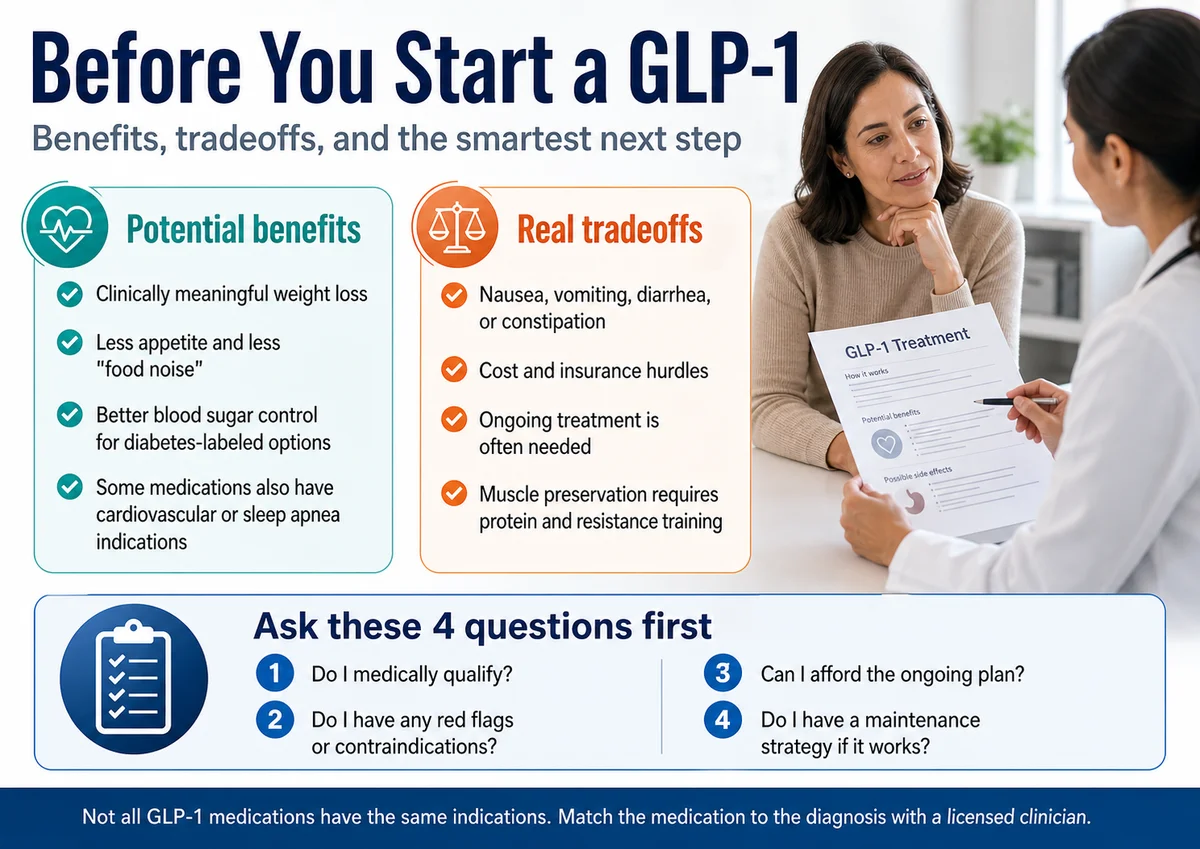
Answer capsule: The 2026 evidence on FDA-approved GLP-1 medications shows large weight loss benefits (drug-specific, ranging from about 11% to 21% at trial endpoints), real cardiovascular benefits in specific labeled populations (Wegovy in adults with established cardiovascular disease), and meaningful improvements in blood sugar, blood pressure, and cholesterol. The most common downsides are GI side effects during initiation, possible muscle loss without resistance training, and significant weight regain after stopping. A few rare but serious risks exist and require monitoring.
Most articles either oversell GLP-1s or fearmonger them. We’ll do neither. Here’s what current research actually says — what’s well-established, what’s being monitored, and what’s still unknown.
The Upside (Drug-Specific, Not a Class Claim)
- Body-weight reduction at FDA-label trial endpoints: up to 20.9% (Zepbound 15 mg, 72 weeks), 13.6% (Wegovy tablets, Week 64), and up to 11.1% (Foundayo 17.2 mg, 72 weeks)
- Cardiovascular benefit in specific labeled populations: Wegovy is labeled to reduce major adverse cardiovascular events in adults with established cardiovascular disease and obesity or overweight
- Sleep apnea benefit: Zepbound is labeled for moderate-to-severe obstructive sleep apnea in adults with obesity
- HbA1c reductions of approximately 1.5% to 2.0% in type 2 diabetes — a meaningful drop
- Improvements in blood pressure, cholesterol, and fatty liver disease for some patients
- Emerging signals on reduced addictive behaviors — alcohol, nicotine, and compulsive patterns show signals in observational studies
Do not assume every GLP-1 has every benefit. Each is medication- and indication-specific.
The Common Side Effects (Most Resolve Over Time)
GLP-1 labels commonly list nausea, vomiting, diarrhea, constipation, abdominal pain, dyspepsia, bloating, and similar symptoms. Severity and duration vary by drug, dose, and patient. Published research on the GLP-1 class describes GI symptoms during initiation in roughly half to two-thirds of patients, generally diminishing over time with continued treatment.
What this looks like in practice:
- Nausea (most common)
- Vomiting
- Diarrhea or constipation
- Bloating, abdominal discomfort
- Fatigue, headaches
- Reduced thirst sensation (you have to drink water on purpose)
These usually fade. Slow titration — starting low and increasing dose gradually — cuts the severity for most people.
The Less-Common but Serious Risks
- Acute pancreatitis (rare; GLP-1 labels include warnings and instruct discontinuation if suspected)
- Gallbladder problems and gallstones
- Severe GI reactions (Foundayo’s label warns severe GI reactions can occur)
- Bowel obstruction (rare)
- Diabetic retinopathy worsening with rapid HbA1c reduction in some type 2 patients
- Hypoglycemia when combined with insulin or sulfonylureas
What 2026 Surveillance Has Clarified
- Suicidal ideation: In January 2026, the FDA requested removal of suicidal behavior and ideation warning language from Wegovy, Saxenda, and Zepbound labels after surveillance reviews didn’t find evidence of increased risk. You should still report new or worsening mood symptoms to your prescriber.
- Muscle loss is real: Without resistance training and adequate protein, weight loss can include significant lean mass loss. With training and a clinician-set protein target, that drops substantially. This is the most-skipped piece of the protocol — see our deeper guide on preventing GLP-1 muscle loss.
- “Ozempic face”: Facial volume loss happens with rapid weight loss generally — it’s not unique to any one drug. Slower weight loss and adequate hydration help.
What’s Still Being Studied
- Outcomes beyond 2 years in non-diabetic populations
- Long-term effects of stop-start cycles
- Effects in adults over 65 and adolescents
- Comparative durability of newer agents like orforglipron
Bottom line: The benefit-to-risk ratio is favorable for the right person. It is not favorable for the wrong person. The Readiness Score above is how you tell which one you are.
The 2026 GLP-1 Drug Comparison — Drug-by-Drug
Answer capsule: The 2026 GLP-1 medications differ in FDA-labeled use, form, label efficacy figures, and trial population. Tirzepatide (Zepbound, Mounjaro) leads on weight reduction. Semaglutide (Wegovy, Ozempic) has the longest real-world track record. Wegovy tablets (FDA-approved December 2025) and Foundayo (FDA-approved April 2026) are the newest oral weight-management options. Liraglutide (Saxenda) has lower efficacy with daily dosing.
If you’ve decided yes, the next question is which one. This is the comparison we wish we’d had when we started researching:
| Medication | FDA-labeled use | Form | Label trial body-weight figure | Trial population | Trial length |
|---|---|---|---|---|---|
| Tirzepatide — Zepbound | Chronic weight management; OSA in adults with obesity | Weekly injection | Study 1: -15.0% / -19.5% / -20.9% (5/10/15 mg); placebo -3.1% | Adults without type 2 diabetes | 72 weeks |
| Tirzepatide — Mounjaro | Type 2 diabetes | Weekly injection | Zepbound Study 2 (T2D pop.): -12.8% / -14.7% (10/15 mg); placebo -3.2% | Adults with type 2 diabetes | 72 weeks |
| Semaglutide — Wegovy injection | Chronic weight management; cardiovascular risk reduction in adults with established CVD + obesity/overweight | Weekly injection | About -14.9% body weight in pivotal trial reporting (verify against current label) | Adults with obesity/overweight | 68 weeks |
| Semaglutide — Wegovy tablets | Chronic weight management (FDA-approved December 22, 2025) | Daily pill | -13.6% at Week 64 (label Study 7) | Adults with obesity/overweight | 64 weeks |
| Semaglutide — Ozempic | Type 2 diabetes; CV risk reduction in T2D + CVD; kidney benefits in T2D + CKD | Weekly injection | Diabetes-labeled — efficacy reported as A1C reduction; weight loss reported as secondary | Adults with type 2 diabetes | Varies |
| Semaglutide — Rybelsus | Type 2 diabetes | Daily pill | Diabetes-labeled | Adults with type 2 diabetes | Varies |
| Orforglipron — Foundayo | Chronic weight management (FDA-approved April 2026) | Daily pill | Trial 1 (no T2D): -7.4% / -8.3% / -11.1% (3/12/17.2 mg). Trial 2 (T2D): -5.1% / -7.0% / -9.6% | Adults with and without T2D | 72 weeks |
| Liraglutide — Saxenda | Chronic weight management | Daily injection | About -4% to -5% pooled across 24 trials | Adults with obesity/overweight | Varies |
The Weight Regain Question Everyone Forgets
Here’s the fact that decides the answer for a lot of people: a March 2026 systematic review and meta-regression in The Lancet eClinicalMedicine found that about 60% of weight lost during GLP-1 treatment is regained within one year of stopping. Long-term modeling suggests the regain plateaus at roughly 75% of weight lost.
Translation: if you lose 50 pounds on the medication and stop, expect to regain about 30 pounds within a year, and roughly 37 pounds over time — unless you transition deliberately with structured nutrition, resistance training, and (often) ongoing maintenance dosing.
This is the single most important fact to internalize before starting. Most “is it a good idea” pages skip it. We’re putting it in bold.
Will I Have to Stay on a GLP-1 Forever?
Answer capsule: Most people who succeed with GLP-1 medications stay on some form of treatment indefinitely or transition through a structured maintenance plan. The March 2026 Lancet meta-analysis confirms about 60% of weight is regained within one year of stopping. Obesity is now widely classified as a chronic condition, similar to high blood pressure, that often needs ongoing management — not a 12-week intervention.
This is the question that keeps people up at night. Here’s the honest answer.
Why Weight Regain Happens (It’s Biology, Not Failure)
GLP-1s suppress appetite and slow how fast your stomach empties. When you stop, your body’s natural hunger signals come back — often louder than before. Your brain’s “set point” for body weight is biological. The medication changed the signal; stopping the medication restores the original signal.
This isn’t willpower failure. It’s the same reason people regain weight after extreme diets — only with GLP-1s, the regain pattern is now well-quantified.
What This Means for the “Good Idea” Decision
If you can only commit to a 3-to-6-month course, GLP-1 is probably not a good idea. The cost, side effects, and regain math don’t work out.
If you can commit to 12 to 24 months minimum with a deliberate transition plan, the math works.
The people who keep their results long-term tend to do one of three things:
- Stay on a maintenance dose indefinitely (most common path)
- Taper slowly over 3–6 months with intensified resistance training and structured nutrition follow-up
- Cycle off and on under clinician supervision when life circumstances change (still being studied)
What an Exit Ramp Looks Like
If you ever want off the medication, the framework that gives you the best shot at keeping the results:
- Slow dose reduction over 3 to 6 months, not abrupt stopping
- Resistance training at least twice a week to preserve and rebuild lean mass
- A clinician-set protein target appropriate for your body weight and goals
- Continued clinical follow-up for the first year off
- Realistic expectation that some regain (about 30%) is likely even with perfect adherence
The best clinicians ask “what’s our maintenance plan?” before they prescribe. If your provider doesn’t, that’s a yellow flag.
What Does a GLP-1 Actually Cost in 2026? (And the 4 Real Paths to Get It)
Answer capsule: GLP-1 costs in 2026 vary widely. Some lower-dose oral cash-pay programs start around $149/month; Ozempic cash-pay can run $900–$1,100/month without insurance. There are four real paths: insurance-covered branded, cash-pay branded direct, compounded telehealth (with FDA caveats), and bridge programs like the Medicare GLP-1 Bridge running July 2026 through December 2027. Cost is the #1 reason people start and stop, so solving the path before starting is the single biggest determinant of success.
Cost is where most “is it a good idea” decisions actually get made. Here’s the unvarnished 2026 reality.
The Four Real Paths
Path 1: Insurance + brand-name medication (Wegovy, Zepbound, Foundayo)
- Best if: You have employer-sponsored coverage that includes obesity treatment, OR you have an FDA-approved indication beyond weight loss (cardiovascular disease, OSA), OR you have a high-quality plan
- Out-of-pocket: $25 to $200 per month after coverage
- The hurdle: Prior authorization paperwork. Some providers handle this for you; most don’t.
- Watch out for: Plans that require step therapy (try other medications first) or have weight-loss exclusions
Path 2: Cash-pay branded direct (FDA-approved, no insurance)
- Best if: You don’t have GLP-1 coverage but you want FDA-approved brand medication
- Out-of-pocket (verified May 2026 via Ro pricing page):
- Foundayo: $149 first month, $199–$299 thereafter
- Wegovy pen: $199 first month, $199–$349 thereafter
- Zepbound KwikPen: $299 first month, $399–$449/month thereafter
- Ozempic: $900–$1,100/month without insurance
- The advantage: You know exactly what you’re getting, made by the manufacturer, with full FDA approval
Path 3: Compounded GLP-1 via licensed telehealth
- Best if: A licensed clinician determines an FDA-approved drug cannot meet your individual medical need, or the FDA-approved drug is not commercially available, and you’ve verified the pharmacy, source, dosing, labeling, ongoing price, and cancellation terms
- The compliance reality: Compounded medications are not FDA-approved. They are not the same as the branded drug. Cost alone is not the FDA’s standard for using a compounded medication.
- 2026 regulatory state: As of April 30, 2026, the FDA proposed excluding semaglutide, tirzepatide, and liraglutide from the 503B bulks list after finding no clinical need for outsourcing facilities to compound them from bulk substances. Compounded availability is changing.
- What to verify: Pharmacy licensing (503A vs 503B), clinician oversight, ongoing pricing past intro month, cancellation terms
Path 4: Bridge programs and alternative coverage
- The CMS Medicare GLP-1 Bridge runs July 1, 2026 through December 31, 2027 for eligible Medicare Part D beneficiaries who meet prior-authorization criteria. Eligible products currently include Foundayo, Wegovy injection, Wegovy tablets, and Zepbound KwikPen. CMS says eligible beneficiaries pay a $50 copay under the Bridge.
- HSA/FSA reimbursement at most providers
- Select state Medicaid programs
- Some employer-sponsored programs
The Hidden Cost Question Nobody Asks
We’ve watched a lot of people sign up for the $39 intro month, get billed $200+ in month two, and quit angry. Before you start anything, ask yourself this:
“Can I afford the ongoing price after the intro offer ends, every month for at least 12 months?”
If the answer isn’t a clear yes, fix the cost path before you fix anything else.
Already decided you want the FDA-approved brand-name path with insurance support?
Ro is the FDA-approved-first option we send most insurance-sensitive readers to. They carry Zepbound® (tirzepatide) and Foundayo™ (orforglipron), match LillyDirect, NovoCare, and TrumpRx pricing on medication, include a free GLP-1 Insurance Coverage Checker, and run an insurance concierge for prior authorizations on eligible non-government plans. Pricing as of May 2026: get started for $39, then as low as $74/month with annual prepay for Ro Body membership. Medication is priced separately.
One important limitation: Ro cannot help coordinate GLP-1 coverage for government insurance plans. Medicaid members cannot join Ro Body. Medicare and TRICARE members may only have cash-pay options through Ro. FEHB members can use Ro’s insurance concierge.
Check Ro’s GLP-1 program eligibility → (sponsored affiliate link, opens in a new tab)Affiliate link.
Still figuring out which path fits your situation?
Take the 60-second GLP-1 path quiz →Get a personalized route based on insurance, budget, medication preference, and goals. No email required.
FDA-Approved vs. Compounded vs. Wait — Which Route Should You Pick?
Answer capsule: The cleanest 2026 route is FDA-approved medication when it’s available, affordable, and medically appropriate. Compounded GLP-1 medications are not FDA-approved, are not the same as branded versions, and operate in a tightening regulatory environment as of 2026. For some people, the right answer is to wait — until insurance changes, until pregnancy plans resolve, until the budget allows the FDA-approved route.
This is the decision most readers don’t realize they have to make. Three options:
Option A: FDA-Approved Route
The FDA-approved options as of May 2026:
- Wegovy injection (semaglutide) — for chronic weight management; cardiovascular risk reduction in adults with established CVD + obesity/overweight
- Wegovy tablets (semaglutide) — for chronic weight management (FDA-approved December 22, 2025)
- Zepbound (tirzepatide) — for chronic weight management; obstructive sleep apnea in adults with obesity
- Ozempic (semaglutide) — for type 2 diabetes
- Mounjaro (tirzepatide) — for type 2 diabetes
- Saxenda (liraglutide) — for chronic weight management
- Foundayo (orforglipron) — daily pill, FDA-approved April 2026 for chronic weight management
- Rybelsus (oral semaglutide) — for type 2 diabetes
Best fit for: Anyone who can access these through insurance or cash-pay manufacturer-aligned programs. Anyone who values regulatory certainty. Anyone with a complex medical history.
Option B: Compounded Route
Important compliance facts: Compounded GLP-1 medications are not FDA-approved. The FDA has stated unapproved GLP-1 products do not undergo FDA premarket review for safety, effectiveness, or quality. The FDA has also said semaglutide sodium and semaglutide acetate are different active ingredients from approved semaglutide products and the FDA is not aware of any lawful basis for their use in compounding.
As of April 30, 2026, FDA proposed excluding semaglutide, tirzepatide, and liraglutide from the 503B bulks list after finding no clinical need for outsourcing facilities to compound them from bulk substances. Outsourcing facilities generally cannot compound from bulk substances unless the substance appears on the 503B bulks list or the compounded drug is on the FDA’s shortage list at the time of compounding, distribution, and dispensing.
Best fit for: Patients where a licensed clinician determines an FDA-approved drug cannot meet the individual’s medical need, or where the FDA-approved drug isn’t commercially available, and the patient verifies the pharmacy, source, dosing, labeling, ongoing price, and cancellation terms. Cost alone is not the FDA’s standard.
Red flags to avoid in any compounded provider:
- Claims that compounded medications are “the same as” branded versions
- “Research peptide” or “not for human consumption” language sold for self-use (the FDA has warned companies for this exact pattern)
- No pharmacy or sourcing disclosure
- No clinician review
- Hidden ongoing pricing
- Guaranteed weight-loss claims
- No cancellation transparency
If you’re comparing compounded providers, our existing GLP-1 telehealth provider comparison covers verified options with transparent pricing, sourcing, and policies.
Option C: Wait
The forgotten option. Sometimes “wait six months” is genuinely the right answer.
Wait makes sense if:
- Your insurance is changing within 6 months (open enrollment, new job)
- You may qualify for the Medicare GLP-1 Bridge (July 2026 – December 2027)
- You’re trying to conceive within the next 12 months
- You need to address a GI, endocrine, or mental health concern first
- You can’t yet afford the ongoing price
- You’re not sure between brand-name and compounded — that decision matters more than which provider you pick
There’s no urgency manufactured here. These medications will still exist in six months. Better to start one you can sustain than start one you can’t.
The “Am I Cheating?” Question — An Honest Answer
Answer capsule: Taking a GLP-1 to address obesity or metabolic disease is not cheating any more than taking a statin for high cholesterol or insulin for diabetes is cheating. Obesity is now classified as a chronic medical condition with biological drivers — hormones, genetics, environment — that lifestyle alone often cannot overcome. Major medical bodies, including the Obesity Society, American Diabetes Association, and Endocrine Society, recognize GLP-1 medications as part of structured obesity care for qualifying adults.
Look, we’ve seen this come up in almost every conversation we’ve had with GLP-1 candidates. So let’s address it.
You’re not cheating. Here’s why.
What the Research Has Made Clear
For people with a BMI of 30 or higher, lifestyle intervention alone produces about 3% to 5% body weight loss on average. For severe obesity (BMI 40+), that’s not enough to reach health-meaningful targets. The biology — your set point, your hunger signaling, your energy expenditure adaptation — is working against you in a way that “just eat less and move more” doesn’t address.
GLP-1s aren’t a shortcut around willpower. They’re a tool that addresses the biological piece so the willpower piece becomes possible.
What the Medical Community Now Says
Major medical bodies recognize GLP-1 medications as part of structured obesity care for qualifying adults. Not as a last resort. Not as a desperate move. As a standard option.
This represents a real shift from a decade ago. The medical consensus has caught up with the biology.
What This Doesn’t Mean
This doesn’t mean lifestyle doesn’t matter. It does — completely. The medication works best with lifestyle changes; the lifestyle changes work best with the medication. Neither alone is the full answer for most people who medically qualify.
The shame people feel about taking a GLP-1 isn’t a signal that they’re doing something wrong. It’s the residue of decades of bad messaging about willpower and body weight. The shame doesn’t deserve to drive your medical decisions.
If your real question is “will my partner, family, or friends judge me?” — that’s a different question than “is it a good idea?” The answer to the second one doesn’t depend on the answer to the first one.
GLP-1 vs. Lifestyle vs. Bariatric Surgery — Which Path Fits?
Answer capsule: The four major weight-loss paths in 2026 are structured lifestyle alone (3–7% weight loss), oral non-GLP-1 medications like phentermine and Contrave (5–10%), GLP-1 medications (label-verified figures from about 11% to 21% depending on drug and dose), and bariatric surgery (25–35%). Each fits different people. GLP-1 isn’t always the right answer — sometimes lifestyle alone is enough, and sometimes surgery is the better long-term solution.
We’re not GLP-1 maximalists. The right tool depends on your situation. Here’s the honest comparison:
| Approach | Typical weight loss | Best fit if you… | Honest tradeoff |
|---|---|---|---|
| Structured lifestyle alone | 3% to 7% | BMI under 27, or 27+ without comorbidities, or strongly prefer no medication | Hardest sustained adherence. Biological hunger isn’t directly addressed. |
| Non-GLP-1 oral medications (phentermine, Contrave, Qsymia) | 5% to 10% | Cost-constrained, can’t tolerate injection, want a shorter-term tool | Lower ceiling than GLP-1. Some have cardiovascular cautions. |
| FDA-approved GLP-1 medications | About 11% to 21% (drug- and dose-dependent) | BMI 30+, or 27+ with a condition, can commit long-term | Cost. GI side effects. Regain after stopping. |
| Bariatric surgery | 25% to 35% | BMI 40+, or 35+ with serious comorbidities, prior medication failures, want one-time intervention | Surgical risk. Irreversible. Longer recovery. |
When Lifestyle Alone Is the Right Answer
If your BMI is under 27 and you don’t have a metabolic condition, lifestyle is your first move. A GLP-1 is overkill for the goal. Save the cost, skip the side effects, build the habits.
When Bariatric Is Worth Considering
If your BMI is 40+ and you’ve failed medications already, bariatric surgery has the best long-term durability of any weight-loss intervention we have. It’s invasive, but for the right person, it’s the cleanest answer.
Which Path Fits If You Decide GLP-1 Is a Good Idea?
Answer capsule: The right GLP-1 path depends on your insurance status, medication preference (FDA-approved brand vs. compounded), budget, and goal. Insurance-covered branded medication is the cleanest path when available. Cash-pay branded is the best fit if you want FDA approval without the insurance hassle. Compounded telehealth fits a narrow set of cases under FDA’s medical-need standard. The matching quiz routes you based on your specific situation in 60 seconds.
You’ve decided yes. Here’s the path that fits, by reader profile:
| Reader profile | Best-fit route | Next action |
|---|---|---|
| “I want FDA-approved medication and help with insurance or prior auth.” | Ro (insurance concierge for non-government plans); Sesame Care as secondary | Check Ro eligibility → (sponsored affiliate link, opens in a new tab) |
| “I want brand-name medication and may pay cash.” | Ro or Sesame, depending on medication and pricing | Compare brand-name paths → |
| “I’m on Medicare.” | CMS Medicare GLP-1 Bridge (July 2026 – December 2027); $50 copay for eligible beneficiaries | See Medicare path → |
| “I want oral GLP-1 options.” | FDA-approved Wegovy tablets, Foundayo, or Rybelsus (diabetes) | See oral comparison → |
| “I’m cash-pay, my clinician determined an FDA-approved drug doesn’t meet my need.” | Compare verified compounded providers with transparent pricing | Compare compounded providers → |
| “I’m not sure I qualify medically.” | Quiz first, then doctor conversation | Take the readiness quiz → |
| “I have red flags or complex history.” | Doctor-first, not telehealth-first | See the doctor checklist → |
How to Talk to Your Doctor About GLP-1 — 12 Questions Worth Asking
Answer capsule: The most useful pre-prescription conversation covers eligibility, contraindications, medication choice, side-effect management, monitoring, cost, follow-up cadence, and a maintenance plan. Bringing 12 specific questions to your appointment turns a 10-minute visit into a real decision conversation.
The single highest-leverage thing you can do before starting is have a focused conversation with your primary care doctor or an obesity-medicine specialist. Most doctors appreciate prepared patients — it makes the visit faster and better.
Print this and bring it with you:
The 12 Questions
- Based on my BMI and conditions, do I medically qualify under current FDA criteria?
- Which GLP-1 do you recommend first for my specific situation, and why that one?
- Will my insurance likely cover it, and if not, what’s the next-best path?
- What’s your protocol for managing GI side effects in the first 8 weeks?
- What symptoms should make me contact you urgently?
- Are there any contraindications or risk factors in my history I should know about?
- How will this interact with my current medications? (Especially important if you take oral hormonal contraceptives and may be prescribed Foundayo.)
- What labs and monitoring do I need, and how often?
- What’s your protein intake, resistance training, and muscle-protection recommendation?
- What’s your follow-up cadence — monthly, quarterly?
- What’s the total monthly cost after any intro pricing ends?
- What’s our maintenance plan if I stop, plateau, or want to reduce dose?
A printable PDF version of this checklist is in development — for now, save or screenshot the 12 questions above to bring to your appointment.
What a Good First Month Should Include
Whether you go through your primary care doctor or a quality telehealth provider, your first month should include:
- A real medical intake with full history
- Contraindication screening (the disqualifiers above)
- Baseline weight and goal-setting
- Side-effect education before you start
- A slow titration plan (not jumping to highest dose)
- Nutrition guidance — at minimum, a clinician-set protein target
- A scheduled follow-up
- Clear refill terms and cancellation policy in writing
What should NOT happen: No clinician review. No medication-source disclosure. No side-effect instructions. No ongoing price clarity. Pressure to buy before screening.
If any of those apply, walk away.
What Real People Worry About Before Starting
Answer capsule: Real searcher concerns about starting GLP-1 medications cluster around five themes: side-effect fear, cost transparency, judgment from family or partners, “cheating” guilt, and trusting online providers. These emotional concerns are as decisive as the medical facts for many people. The themes below are recurring patterns we see in public GLP-1 forums and provider-review discussions — used here as voice-of-customer language only, not medical evidence.
We spent time reading the actual forums where people work through this decision. Here’s what comes up over and over.
Worry #1: “What if the side effects are unbearable?”
Common framing: “I want to do this, but I’m scared of the nausea everyone talks about.”
The honest answer: GI symptoms during initiation are common across the GLP-1 class. Most are mild to moderate and fade within 4 to 8 weeks. Slow titration helps. Eating smaller meals helps. Hydration helps. A subset of patients can’t tolerate the side effects and have to stop or switch — that’s not nothing, but it’s not the majority.
Worry #2: “Which online company won’t pull a bait-and-switch?”
This concern shows up constantly in GLP-1 community discussions. People sign up for the cheap intro month, get a bigger bill in month two, and feel deceived.
The honest answer: The cleanest providers post their ongoing pricing as prominently as their intro pricing. Before you sign up anywhere, screenshot the actual monthly cost for months 2 through 12. If you can’t find it in 60 seconds on the provider’s site, that’s a yellow flag. We track this in our hidden-fees breakdown for GLP-1 telehealth providers.
Worry #3: “Am I cheating? Will my partner judge me?”
The shame question. We covered this in detail above. Short version: you’re not cheating. The medical community doesn’t think you’re cheating. The shame is residue from a decade of bad cultural messaging about body weight, and it doesn’t deserve to drive your medical decisions.
Worry #4: “What if I can’t tolerate it OR can’t afford it OR have to stop?”
This is the right worry. We’d rather you sit with this one for a week before signing up than rush into something you can’t sustain.
The honest answer: Plan for it. Solve the cost path before you start. Know the GI symptom plan. Know the maintenance plan. If two out of three of those aren’t solid, wait until they are.
Worry #5: “Will my doctor take me seriously?”
Some people get a great experience. Some get dismissed. If your primary care doctor doesn’t take it seriously and you medically qualify, you can ask for a referral to an obesity medicine specialist (yes, that’s a board-certified specialty now) or use a quality telehealth provider that handles screening properly.
You don’t have to wait for your doctor to bring it up. Walk in with the 12 questions above.
The Bottom Line — When Is Taking a GLP-1 a Good Idea?
Answer capsule: Taking a GLP-1 is a good idea when the medical case is clear (FDA-labeled criteria), the disqualifiers are checked, the cost path is solved, and the treatment is part of a long-term supervised plan. It is not a good idea when the goal is short-term aesthetic weight loss, the cost path isn’t solved, or medical red flags exist. For the right person, the 2026 evidence is some of the strongest we’ve seen for any chronic disease intervention.
Here’s the final verdict matrix:
| Verdict | Who fits |
|---|---|
| 🟢 Good idea — start the conversation | Adults with BMI 30+, or 27+ with a weight-related condition, type 2 diabetes that needs more than metformin, established CVD + obesity (Wegovy), moderate-to-severe sleep apnea + obesity (Zepbound) — who have no contraindications, can sustain the cost long-term, and treat this as ongoing care |
| 🟡 Maybe — but pause first | People worried about cost, side effects, insurance, pregnancy plans, GI history, or long-term maintenance |
| 🔴 Probably not your path | People seeking small cosmetic weight loss, people with contraindications, people using non-clinical sources, or people who can’t afford ongoing care |
The shame is in not knowing where you fit. We built this page so you’d know.
Still Not Sure Which GLP-1 Program Fits Your Situation?
Take our free 60-second matching quiz
Answer 7 questions about your insurance, medication preference, budget, and goals. Get a personalized recommendation — doctor-first, FDA-approved brand, oral option, compounded comparison, or “not yet.” No email required to see your match.
Take the 60-second quiz →Already decided you want the FDA-approved brand-name path?
Ro matches LillyDirect, NovoCare, and TrumpRx pricing on medication, includes insurance concierge for prior authorizations on eligible non-government plans, and offers a free GLP-1 Insurance Coverage Checker. Get started for $39, then as low as $74/month with annual prepay (medication priced separately). Ro cannot coordinate GLP-1 coverage for government insurance plans; Medicaid members cannot join Ro Body; Medicare and TRICARE members may only have cash-pay options.
Check Ro’s GLP-1 program → (sponsored affiliate link, opens in a new tab)Affiliate link.
Realized GLP-1 isn’t your path?
See our 2026 GLP-1 medication comparison for evidence-backed alternatives, and check our deeper guide on GLP-1 muscle loss if your concern is body composition.
Frequently Asked Questions
Is taking a GLP-1 a good idea if I only want to lose 10 pounds?
Usually no. FDA-approved weight-management GLP-1 medications are labeled for adults with obesity (BMI 30+) or overweight (BMI 27+) with at least one weight-related condition. For 10-pound aesthetic goals, the cost, side-effect risk, muscle-loss potential, and regain probability after stopping make the math unfavorable. A focused 12-week structured nutrition and resistance training plan is the better starting point.
Is GLP-1 safe long-term?
Multi-year safety data from diabetes populations is reassuring. Long-term data in non-diabetic obesity populations is still maturing — most large randomized trials have followed people for 1 to 2 years. The known risks (boxed warnings for thyroid C-cell tumors, pancreatitis warnings, gallbladder disease warnings) are managed through screening and monitoring with a clinician.
Will I gain the weight back if I stop GLP-1?
Most likely, yes — about 60% within one year, plateauing at roughly 75% over time, per a March 2026 Lancet eClinicalMedicine meta-analysis. Resistance training, a clinician-set protein target, structured nutrition, and a deliberate taper reduce but don't eliminate this.
How much does GLP-1 cost without insurance in 2026?
FDA-approved GLP-1s without insurance can range from about $149/month for some lower-dose oral cash-pay programs to around $900–$1,100/month for Ozempic cash-pay without insurance. Some injectable list prices still sit around $1,000+ when reduced cash-pay channels aren't used. The actual cost depends on the medication, dose, and program you choose.
Is "Ozempic face" a real side effect?
Facial volume loss happens with rapid weight loss generally — it's not unique to any specific GLP-1 medication. Slower weight loss, adequate protein intake, hydration, and resistance training help reduce the appearance.
Can I get a GLP-1 if I have type 2 diabetes?
Yes — and the medical case is one of the strongest. GLP-1 therapy is commonly added when metformin and lifestyle aren't enough, and 2026 ADA guidance prioritizes medication choice based on your other conditions. Several GLP-1s are FDA-approved specifically for type 2 diabetes (Ozempic, Mounjaro, Rybelsus, Victoza). Match the medication to the indication with your doctor.
Is compounded GLP-1 the same as FDA-approved GLP-1?
No. Compounded GLP-1 medications are not FDA-approved and are not the same as the branded versions. The FDA has stated unapproved GLP-1 products do not undergo FDA premarket review for safety, effectiveness, or quality. Compounded options exist but should be considered only when a licensed clinician determines an FDA-approved drug cannot meet your individual medical need.
Should I talk to my primary doctor or use telehealth?
If you have complex medical history, take diabetes medications, are planning pregnancy, have GI conditions or eating disorder history, or have other significant risk factors — start with your doctor. If your case is straightforward and you medically qualify, a quality telehealth provider may be a convenient access route, but they should still screen you properly and disclose costs clearly.
Can I use Ro if I have Medicare, Medicaid, TRICARE, or FEHB?
Ro cannot coordinate GLP-1 coverage for government insurance plans. Medicaid members cannot join Ro Body. Medicare and TRICARE members may join Ro Body but only have cash-pay options through Ro. FEHB members can use Ro's insurance concierge for eligible plans. Medicare beneficiaries may also want to look at the CMS Medicare GLP-1 Bridge (July 2026 through December 2027) for $50-copay access to eligible weight-management GLP-1s.
Does Foundayo affect birth control?
Yes — this is important if you take oral hormonal contraceptives. The Foundayo label says oral hormonal contraceptive users should switch to a non-oral method or add a barrier method for 30 days after starting Foundayo and for 30 days after each dose escalation. Talk to your clinician about contraception planning before starting.
What's the best GLP-1 for weight loss in 2026?
For most adults who medically qualify, tirzepatide (Zepbound) shows the highest body-weight reduction in trials — Zepbound's label reports up to 20.9% at 72 weeks at the 15 mg dose. Wegovy injection has the longest real-world track record and is also labeled for cardiovascular risk reduction in adults with established CVD. Foundayo (FDA-approved April 2026) is the newest oral option. The "best" depends on your insurance, side-effect tolerance, injection vs. pill preference, and medical history.
What Would Make This Page Wrong?
We’ve tried to be honest. But the science evolves, prices change, and FDA actions happen. Here’s our recheck list — what we’ll re-verify and update on a regular cadence:
- Pricing for every provider and medication mentioned (monthly)
- FDA-approved vs. compounded regulatory status (monthly until stable)
- Medicare GLP-1 Bridge eligibility and rollout (monthly through 2027)
- Side-effect and contraindication language against current FDA labels (quarterly)
- New FDA approvals or label changes (continuously)
- New long-term outcome studies (quarterly)
- Provider state availability (monthly for affiliate links)
If you spot something stale, email us and we’ll re-verify. This page is meant to age well.
The RX Index is a pricing intelligence and comparison resource for GLP-1 telehealth providers. This page is educational and is not medical advice. Talk to a licensed clinician before starting, stopping, or changing any medication. Affiliate disclosure: we may earn a commission when readers use certain provider links — that does not change our editorial recommendations or whether we tell readers a path isn’t right for them.
Last verified: .
Related Guides
Your situation changes the answer
Find My GLP-1 Path
The right GLP-1 provider isn't the same for everyone. It depends on your state, your insurance and formulary, whether you want an FDA-approved or compounded medication, your preferred route (injection or oral), and your budget. Because a general answer can't resolve those for you, use The RX Index's Find My GLP-1 Path tool to get a personalized provider match with source-verified pricing before you choose.
- What it asks: your state, insurance situation, medication preference, budget, and support needs
- What you get: a personalized shortlist of GLP-1 providers matched to your situation, with verified pricing and the right questions to ask
- Cost: free · about 2 minutes · no signup