
GLP-1 Providers That Don't Make You Sick? Best Side-Effect Support in 2026
By The RX Index Editorial Team · The RX Index is a pricing intelligence and comparison resource for GLP-1 telehealth providers.
Last verified: May 12, 2026
Published: · Last reviewed:
This content is educational and is not medical advice. GLP-1 medications can have serious risks. Talk to a licensed clinician before starting any medication. We may earn commissions on some links.
The honest bottom line
If you searched for GLP-1 providers that don't make you sick, the honest answer is: no provider can promise that. Anyone who does is selling you something.
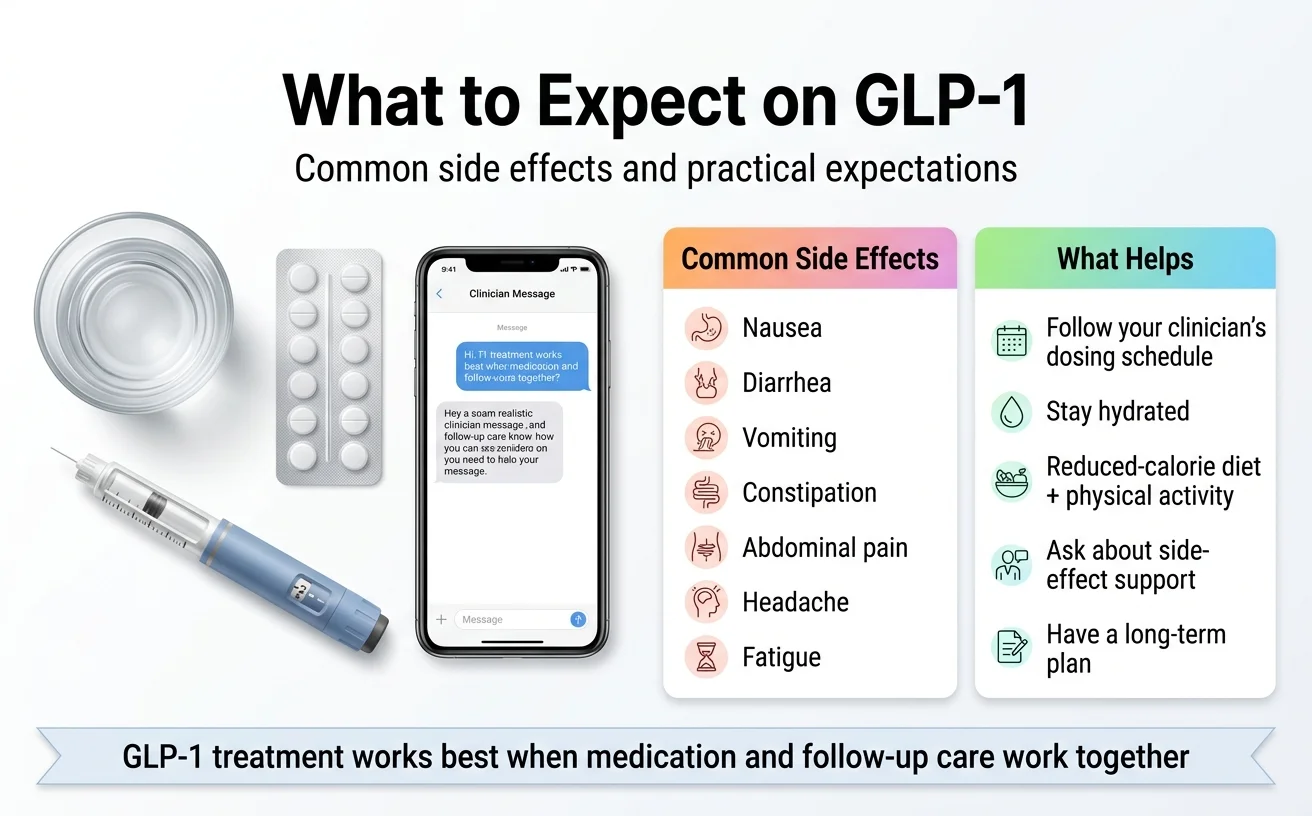
Here's the real situation. GLP-1 medications can slow how fast food leaves your stomach and change appetite signals. That's part of how they help you eat less — and part of why nausea, fullness, reflux, or constipation can show up, especially in the first few weeks and after dose changes.
So the better question isn't "which provider doesn't make you sick?" It's "which provider gives me the strongest support if side effects do happen?" That answer changes everything.
Based on our May 2026 review of provider pages, FDA materials, and clinical sources, here's the short version:
- ●Best overall for side-effect support: Ro — FDA-approved options including Wegovy and Zepbound, plus the new daily pill Foundayo. Insurance concierge handles prior auth. Unlimited messaging with your clinician. Check Ro eligibility →
- ●Best if you want to pick your own doctor: Sesame Care — live video visits, your choice of clinician, broadest branded formulary we verified.
- ●Best low-cost cash-pay starter: Embody — low first-month pricing ($99 for a compounded semaglutide injection), 24/7 care-team messaging, and a needle-free GLP-1 gum option. (Embody's GLP-1 path is compounded — not FDA-approved finished drugs. Caveats explained below.)
- ●Best verified no-cost ondansetron offer: Hers / Hims — Hims has publicly stated eligible weight-loss customers may receive ondansetron (an anti-nausea medication) at no additional cost.
- ●Best if you're scared of needles: Talk to Ro about Foundayo (the FDA-approved daily pill) or Wegovy pill, or look at needle-free compounded options like Embody's GLP-1 gum or SHED's lozenges and drops.
- ●Not sure yet? Take our free 60-second matching quiz →
About 60–70% of people on GLP-1s have been described as reaching their full dose with little to no significant GI trouble in one 2026 review (Frontiers in Endocrinology, 2026). That doesn't mean you won't feel sick. It means dose escalation, dose holds, and the support you have when symptoms hit really do change the experience.
Where to start by situation
| If this is you | Start here | Why | Key thing to check |
|---|---|---|---|
| I want FDA-approved medication and the clearest support path. | Ro | Strong FDA-approved menu, insurance help, titration support built into membership | Membership and medication are billed separately |
| I want to choose my clinician and talk on video. | Sesame Care | Provider choice, video visits, messaging, labs where appropriate | Medication cost is separate; per-visit pricing varies |
| I'm self-pay and want a low starting price. | Embody | $99 first month (compounded sema injection), 24/7 care team, needle-free gum option | Cash-pay only; compounded meds are not FDA-approved finished drugs |
| My biggest fear is vomiting. | Hers / Hims | Publicly stated no-cost ondansetron for eligible weight-loss customers | Confirm eligibility for your specific path before paying |
| I'm not sure what path fits me. | The 60-second match | Routes by FDA preference, fear, budget, and format | Takes about a minute; no charge to find out |
Worried about side effects but ready to compare your real options?
Are there GLP-1 providers that don't make you sick?
Short answer:
No GLP-1 provider can promise you won't get sick. The providers that actually help are the ones with strong support if symptoms happen: real clinician access, sensible titration, a way to hold or reduce a dose, and clear cancellation terms if you need to stop.
Here's what's actually going on. GLP-1 receptor agonists copy a gut hormone your body already makes. They tell your brain you're full, slow how fast food leaves your stomach, and steady your blood sugar. Food sitting longer than you're used to can feel like queasiness, fullness, or full nausea — especially in week one and right after each dose increase.
In the original STEP-1 trial for semaglutide (Wegovy), nausea peaked around week 4 and largely faded by week 12. About 44% of people felt some nausea at some point — and roughly 4–5% stopped because of GI side effects (Wilding et al., NEJM, 2021). Zepbound's official pooled obesity-trial safety table reports nausea in 25%, 29%, and 28% of patients at 5 mg, 10 mg, and 15 mg respectively (Zepbound HCP data). Foundayo (orforglipron), FDA-approved in 2026 for chronic weight management, reports nausea of 26%, 34%, and 35% across its approved maintenance doses, with GI events more common during escalation and decreasing over time (FDA approval announcement, April 2026).
- 1.Most people who tolerate the medication well got there because someone slowed the dose escalation or held it when symptoms hit. That requires a provider who responds when you message.
- 2.A small minority can't tolerate any dose. That's a real outcome and a legitimate reason to stop — but for most readers on this page, it's not the likely scenario.
The Wegovy pill prescribing information specifically recommends gradual dose escalation to help your body adjust (Wegovy, 2026). Zepbound's dosing guidance says the same — escalate based on response and tolerability (Zepbound HCP dosing). The medication makers themselves are telling you: this is a "go slow and listen to your body" treatment.
The honest framing for this whole page:
We're not ranking providers by who eliminates side effects. We're ranking them by who's best equipped to help you through them.
What actually makes you sick on a GLP-1 — and what providers can change
Short answer:
The biggest provider-controlled variables are titration speed, dose-hold flexibility, access to anti-nausea help, and how fast you can reach a clinician when something feels wrong.
The most common GLP-1 side effects, in rough order:
- 1.Nausea — feeling queasy, especially in the first 1-4 weeks and right after dose increases.
- 2.Constipation — gut motility slows on these drugs.
- 3.Diarrhea — sometimes alternates with constipation.
- 4.Vomiting — less common than nausea, but harder to ignore.
- 5.Reflux / heartburn — slower stomach emptying means food sits longer.
- 6.Appetite crash — the drug is working, but if you don't track your intake you can end up dehydrated and tired.
- 7.Fatigue — usually downstream of not eating enough.
When people quit, the most common friction points include side effects, cost, access problems, and lack of follow-up (Yale Medicine, 2026). That's why this page scores providers on the things they can actually control.
The provider-controlled variables are operational:
- The titration schedule and whether it can flex
- Messaging access when symptoms hit
- Whether you can hold or reduce a dose without paying more
- Refill rules and cancellation terms
- Price transparency on day one and at higher doses
Those are the variables this page can compare side by side. We can't compare individual outcomes. We can compare structures.
Which provider features matter most if GLP-1 nausea is your biggest fear?
Short answer:
Seven features show up consistently in clinical guidance and patient reports as the things that change a GLP-1 experience from manageable to miserable. These tell you whether a provider has the support structure to help when nausea, constipation, vomiting, reflux, or dose-escalation problems happen.
We built this rubric by cross-referencing clinical guidance on managing nausea (Hopkins MD, Tandfonline 2022 management review, Frontiers 2026) with what real patients say breaks their experience.
Lower starting dose or microdose option
Standard semaglutide titration starts at 0.25 mg weekly. Some compounded providers advertise lower-dose or microdose starts. Treat this as an off-label, provider-directed approach — not an FDA-approved titration schedule and not proof of fewer side effects. The option matters because some patients and clinicians use it when nausea is a known concern, but the evidence around outcomes is limited.
Pricing that doesn't punish you for going slow
This one's underrated. If your provider charges more every time your dose goes up, you have a real financial reason to push through nausea and escalate when slowing down would be smarter. Look for cash-pay programs that publish a clear ongoing monthly price up front. Embody, for example, lists its price by medication and format — a compounded semaglutide injection at $99 the first month, then $299/month — and offers an optional Embody Flat Program with predictable monthly pricing from $199/month, so you can see the ongoing cost before you commit. Dose holds still require your clinician's approval — but transparent up-front pricing means there's no surprise bill waiting if you need to hold.
24/7 messaging with the care team
When nausea hits at 11 p.m. on a Sunday, you don't want to be told the next appointment is Thursday. Embody advertises 24/7 care-team messaging. Ro advertises unlimited messaging with monthly check-ins. Confirm response times before signing up — "we'll respond" and "we'll respond in two hours" are different products.
Anti-nausea prescription access through the platform
Ondansetron (brand name Zofran) is a prescription anti-nausea medication originally FDA-approved for chemotherapy and post-surgery nausea — it's commonly prescribed off-label for GLP-1 nausea. Hims has publicly stated that eligible weight-loss customers may receive ondansetron at no additional cost. That's the strongest verified no-cost offer we found. Other providers can prescribe it on request — typically at additional cost. Worth asking about specifically.
Dose-hold or dose-reduction without billing penalty
A patient-respectful provider lets you stay at a dose for 6-8 weeks instead of 4 — or step back to a lower dose — without charging you for a new consult or restarting your plan. Dose changes still require clinician approval. But the option should be free.
Alternative format options
Not everyone tolerates weekly injections. Some get worse nausea right after a weekly peak; some have injection anxiety; some have skin reactions. FDA-approved alternatives include daily oral pills (Foundayo, Wegovy pill). Compounded alternatives — none of which are FDA-approved — include sublingual tablets, gummies, and lozenges. Daily dosing gives some patients a different routine than weekly injections, but it does not guarantee fewer GI side effects.
Deep medication menu
If you don't tolerate semaglutide, can you switch to tirzepatide on the same platform? Or step over to Saxenda (the daily injection)? More options on one platform means fewer painful restarts. Ro lists Wegovy pen, Wegovy pill, Zepbound pen, Zepbound KwikPen, and Foundayo — plus Ozempic for eligible patients when clinically appropriate. Sesame Care lists the broadest branded formulary we verified, including Saxenda.
The 2026 GLP-1 Side-Effect Support Scorecard
Across the 7 features, Ro leads for FDA-approved support. Embody leads for low-cost cash-pay simplicity. Hers / Hims is the only major provider with a publicly stated no-cost anti-nausea offer for eligible weight-loss customers. Sesame Care wins on provider choice and Saxenda access. Compounded paths come with regulatory caveats explained below.
Verified against provider public pricing, support, and policy pages on May 12, 2026.
| Provider | Lower-dose start | Up-front pricing | 24/7 messaging | Anti-nausea Rx access | Dose-hold flexibility | Alt formats | Medication menu | Score |
|---|---|---|---|---|---|---|---|---|
| Ro | Not publicly listed; ask provider | Membership flat; medication separate | ✓ Unlimited messaging + monthly check-ins | Provider can prescribe; verify cost in intake | ✓ Built into titration support | ✓ Wegovy pill + Foundayo pill | Wegovy pen, Wegovy pill, Zepbound pen, Zepbound KwikPen, Foundayo + Ozempic where appropriate | 5 / 7 |
| Embody | Per provider judgment | ✓ Price published up front by med & form ($99 first mo) | ✓ 24/7 care team messaging | Verify in intake | Clinician approval required | ✓ Injection + needle-free GLP-1 gum | Compounded semaglutide and tirzepatide (injection or gum); cash-pay only | 5 / 7 |
| Hers / Hims | Standard FDA titration | Plan-based prepaid | Async + scheduled | ✓ Hims publicly stated eligible customers may receive ondansetron at no additional cost | Verify in intake | ✓ Wegovy pill + Wegovy pen + compounded injection | Wegovy pill, Wegovy pen + Ozempic where appropriate + compounded semaglutide and tirzepatide | 5 / 7 |
| Sesame Care | Per provider | Membership + medication separate | ✓ Messaging + video visits | Provider can prescribe; verify cost | Per provider | ✓ Wegovy pill + branded injections | Wegovy, Zepbound, Saxenda + Ozempic/Mounjaro for eligible patients (broadest branded formulary verified) | 5 / 7 |
| Enhance.MD | ✓ Microdose program publicly listed | Same-dose pricing language | Messaging access | Verify | Hold supported under clinician judgment | Injection-focused | Compounded semaglutide and tirzepatide (Core, Advanced, Elite tiers) | 4 / 7 |
| SHED | Standard titration | Tier-based pricing | Text/email only | Verify | 72-hour cancel window; two-month minimum on some plans | ✓ Lozenge + liquid drops + injection | Compounded semaglutide and tirzepatide + brand Wegovy and Zepbound | 3 / 7 |
| MEDVi | Standard titration | $179 first month, $299/mo refill (refill price is higher) | ✓ Unlimited 24/7 messaging | Verify | Per provider | Injection + sublingual tablet | Compounded semaglutide and tirzepatide | 3 / 7 + see note |
About MEDVi:
On February 20, 2026, the FDA issued warning letter #721455 to MEDVi, LLC. The letter cited false or misleading marketing claims and misbranding related to compounded GLP-1 products on the medvi.io site. It was not a finding that a specific patient was harmed, but it is a material regulatory trust signal. In March 2026, the FDA issued warning letters to 30+ telehealth companies for similar violations — an industry-wide enforcement action, not specific to MEDVi. Verify the provider's current marketing language directly before enrolling.
Provider-stated vs RX Index verified
| Provider | Provider-stated claim | What we verified | Source | Last checked |
|---|---|---|---|---|
| Ro | FDA-approved menu, insurance concierge, side-effect and titration support | Public pages list Wegovy pen, Wegovy pill, Zepbound pen, Zepbound KwikPen, Foundayo, plus Ozempic for eligible patients; membership $39 first month, $149/mo ongoing or as low as $74/mo with annual plan; medication billed separately | Ro pricing, Foundayo page (sponsored affiliate link, opens in a new tab) | May 12, 2026 |
| Embody | Low first-month cash-pay pricing; 24/7 support; injection or needle-free GLP-1 gum | Official pages list cash-pay pricing from $99 first month (compounded semaglutide injection), 24/7 care-team support, and a needle-free GLP-1 gum option; compounded GLP-1 medications are not FDA-approved finished drugs; broad U.S. availability but not every state | Embody program page (sponsored affiliate link, opens in a new tab) | May 12, 2026 |
| Hers / Hims | Ondansetron at no additional cost for eligible weight-loss customers | Hims announcement publicly states this offer; following the Novo Nordisk partnership, Hims and Hers list Wegovy pill, Wegovy pen, and Ozempic plus compounded options | Hims announcement | May 12, 2026 |
| Sesame Care | Provider choice, video visits, labs/messaging | Official page lists provider choice, video visits, messaging, labs where appropriate; broad branded formulary including Saxenda | Sesame GLP-1 page (sponsored affiliate link, opens in a new tab) | May 12, 2026 |
| SHED | Lozenges, drops, injections, brand options | Official page lists lozenges from $199/mo, drops from $229/mo, compounded injections from $299-$399/mo, Wegovy and Zepbound; terms include two-month minimum on certain plans, 72-hour cancellation, generally non-refundable charged fees | SHED weight loss, SHED terms (sponsored affiliate link, opens in a new tab) | May 12, 2026 |
| MEDVi | 24/7 support, intro/refill pricing | Official pages list intro ($179) and refill ($299) pricing and 24/7 messaging; FDA warning letter #721455 dated Feb 20, 2026 cites false/misleading marketing claims | MEDVi pricing, FDA warning letter (sponsored affiliate link, opens in a new tab) | May 12, 2026 |
Best GLP-1 providers for side-effect support — ranked
#1 — Ro: Best overall for side-effect support and FDA-approved access
Why it wins:
Ro publicly lists FDA-approved weight-loss options including Wegovy pill, Wegovy pen, Zepbound pen, Zepbound KwikPen, and Foundayo, plus Ozempic for eligible patients when clinically appropriate. Membership includes an insurance concierge that handles prior authorization paperwork on your behalf, unlimited messaging with your clinician, side-effect management, dose tracking, and coaching.
Note on indications: Ozempic and Mounjaro are FDA-approved for type 2 diabetes, not weight loss, and may be prescribed off-label for weight management when clinically appropriate. Wegovy, Zepbound, Foundayo, and Saxenda are the FDA-approved GLP-1 medications for chronic weight management.
The verified facts:
- ✓Membership pricing: $39 first month, then $149/month ongoing — or as low as $74/month with an annual plan paid upfront. Medication is billed separately.
- ✓Foundayo: Ro lists Foundayo at $149 for the first month, with ongoing pricing varying by dose.
- ✓Insurance support: dedicated concierge submits prior authorization; free GLP-1 Insurance Coverage Checker on site.
- ✓Care model: members can message their clinician anytime for nausea, dose timing, or adjustments. Titration support is part of the Body membership.
- ✓Pharmacy: brand-name medications fulfilled by FDA-regulated pharmacies.
Why this fits the reader who's worried about getting sick: if you're already nervous, the cleanest possible story is FDA-approved medication, dedicated side-effect support included in the membership, and someone fighting your insurance for you so you don't have to.
One honest drawback: Ro is not the cheapest GLP-1 provider. If your only goal is the lowest possible cash-pay sticker price, Embody will likely be less expensive to start (from $99 the first month for a compounded semaglutide injection). But because Ro skips the compounded-only model, you get FDA-approved medication, insurance navigation, and dedicated nausea-management support that bargain providers don't include. If price is your top priority and you're comfortable with compounded medication, see our cheapest GLP-1 guide instead.
If you want FDA-approved options with built-in side-effect and titration support, this is the cleanest place to start.
Takes about 2 minutes. No charge to find out if you qualify.
Check Ro eligibility and see current pricing → (sponsored affiliate link, opens in a new tab)#2 — Sesame Care: Best if you want to choose your own doctor
Why it wins:
Some people calm down by talking to a clinician before paying. Sesame is the major GLP-1 telehealth platform built around clinician choice, with live video visits, messaging, labs where appropriate, and access to the broadest FDA-approved branded formulary we verified — Wegovy, Zepbound, and Saxenda for weight management, plus Ozempic and Mounjaro for eligible patients.
The verified facts:
- ✓Pricing: Membership starts at $59/month with an annual plan. Cash-pay GLP-1 medication starts from $149/month, billed separately.
- ✓Provider model: you choose your clinician from Sesame's network and can have video visits with the same provider for follow-ups.
- ✓Saxenda available: Saxenda is the daily FDA-approved GLP-1 injection — a different cadence than the weekly options. Most providers don't list it. Sesame does.
Who this fits: readers who want a real conversation before committing, want flexibility to switch clinicians if the first one isn't a good fit, or want a daily-injection option for a different dosing rhythm than once-a-week.
One honest drawback: Sesame's per-visit model means total cost varies more than at fixed monthly-price providers. But because Sesame skips the one-size-fits-all telehealth flow, you actually get to talk to your doctor on video before paying — exactly what reduces anxiety for many readers researching this page. If you prefer predictable monthly pricing with async messaging only, Embody is a better fit.
#3 — Embody: Best low-cost cash-pay starter, with a needle-free GLP-1 gum
Why it wins:
Embody is a cash-pay telehealth GLP-1 program with one of the lowest first-month entry prices we track — $99 for a compounded semaglutide injection — and no insurance required. Its standout feature for the nausea-worried reader is choice of format: weekly injections or a needle-free GLP-1 gum (“one minty piece per day”), plus 24/7 care-team messaging so you can reach someone when symptoms hit.
The verified facts:
- ✓Pricing (Embody Start Program): compounded semaglutide injection $99 first month, then $299/month; tirzepatide injection $149 first month, then $399/month.
- ✓Needle-free GLP-1 gum: semaglutide gum $149 first month → $349/month; tirzepatide gum $199 first month → $449/month.
- ✓Optional Embody Flat Program: predictable monthly pricing from $199/month for semaglutide injection, with lower equivalent pricing on 3-, 6-, and 12-month bundles.
- ✓24/7 care-team messaging and ongoing clinician oversight; no separate membership fee.
- ✓Cash-pay only — no insurance required or accepted. Advertised as HSA/FSA eligible (confirm with your plan).
- ✓Fast ~5-minute online intake; a provider reviews your chart, often within 24 hours, and prescribes if appropriate.
- ✓Broad U.S. availability, but not every state — check availability in your state during intake.
One honest drawback we have to disclose plainly:
Embody's shipped GLP-1 options are compounded — they are not FDA-approved finished drugs, and the FDA has not reviewed them for safety, effectiveness, or quality the way it reviews brand-name drugs. A licensed provider determines whether treatment is medically appropriate. Embody does not sell or ship branded Wegovy, Ozempic, or Zepbound. If FDA-approved medication is non-negotiable for you, Ro is the better path. Prices, pharmacy availability, shipping timelines, and state eligibility can change and should be confirmed during intake. Last verified June 11, 2026.
Cash-pay only; review the compounded medication disclosure and confirm availability in your state before signing up.
Hers / Hims: Best for verified no-cost anti-nausea support
Why it wins:
Hims has publicly stated that eligible weight-loss customers may receive ondansetron (an anti-nausea medication) at no additional cost through the platform (Hims announcement). For a reader whose specific fear is severe nausea, that's a tangible safety net no other major provider we reviewed has publicly stated.
The verified facts:
- ✓Pricing: $39 first month, then $149/month membership. Wegovy pill from $149/month, medication billed separately.
- ✓FDA-approved formulary: following the March 2026 Novo Nordisk partnership, Hims and Hers list Wegovy pill and Wegovy pen alongside their compounded GLP-1 program, plus Ozempic for eligible patients when clinically appropriate.
- ✓Anti-nausea benefit: Hims has publicly stated this offer for eligible customers. Confirm eligibility and whether it applies to your specific medication path before enrolling.
- ✓Lifestyle support: the app includes psychologist-developed protocols and 100+ nutritionist-created recipes.
Who this fits: readers whose primary worry is "what if I vomit and can't keep food down" — having an anti-nausea prescription publicly offered means you don't have to scramble for help if symptoms hit.
One honest drawback: Hers/Hims terms describe membership and medication plans that may renew monthly or be paid upfront depending on checkout. Refund flexibility is limited — medication costs are separate from membership, and unused membership time, medication plans, or shipped medications are generally non-refundable. Cancel at least 2 days before the next billing date to avoid renewal (Hers terms (sponsored affiliate link, opens in a new tab)).
Confirm ondansetron eligibility for your specific path before paying.
Enhance.MD: Best lab-guided compounded option for cautious starters
Why it wins:
Enhance.MD positions itself as a more clinical, lab-guided compounded path — explicitly offering microdose programs and tiered protocols (Core, Advanced, Elite) (Enhance.MD).
- ✓Microdose programs: listed publicly as part of the offering.
- ✓Lab inclusion: baseline labs and repeat labs at intervals where clinically indicated.
- ✓Tiered programs: Core (semaglutide), Advanced (tirzepatide), Elite (combination protocols).
- ✓Compounded: not FDA-approved as finished products.
Who this fits: readers who specifically want labs before starting, have a history of being side-effect prone, or want a slower clinical ramp. Not the cheapest, but the lab-guided model is rare in this category.
Enhance.MD is compounded — same disclaimer as Embody. If FDA-approved is your bar, this isn't your provider. But because Enhance.MD is willing to start at lower-than-standard doses with labs alongside, it's a legitimate cautious-starter path that most cheap competitors don't offer.
SHED: Best if you hate needles
Why it wins:
SHED is the most-developed needle-free compounded option in the category. They offer compounded GLP-1 lozenges (from $199/month) and liquid drops (from $229/month), plus standard injection options and brand-name Wegovy and Zepbound where appropriate (SHED product page (sponsored affiliate link, opens in a new tab)).
- ✓Lozenges from $199/month.
- ✓Liquid drops from $229/month.
- ✓Compounded semaglutide injections from $299/month.
- ✓Compounded tirzepatide injections from $399/month.
- ✓Brand-name options: Wegovy and Zepbound also offered.
Important terms to review:
SHED's terms describe a two-month minimum for certain subscription plans, cancellation at least 72 hours before the next billing cycle, and generally non-refundable charged fees (SHED terms (sponsored affiliate link, opens in a new tab)). Review the adverse-reaction and multi-month-plan refund language before paying.
One honest drawback: SHED's compounded oral and lozenge options are not FDA-approved. If you have a Foundayo prescription intent specifically (the FDA-approved daily pill), route to Ro instead — never mix FDA-approved brand intent with a compounded oral path.
Who this fits: readers whose main reason they haven't started a GLP-1 is genuine needle-related anxiety. The lozenge format gives a daily routine instead of a weekly injection.
Compare SHED's needle-free options → (sponsored affiliate link, opens in a new tab)Confirm exactly which formulation you're being prescribed before paying.
MEDVi: 24/7 messaging, but review the FDA warning letter first
MEDVi offers compounded semaglutide and tirzepatide with an intro price of $179/month and a refill price of $299/month, plus 24/7 messaging. The refill price being higher than the intro price is an unusual model worth noting.
Before enrolling with any compounded GLP-1 provider, review the FDA warning letter #721455 (Feb 20, 2026) referenced in the scorecard above, and verify MEDVi's current marketing language on their site before paying.
FDA-approved vs compounded GLP-1s — which is safer if you're worried about side effects?
Short answer:
If your main concern is side-effect risk, FDA-approved medications are the cleaner choice because they've been reviewed by the FDA for safety, effectiveness, and quality. Compounded GLP-1 medications can have a role under a clinician's judgment, but they are not FDA-approved as finished products.
What "FDA-approved" actually means
FDA-approved GLP-1 medications for chronic weight management include Wegovy (semaglutide), Zepbound (tirzepatide), Saxenda (liraglutide), and Foundayo (orforglipron — FDA-approved April 2026, the first FDA-approved daily GLP-1 pill for weight loss). These have gone through FDA review for safety, efficacy, and manufacturing quality and come with approved labeling, dosing schedules, and manufacturer safety information.
Ozempic, Mounjaro, and Rybelsus are FDA-approved for type 2 diabetes, not weight loss. They may be prescribed off-label for weight management when clinically appropriate.
What "compounded" means — plainly
Compounded GLP-1 medications are prepared by compounding pharmacies based on a patient's prescription. They contain semaglutide or tirzepatide active ingredients, but they are not FDA-approved as finished products. The FDA has not reviewed compounded GLP-1s for safety, effectiveness, or quality the way it reviews brand-name drugs (FDA compounding clarification).
Compounding had a real role during the 2023–2025 semaglutide and tirzepatide shortages, when brand-name medications were genuinely unavailable. As of early 2026, the FDA has signaled that broad shortages have eased and mass-marketing of compounded GLP-1s is being held to stricter standards. The March 2026 enforcement wave of 30+ warning letters reflects that shift.
Practical takeaway
- ✓If you're scared of side effects and want the cleanest regulatory story, start with FDA-approved options — that's Ro for the deepest menu, Sesame Care for provider choice and Saxenda access, or Hers/Hims for mainstream brand fit.
- ✓If you're considering compounded options, work with a provider who clearly discloses that the medication isn't FDA-approved, names the licensed pharmacy fulfilling it, and explains their dosing protocol. Embody, Enhance.MD, and SHED disclose this; ask the others.
Never trust a provider that says "compounded GLP-1 is the same as Wegovy."
That language is the most common marketing violation the FDA cited in its warning letters.
12 questions to ask any GLP-1 provider before you sign up
A legitimate provider will answer these clearly. A questionable one will deflect or quote marketing copy back at you. Save this list — use it on every provider you consider.
- 1.What dose will I start on, and how long will I stay there?
- 2.Can we slow titration if I'm feeling sick?
- 3.What's the longest I can stay at a lower dose if I'm not ready to increase?
- 4.How do I message my clinician? What's the typical response time?
- 5.What symptoms should make me message you right away?
- 6.Do you prescribe anti-nausea medication if needed? Is it included or extra?
- 7.Are labs required or available? Are they included in my pricing?
- 8.What pharmacy will fill my prescription? Is it state-licensed?
- 9.Is the medication FDA-approved, or is it compounded? Please explain the difference.
- 10.Can I switch medications if I don't tolerate the first one?
- 11.What's the cancellation policy if I can't tolerate the medication?
- 12.What happens to any pre-paid months if I have to stop?
Good answers sound like:
- ✓“We start most patients at 0.25 mg and hold for 4 weeks. We can slow that down if needed.”
- ✓“Message us anytime through the portal. We typically respond within a few hours.”
- ✓“Severe abdominal pain, persistent vomiting, signs of dehydration — message us immediately or go to urgent care.”
- ✓“Yes, we can prescribe ondansetron when clinically appropriate.”
Bad answers sound like:
- ✗“Everyone tolerates this fine.”
- ✗“Side effects mean it's working.”
- ✗“Just push through the first few weeks.”
- ✗“All sales are final, no exceptions.”
Want this checklist applied for you?
Take the 60-second matching quiz →Red flags that mean walk away from a GLP-1 provider
Short answer:
The biggest red flag isn't high price — it's unclear medical responsibility. Walk away from any provider that promises no side effects, blurs FDA-approved with compounded, sells "research only" products, hides pharmacy details, or has no real clinician evaluation.
The non-negotiable walk-away list:
- ✗Claims "no nausea," "no side effects," or "guaranteed easy GLP-1"
- ✗Calls compounded medication "generic Wegovy," "same as Ozempic," or implies it's FDA-approved
- ✗No licensed clinician evaluation — just a form and a checkout button
- ✗No clear pharmacy disclosure (you can't find the name of who's filling your prescription)
- ✗No support channel beyond a generic contact form
- ✗Pricing changes between intake and checkout
- ✗No cancellation terms visible before you pay
- ✗Pushes "research only" or "not for human consumption" GLP-1 products
- ✗Uses obvious fake urgency ("Last 3 spots! Today only!")
- ✗Uses testimonials with no name, no photo, no source you can verify
The FDA has specifically warned consumers about unapproved GLP-1 products marketed outside legitimate prescribing channels. If a seller is using "research only" framing or selling without a prescription, the answer is always no.
→ Compare the providers that publish clear answers to all of theseWhat to do if a GLP-1 already made you sick
Short answer:
Don't just switch providers based on price. Talk to your prescribing clinician first about dose timing, slower titration, dose reduction, food strategy, hydration, and whether continuing the same medication is appropriate. If symptoms were severe — persistent vomiting, severe abdominal pain, signs of dehydration, or anything that felt like an allergic reaction — seek medical care before doing anything else.
Don't restart blindly
If you already had a bad experience on a GLP-1, that's medical history. A new provider needs to know:
- ✓Which medication you were on
- ✓What dose
- ✓What schedule
- ✓What symptoms you had
- ✓How long they lasted
- ✓Whether you were able to eat and stay hydrated
- ✓What you tried and whether it worked
Going to a cheaper provider and starting over without that conversation is how people end up doing the same thing twice and quitting again.
What to ask before restarting
| What went wrong last time | What to ask your next provider |
|---|---|
| Severe nausea during titration | “Can we start lower than the standard dose, and can you prescribe anti-nausea medication if I need it?” |
| Constipation that didn't resolve | “What's your protocol for GLP-1 constipation, and when do I escalate to you?” |
| Vomiting after each dose | “Can I get an anti-nausea prescription before I start? Is it included or extra?” |
| Couldn't tolerate any dose | “Is a daily option (Saxenda or Foundayo) a better fit for me given my history?” |
| Injection-day dread plus nausea | “Do you offer Foundayo, Wegovy pill, or another non-injection path that fits my situation?” |
When this page should not route you to an affiliate
If you experienced any of the following, stop shopping providers and contact a licensed clinician:
- ⚠Persistent vomiting that lasted more than 24 hours
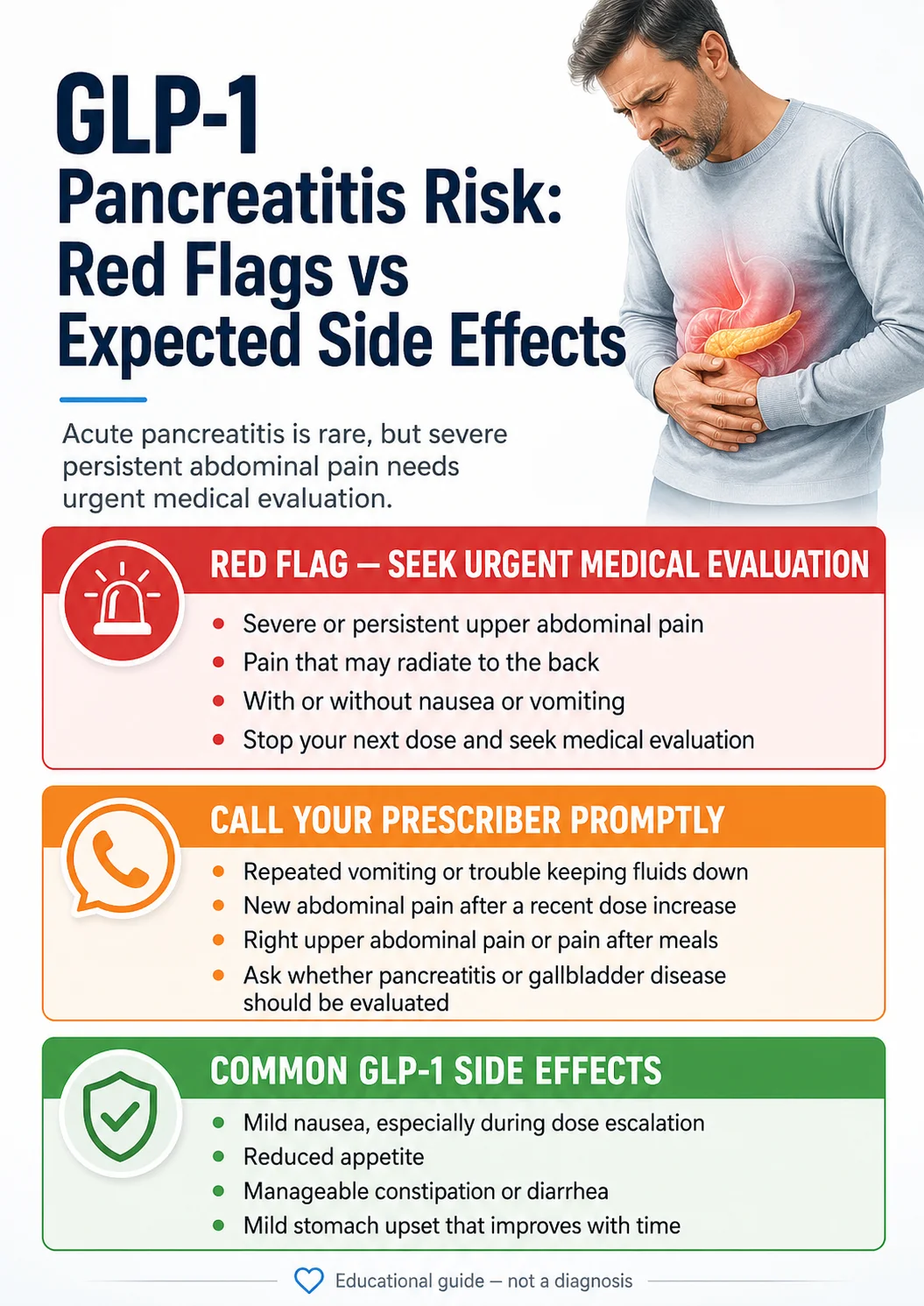
- ⚠Severe abdominal pain
- ⚠Signs of dehydration (dark urine, dizziness, rapid heart rate)
- ⚠Symptoms that felt like an allergic reaction (hives, swelling, trouble breathing)
- ⚠Severe gallbladder or pancreatitis symptoms (severe upper abdominal pain, fever, yellowing of skin or eyes)
- ⚠Pregnancy
How to manage GLP-1 nausea day to day
Short answer:
Five layers, in order — slow your titration, eat smaller meals and avoid greasy or fried food, hydrate constantly with small sips, try OTC support like ginger if your clinician okays it, and ask your provider about prescription ondansetron if symptoms are moderate or severe. Most patients see substantial improvement by weeks 5–12 as the body adapts.
Slow your titration
The first instinct when you feel queasy at week 3 is to push through to your next dose increase. The better instinct is often to hold. If you're still nauseous after 4 weeks at a given dose, talk to your provider about holding for another 4-8 weeks instead of escalating. Holding isn't failure. It's listening.
Change how you eat
- ✓Smaller portions, more often. Half-portions four times a day beats one big plate.
- ✓Stop when you feel full, not when your plate is empty. GLP-1s shift the signal.
- ✓Skip greasy, fried, fatty, and very spicy foods during the first few weeks. Common nausea triggers.
- ✓Avoid carbonated drinks and alcohol during titration.
- ✓Eat slowly. Chew thoroughly.
- ✓Don't lie down right after eating. Wait at least 30 minutes.
Hydrate constantly with small sips
GLP-1 dehydration is a sneaky problem. You feel less thirsty, so you drink less, and then suddenly your headache, fatigue, and constipation all get worse at once. Sip water throughout the day. Add electrolytes if needed. Alcohol and carbonated drinks can worsen nausea or reflux for some people during titration. Ask your clinician about caffeine if dehydration, reflux, or nausea is already a problem.
First-line OTC support
- ✓Ginger — used in clinical trials for nausea. Ginger chews, ginger tea, or capsules are options to ask your clinician about.
- ✓Vitamin B6 — sometimes used for nausea; ask your clinician or pharmacist whether it fits your situation before using it.
- ✓Bismuth subsalicylate (Pepto-Bismol) — can help with mild upset stomach.
- ✓Dimenhydrinate (Dramamine) — over-the-counter motion sickness medication that some people find helpful.
Ask about prescription anti-nausea support
If OTC support isn't enough, ondansetron (Zofran) is a prescription anti-nausea medication that works for many GLP-1 patients. Ask your provider whether it's appropriate for you and how to use it. As noted above, Hims has publicly stated that eligible weight-loss customers may receive ondansetron at no additional cost; other providers can prescribe it on request, usually at additional cost.
When to call your provider — fast:
- ⚠Persistent vomiting that lasts more than 24 hours
- ⚠Severe abdominal pain
- ⚠Inability to keep liquids down
- ⚠Signs of dehydration (dark urine, dizziness, low energy)
- ⚠Vision changes
- ⚠Fever or yellowing of the skin or eyes
Can you pick a GLP-1 by the lowest nausea rate?
Short answer:
Not reliably from one simple ranking. Nausea rates come from different trials, doses, populations, and titration schedules, so cross-trial comparisons can mislead. Use the table below as label and trial context — not as a promise that one medication will be easier on your stomach.
| Medication | Class | Form | Label / trial nausea | Notes |
|---|---|---|---|---|
| Saxenda (liraglutide) | GLP-1 | Daily injection | 39.3% (vs 13.8% placebo) | FDA-approved for chronic weight management. Daily dosing is the practical difference, not a guarantee of an easier stomach experience. |
| Wegovy (semaglutide) | GLP-1 | Weekly injection or daily pill | ~25-44% in trials | FDA-approved for chronic weight management. Pill form avoids injections. ~4-5% discontinue due to GI side effects in trials. |
| Zepbound (tirzepatide) | GLP-1 + GIP | Weekly injection | 25%, 29%, 28% at 5/10/15 mg | FDA-approved for chronic weight management. Dual-receptor profile; greater average weight loss in trials than semaglutide. |
| Foundayo (orforglipron) | GLP-1 | Daily oral pill | 26%, 34%, 35% across approved maintenance doses | FDA-approved April 2026 — the first FDA-approved daily GLP-1 pill for weight loss. GI events more common during escalation and decreased over time. |
| Rybelsus | GLP-1 | Daily oral pill | Trial-dependent | FDA-approved for type 2 diabetes (not weight loss). Sometimes prescribed off-label for weight management. |
| Compounded semaglutide / tirzepatide | GLP-1 (and GIP for tirzepatide) | Injection, oral, sublingual, gummy, lozenge | Not separately studied | Not FDA-approved. Tolerability depends on formulation and provider protocol. |
The biggest point: the medication choice matters, but the protocol around it often matters more. Two providers prescribing the same medication can produce very different patient experiences depending on how they handle dose escalation, messaging, and dose-hold decisions.
Want a guided pick instead of a cross-trial comparison?
Take the 60-second matching quiz →What we actually verified — and what we didn't
We built this page by reviewing official provider pages, FDA materials, and clinical sources. Specifically, on May 12, 2026, we verified:
What we did NOT verify (and you should before signing up):
- ✗Whether your specific state allows the medication being prescribed
- ✗Whether your specific insurance plan covers Wegovy or Zepbound
- ✗Real-time medication availability — supply can shift
- ✗Individual clinician experience at each provider (varies)
- ✗Real-time pricing — providers update prices and promo codes
- ✗Whether any provider's policies have changed since the verification date above
Frequently asked questions
Which GLP-1 provider is least likely to make me nauseous?
No provider can promise that — and anyone who does is selling you something. The provider most likely to help you handle nausea if it happens is Ro (FDA-approved support-first), followed by Hers/Hims (publicly stated no-cost ondansetron offer for eligible weight-loss customers) and Embody (a low-cost cash-pay option with 24/7 care-team messaging and a choice of weekly injections or a needle-free GLP-1 gum).
Can my GLP-1 provider increase my dose more slowly than the standard schedule?
Yes. Any legitimate provider should be willing to hold you at a lower dose for longer if your body needs it, based on clinician judgment. The standard semaglutide schedule increases the dose every 4 weeks — but holding for 6-8 weeks at the same dose is medically reasonable when symptoms are still present. Ask your provider directly.
Is nausea a sign the GLP-1 is working?
Not exactly. Nausea is a side effect of slowed gastric emptying, which is part of how the medication works. Severe or persistent nausea is not a sign things are going well — it is a sign your provider should help you adjust. Do not push through bad symptoms because someone said it means it is working.
Is Wegovy less nauseating than Zepbound?
Not universally. Trial data shows comparable nausea rates between the two at maintenance dose (around 25-44% for semaglutide, 25-29% for tirzepatide across approved doses). Individual response varies. Some patients tolerate tirzepatide better; others have the opposite experience. The protocol around the medication usually matters more than the choice between these two.
Are oral GLP-1s easier on the stomach than injections?
Not necessarily. The mechanism — slowed gastric emptying — is the same regardless of route. Daily oral options (Foundayo, Wegovy pill) give a different routine than weekly injections, which some patients prefer. But Foundayo trials show 26-35% nausea across approved doses, so oral is not side-effect-free. It is a different shape of side effect curve.
Should I choose a compounded GLP-1 if I am worried about nausea?
Compounded medications can have a role under a clinician's judgment, but they are not FDA-approved as finished products, and there is no clinical evidence that compounded versions have fewer side effects than FDA-approved brands. If your top priority is the cleanest regulatory and safety story, an FDA-approved option (Wegovy, Zepbound, Saxenda, or Foundayo) is the safer starting point.
What should I do if I vomit after taking a GLP-1?
Contact your prescribing clinician, especially if vomiting is persistent (more than 24 hours), severe, or paired with dehydration, severe abdominal pain, or inability to keep liquids down. For mild post-dose nausea that fades within a day, your provider may recommend smaller meals, hydration, ginger, or prescription ondansetron.
Do GLP-1 providers prescribe ondansetron (Zofran) for nausea?
Some do. Hims has publicly stated that eligible weight-loss customers may receive ondansetron at no additional cost. Other providers can prescribe it on request, usually at additional cost. Ask before signing up, and confirm whether it applies to your specific medication path.
Can I stop a GLP-1 if it makes me sick?
Yes, but talk to your prescribing clinician about how to do it safely. Do not stop mid-titration without guidance. Also check the provider's cancellation policy before paying — some require advance notice or have non-refundable plan terms. This is one of the most important questions to ask any provider before you sign up.
What is the best GLP-1 provider for someone who wants FDA-approved medication only?
For side-effect-support intent, Ro is the strongest pick — deepest FDA-approved menu we verified, insurance concierge, and titration support built in. Sesame Care is the strongest alternative if you want to pick your own clinician and have access to Saxenda (the FDA-approved daily GLP-1 option).
How long does GLP-1 nausea usually last?
In the original STEP-1 semaglutide trial, nausea peaked around week 4 and largely faded by week 12 as the body adapted. Each dose increase can bring back symptoms temporarily. If nausea is not improving by week 4 at a given dose, talk to your provider about holding instead of escalating.
Is microdosing a GLP-1 safe?
Microdosing means using a starting dose below the standard FDA-approved 0.25 mg, under provider judgment. It is an off-label, provider-directed approach — not an FDA-approved protocol and not proof of fewer side effects. Microdosing typically requires a compounding pharmacy. Sustained weight loss usually requires reaching therapeutic doses; microdose alone may not produce the weight loss seen at full doses.
Still not sure which GLP-1 program is right for you?
You've now seen:
- ✓The honest answer (no provider can guarantee zero sickness — that's a red flag, not a feature)
- ✓The 7 features that matter most if nausea is your biggest fear
- ✓The full provider scorecard with provider-stated vs verified breakdown
- ✓The deep-dive on each top-ranked provider
- ✓The FDA-approved vs compounded reality
- ✓The 12 questions to ask before paying
- ✓The red-flag walk-away list
- ✓The 'if you already got sick' framework
- ✓The day-to-day nausea management playbook
If you're ready to take a specific next step, the strongest support-first FDA-approved path is Ro. You can check eligibility and current pricing without paying a thing to find out if you qualify. If you'd rather have us point you to a specific fit, the matching quiz takes about a minute.
Still not sure which GLP-1 program is right for you? Take our free 60-second matching quiz.
About this guide
This guide was written by the editorial team at The RX Index, a pricing intelligence and comparison resource for GLP-1 telehealth providers. We verified each provider's pricing, support claims, and policies on May 12, 2026 against their public pricing and policy pages, FDA materials, and primary clinical sources. We score providers independently.
This content is educational and is not medical advice. GLP-1 medications can have serious risks. Some carry boxed warnings about thyroid C-cell tumors seen in animal studies, and they are contraindicated for people with a personal or family history of medullary thyroid carcinoma or Multiple Endocrine Neoplasia syndrome type 2. Serious risks can also include pancreatitis, gallbladder problems, dehydration from vomiting or diarrhea, and severe stomach problems. Talk to a licensed clinician before starting any medication.
Related guides most readers want next: Best GLP-1 Telehealth Providers, Cheapest GLP-1 Without Insurance, Best GLP-1 Providers That Accept Insurance, Oral GLP-1 Providers That Take HSA/FSA, Best GLP-1 With Least Side Effects, and GLP-1 Nausea Guide.
Page last verified: May 12, 2026.
Your situation changes the answer
Find My GLP-1 Path
The right GLP-1 provider isn't the same for everyone. It depends on your state, your insurance and formulary, whether you want an FDA-approved or compounded medication, your preferred route (injection or oral), and your budget. Because a general answer can't resolve those for you, use The RX Index's Find My GLP-1 Path tool to get a personalized provider match with source-verified pricing before you choose.
- What it asks: your state, insurance situation, medication preference, budget, and support needs
- What you get: a personalized shortlist of GLP-1 providers matched to your situation, with verified pricing and the right questions to ask
- Cost: free · about 2 minutes · no signup