
Best FDA-Approved GLP-1 on Navitus Formulary (2026): What's Actually Covered
Published: · Last updated: · Last reviewed:
By The RX Index Editorial Team
Medical disclaimer: This page is for general information. We don't provide medical advice, prescribe medications, or run a pharmacy. Always confirm coverage directly with Navitus and discuss medication options with a licensed prescriber.
Quick verdict (first screen). The best FDA-approved GLP-1 on a Navitus formulary depends on why it's being prescribed. For weight loss, Zepbound, Wegovy, and the new oral Foundayo are the strongest FDA-approved picks — but the public 2026 Navitus formularies we reviewed (Wisconsin GHIP, SISC, UC MedicareRx) do not show a clean weight-loss coverage path. Wisconsin lists them as 100%/EXC, SISC lists them as EXC, and UC MedicareRx did not list Wegovy, Zepbound, or Foundayo at all in the document we reviewed. For type 2 diabetes, Ozempic, Mounjaro, Rybelsus, and Trulicity appear in diabetes categories with prior authorization, quantity limits, and/or diagnosis restrictions. Some Navitus-administered plans do cover Wegovy or Zepbound, so the single most useful thing you can do is verify your specific plan. Skip to the free coverage check →
Quick verdict table
| Your situation | Best first answer | Navitus formulary reality | Your next step |
|---|---|---|---|
| Weight loss only | Zepbound, Wegovy, or Foundayo are the FDA-approved options — coverage is the gate | Wisconsin: 100%/EXC. SISC: EXC. UC MedicareRx: not located in document. | Check your exact plan; compare self-pay if excluded |
| Type 2 diabetes | Ozempic, Rybelsus, Mounjaro, Trulicity, or liraglutide | UC MedicareRx: Tier 2 with PA and QL. Wisconsin and SISC: QL with diagnosis restriction (QL-RDX). | Ask prescriber for a diagnosis-specific PA packet |
| OSA (with obesity) | Zepbound under the OSA indication | Plan-specific; coded under G47.33 changes the framing | Talk to your sleep doctor about the OSA pathway |
| MASH (with obesity) | Wegovy injection (FDA-approved for MASH Aug 2025) | Plan-specific; alternative-indication pathway | Ask prescriber if MASH framing fits |
| Established CV disease | Wegovy (FDA-approved for CV risk reduction) | Plan-specific; some plans honor the CV indication | Ask prescriber about CV-indication PA |
| Need help verifying | Ro's free GLP-1 Insurance Coverage Checker | Independent of your specific Navitus plan | Run the free check |
| Plan excludes weight-loss drugs | Self-pay through Sesame, NovoCare, LillyDirect, or Ro | Excluded means $0 from your plan toward the medication | Compare current self-pay prices |
Want someone else to do the verifying?
Ro says its free GLP-1 Insurance Coverage Checker sends a personalized report with coverage details, cost estimates, and whether prior authorization is required. It does not submit prescriptions or treatment requests through the checker.
→ Check my coverage on Ro (free) (sponsored affiliate link, opens in a new tab)What we actually verified for this page
We pulled and cross-checked three public 2026 Navitus formularies:
- State of Wisconsin Group Health Insurance Program formulary (wisconsin.edu/ohrwd/benefits/download/formulary.pdf)
- SISC (Self-Insured Schools of California) Navitus prescription formulary (bsspjpa.org/navitus-prescription-formulary)
- University of California MedicareRx (PDP) formulary, HPMS Approved File ID 00026151 v07, updated 09/26/2025
We confirmed FDA-approved indications against the current drug labels for Wegovy, Zepbound, Foundayo, Saxenda, Ozempic, Mounjaro, Rybelsus, and Trulicity. We pulled current self-pay pricing from NovoCare, Sesame, LillyDirect, and Ro.
What we could not verify: every Navitus-administered employer plan in the country (Navitus serves hundreds), every state-specific provider availability, and your individual benefits. We also found at least one third-party coverage database listing some Navitus plans as covering Wegovy with no prior authorization, no step therapy, and no quantity limit — which directly contradicts the public sponsor formularies we reviewed. The honest takeaway: your specific plan can differ significantly from any example, so treat this page as a coverage interpretation guide, not a guarantee of benefits.
What is the best FDA-approved GLP-1 on Navitus formulary in 2026?
Answer capsule
For a Navitus member, the best FDA-approved GLP-1 depends first on the covered indication. If your plan covers obesity treatment, Zepbound is the strongest evidence-based weight-loss pick because tirzepatide produced greater average weight loss than semaglutide in the SURMOUNT-5 head-to-head trial (Aronne et al., NEJM 2025). If you need semaglutide history, the cardiovascular-risk indication, the MASH indication, or adolescent eligibility, Wegovy fits better. If you want an oral medication, Foundayo is the newest FDA-approved oral GLP-1 for weight management. If you have type 2 diabetes, Ozempic, Rybelsus, Mounjaro, or Trulicity are the realistic Navitus formulary paths.
That's the short version. The rest of the page handles every angle of the longer answer — what Navitus actually is, what the codes in your portal mean, what's covered for diabetes vs. weight loss, the prior-authorization playbook, the Medicare GLP-1 Bridge launching July 1, 2026, what to do if your plan excludes the drug you want, and the real cash-pay prices if you go that route.
The Navitus GLP-1 Coverage Reality Matrix (2026)
Answer capsule
Across the three public 2026 Navitus formulary documents we reviewed, the obesity GLP-1 path was consistently unfavorable but not identical. Wisconsin lists Foundayo, Wegovy, Saxenda, and Zepbound as 100%/EXC in the anti-obesity section. SISC lists the same drugs as EXC. UC MedicareRx did not list Wegovy, Zepbound, or Foundayo in the document we reviewed. For diabetes GLP-1s, UC MedicareRx places Ozempic, Mounjaro, Rybelsus, and Trulicity at Tier 2 with prior authorization and quantity limits, while Wisconsin and SISC list diabetes GLP-1s with quantity limits and diagnosis restrictions (QL-RDX).
| Drug | Active ingredient | FDA-approved indication | Navitus formulary reality (2026 examples) | Restrictions you'll see |
|---|---|---|---|---|
| Wegovy (pen + tablet) | semaglutide 2.4 mg | Chronic weight management; CV risk reduction in adults with established CVD + obesity/overweight; MASH (Aug 15, 2025 — injection only) | Wisconsin: 100%/EXC in anti-obesity. SISC: EXC in anti-obesity. UC MedicareRx: not located in document. | Plan-sponsor exclusion for weight-loss-only use |
| Zepbound (pen, KwikPen, vial) | tirzepatide | Chronic weight management; moderate-to-severe OSA in adults with obesity (Dec 2024) | Wisconsin: 100%/EXC. SISC: EXC. UC MedicareRx: not located in document. | Plan-sponsor exclusion for weight-loss-only use |
| Foundayo | orforglipron (oral) | Chronic weight management in adults with obesity, or overweight + ≥1 weight-related comorbidity (FDA approval 2026) | Wisconsin: 100%/EXC in anti-obesity. SISC: EXC in anti-obesity. UC MedicareRx: not located. | Brand-new drug; commercial coverage will lag |
| Saxenda | liraglutide 3.0 mg | Chronic weight management (adults + adolescents 12+) | Wisconsin: 100%/EXC. SISC: EXC. | Plan-sponsor exclusion |
| Ozempic | semaglutide | Type 2 diabetes; CV risk reduction in T2D + CVD; CKD risk reduction in T2D | UC MedicareRx: Tier 2 with PA, QL=1/28 days. Wisconsin & SISC: listed with QL-RDX diagnosis restrictions. | PA + QL + diagnosis match |
| Mounjaro | tirzepatide | Type 2 diabetes | UC MedicareRx: Tier 2 with PA, QL=4/28 days. Wisconsin & SISC: QL-RDX. | PA + QL + diagnosis match |
| Rybelsus | semaglutide (oral) | Type 2 diabetes | UC MedicareRx: Tier 2 with PA, QL=30/30 days. Wisconsin & SISC: QL-RDX. | PA + QL + diagnosis match |
| Trulicity | dulaglutide | Type 2 diabetes; CV risk reduction in T2D | UC MedicareRx: Tier 2 with PA, QL=4/28 days. Wisconsin & SISC: QL-RDX. | PA + QL + diagnosis match |
Sources: Wisconsin GHIP 2026 Formulary (wisconsin.edu/ohrwd/benefits); SISC Navitus prescription formulary (bsspjpa.org); UC MedicareRx 2026 PDP Approved File ID 00026151 v07 (medicaresupplement.universityofcalifornia.edu/document/233); current FDA drug labels; CMS Medicare GLP-1 Bridge FAQ (cms.gov/medicare/coverage/prescription-drug-coverage/medicare-glp-1-bridge).
What this tells you in one sentence: If your search is about a weight-loss-only prescription, the FDA-approved obesity drugs are the right clinical answer but a long shot on standard coverage — plan on prior authorization, an alternative-indication pathway, or self-pay. If your search is about type 2 diabetes, the diabetes-labeled GLP-1s are listed with paperwork requirements but are realistic coverage paths.
What Navitus actually is (and why your plan matters more than the brand)
Answer capsule
Navitus Health Solutions is a pharmacy benefit manager — a PBM — which means it processes your prescription claims and manages the drug list (the “formulary”) for whichever insurance plan or employer hired it. Navitus does not decide on its own whether your plan covers Wegovy or Zepbound. Your plan sponsor — your employer, your union, your school district, or the agency that runs your insurance — picks which Navitus formulary to use and decides whether weight-loss drugs are in or out.
Here's the thing most pages get wrong. They write as if “Navitus” is one formulary you can look up. It isn't. Navitus runs different formularies for different clients. The University of California uses one. The State of Wisconsin uses another. SISC (the school plan in California) uses a third. OhioHealthy has its own. Same PBM, different drug lists. That's why a coworker on Navitus might tell you Wegovy is covered while your portal says it's excluded — you're on different plans.
Five short definitions you'll need, because the codes in your portal are not going to explain themselves:
- Tier:A number (Tier 1, 2, 3, 4) that sets your share of the cost. Tier 1 is usually generics and cheapest. Tier 4 is usually specialty and most expensive.
- PA (prior authorization):Your prescriber has to send paperwork showing you meet the plan's criteria before the plan will pay.
- QL (quantity limit):The plan only covers a set amount per fill — like one pen every 28 days.
- RDX (restricted to diagnosis):The plan only pays if the prescription matches a specific covered diagnosis on the claim.
- EXC (excluded):The drug is on the list but not paid for under normal benefits.
What “100%/EXC” really means on a Navitus formulary
Answer capsule
On Navitus, “EXC” stands for excluded product — a drug that is listed in the formulary but is not available at a reduced copayment or coinsurance under normal conditions, per Navitus's own benefit glossary at navitus.com/who-we-serve/members/benefit-glossary/. The “100%” prefix you may see on some sponsor formularies (like Wisconsin) means you'd pay 100% of the cost at the pharmacy. In plain English: if your portal shows “100%/EXC” or “EXC” next to Wegovy or Zepbound, your plan is almost certainly not paying for it.
This is the single biggest source of confusion in Navitus GLP-1 land, and it's not your fault. The word “Covered” appears right next to the EXC code in many member portals. People reasonably assume “Covered” means their plan pays. Then they get the pharmacy quote.
One Navitus member on Reddit summed it up perfectly: “Covered – Level 100%/EXC” — followed by a pharmacy price showing in the four figures. That's the exact pattern. The drug is technically “on the list,” but the plan has excluded it from paid benefits.
Why that happens
Plan sponsors decide whether to cover anti-obesity medications. Many still exclude them because of cost — Wegovy's list price runs $1,300–$1,600 per month, Zepbound runs $1,000–$1,300 per month, and these drugs have exploded in demand. GoodRx reported that over 12 million people lost some form of commercial insurance coverage for Wegovy in 2026. When plan sponsors decide not to cover weight-loss drugs, Navitus still lists them in the formulary document for transparency — but flags them as excluded.
The Navitus code translator (use this to read your own portal)
| What you see | What it means | What to do |
|---|---|---|
| EXC | Excluded product. Not available at a reduced copay under normal conditions. | Call Navitus; ask about exception; compare self-pay |
| 100%/EXC | You'd pay 100% of the cost — effectively excluded | Same as EXC |
| PA | Prior authorization required before plan pays | Have your prescriber submit a complete PA packet |
| QL | Quantity limit — set amount per fill (often 1 pen/28 days or 4 pens/28 days) | Match your prescription to the limit |
| RDX | Restricted to diagnosis — claim must match a covered diagnosis | Confirm the diagnosis on your prescription |
| QL-RDX | Both quantity limit and diagnosis restriction | Diagnosis match + dose within the limit |
| ST | Step therapy — must try cheaper drug first | Document prior trials if applicable |
| NC | Not covered | Excluded entirely |
| Tier 1 / 2 / 3 / 4 | Cost-share tier (1 = cheapest, 4 = specialty) | Higher tier = higher copay |
What to do if you see EXC or 100%/EXC
- Screenshot it. Date-stamp the screen. You'll want this if you file an exception.
- Check the category. If the drug is in the “anti-obesity agents” section, the exclusion is policy-driven. If it's in the “diabetes” section, it's a different conversation entirely.
- Call Navitus at the number on the back of your member ID card. Ask three specific questions: Is this drug fully excluded, or only excluded for certain uses? Is an exception process available? Which FDA-approved alternatives are preferred?
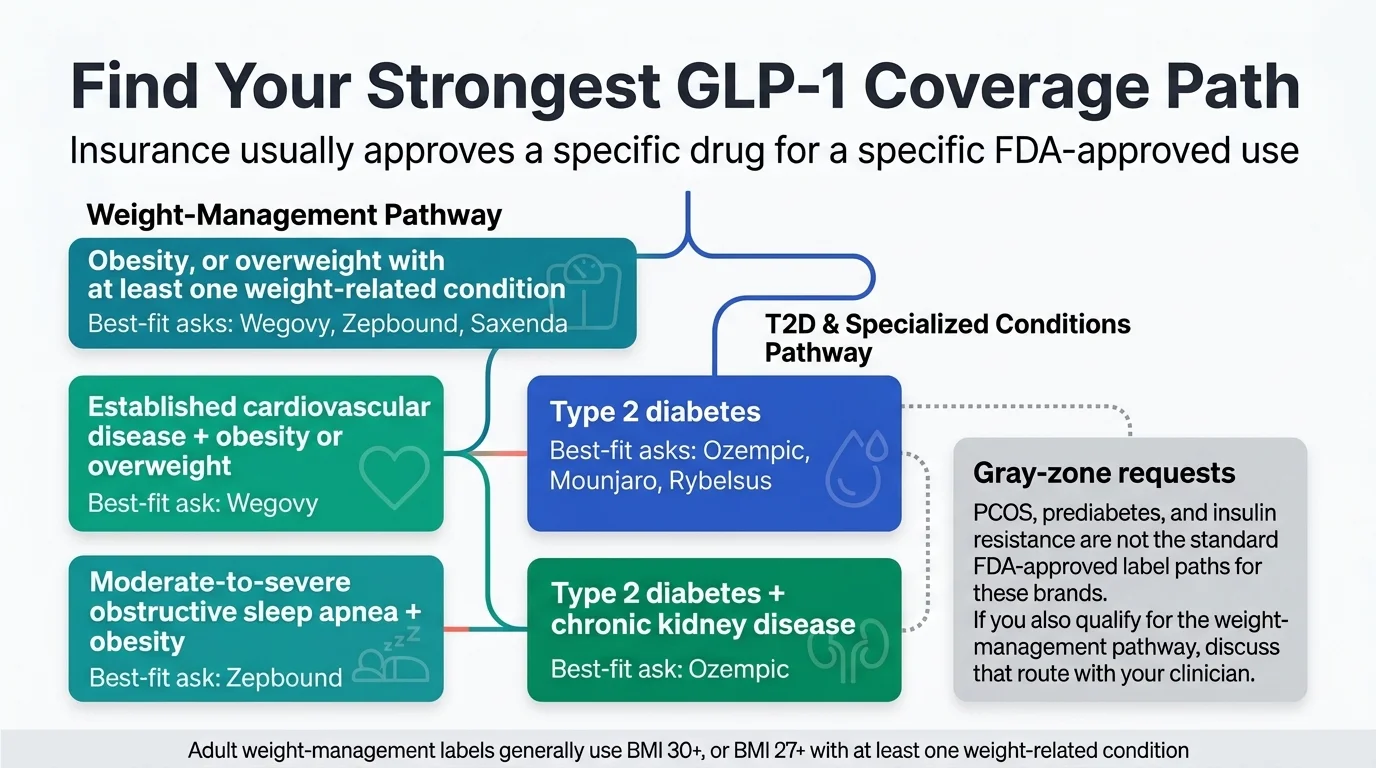
- Loop in your prescriber. If you have a documented condition that triggers a different FDA-approved use — like obstructive sleep apnea, established cardiovascular disease, or MASH — the prescription framing changes, and so might coverage.
- Have a backup ready. If your plan won't pay, you have legitimate self-pay paths at transparent pricing (covered below).
If your plan shows EXC or 100%/EXC and you don't want to fight an appeal:
Sesame publishes transparent self-pay pricing on FDA-approved branded GLP-1s — including Wegovy pill from $149/month, Zepbound KwikPen from $299/month, and Foundayo from $149/month at the starter dose. Worth comparing before you assume retail price is your only option.
→ See Sesame's current GLP-1 prices (sponsored affiliate link, opens in a new tab)Is Wegovy covered by Navitus?
Answer capsule
Wegovy (semaglutide 2.4 mg) is covered on Navitus-administered plans only when the plan sponsor has chosen to include anti-obesity medications. In the three public 2026 Navitus formularies we reviewed, Wegovy appeared as 100%/EXC in Wisconsin's anti-obesity section, EXC in SISC's, and was not located in the UC MedicareRx formulary document we reviewed. Some Navitus-administered commercial plans do cover Wegovy with prior authorization.

Wegovy has more pathways than most GLP-1s, and that matters here. The FDA has approved Wegovy for:
- Chronic weight management in adults with obesity (BMI ≥30) or overweight (BMI ≥27 with at least one weight-related condition)
- Chronic weight management in pediatric patients 12 and older with obesity
- Reducing the risk of major adverse cardiovascular events (heart attack, stroke, cardiovascular death) in adults with established cardiovascular disease and either obesity or overweight
- Treatment of adults with noncirrhotic MASH (metabolic dysfunction-associated steatohepatitis) with moderate-to-advanced fibrosis under accelerated approval — Wegovy injection received this indication on August 15, 2025. Wegovy tablets are not established for MASH.
That last point matters because some Navitus plans that exclude weight-loss-only use will cover Wegovy injection when the prescription is documented for a different FDA-approved indication. If you have a CV disease history or MASH, talk to your prescriber about the framing.
Typical Wegovy PA criteria on Navitus commercial plans
- BMI ≥30, or BMI ≥27 with at least one weight-related condition (type 2 diabetes, hypertension, high cholesterol, OSA, established CVD)
- Documentation of a structured lifestyle program lasting 3 to 6 months in the past 2 years
- Prescriber attestation that Wegovy is part of a comprehensive weight-management plan
- Some plans require step therapy — a documented trial of cheaper drugs (phentermine, Contrave, Saxenda) before Wegovy approval
- Several 2026 Navitus-administered plans tightened criteria to require pre-treatment BMI ≥40 for new starts (UC PPO, Valley Health Plan 2026)
Wegovy self-pay reality if your plan excludes it
Verified numbers as of May 2026:
- NovoCare cash price: $199/month for the first two fills of 0.25 mg or 0.5 mg through December 31, 2026, then $349/month for standard doses and $399/month for Wegovy HD. Source: novocare.com.
- Sesame Wegovy pen: Starts at $199/month for the first two fills, then $349/month. Source: sesamecare.com.
- Sesame Wegovy pill: $149/month for 1.5 mg and 4 mg starter doses; $299/month for 9 mg or 25 mg maintenance doses. Source: sesamecare.com.
- Sesame + Costco Pharmacy: Costco members can access Wegovy or Ozempic injections for $349/month self-pay at Costco Pharmacy through Sesame. Source: sesamecare.com.
- Ro: Medication prices aligned with NovoCare, LillyDirect, and TrumpRx, with a separate Ro Body membership fee — $39 for the first month, then as low as $74/month with the annual plan paid upfront.
Is Zepbound covered by Navitus?
Answer capsule
Zepbound (tirzepatide) is covered on Navitus-administered plans only when the plan sponsor has chosen to include anti-obesity medications. In the three public 2026 Navitus formularies we reviewed, Zepbound appeared as 100%/EXC in Wisconsin's anti-obesity section, EXC in SISC's, and was not located in the UC MedicareRx formulary document. Zepbound is also FDA-approved for moderate-to-severe obstructive sleep apnea (OSA) in adults with obesity — an alternative pathway some plans will honor when weight-loss-only coverage is excluded.
The OSA pathway is the most underused move in this category, and it's worth understanding because it's the difference between a denial and a paid prescription for thousands of people:
- The FDA approved Zepbound for moderate-to-severe OSA in adults with obesity in December 2024.
- Typical insurance criteria require an apnea-hypopnea index (AHI) of 15 or higher documented by a sleep study (polysomnography or home sleep test), a BMI ≥30, and either intolerance to or inadequate response to CPAP.
- When the prescription is tied to ICD-10 G47.33 (obstructive sleep apnea), the claim framing changes from “weight loss” to “sleep medicine.”
- Some Navitus plans that exclude weight-loss-only use will pay for Zepbound under the OSA indication. Not all. But it's worth asking your sleep doctor and prescriber if the criteria fit.
The wider Zepbound coverage trend
For context: CVS Caremark's own published material confirms Zepbound was no longer included in its Standard Control, Advanced Control, and Value formularies effective July 1, 2025, with Wegovy continued as a preferred similar medication. That move pushed millions off Zepbound coverage on CVS Caremark plans. Navitus has not made an equivalent industry-wide announcement, but the broader trend toward tighter weight-loss-drug formularies is across the industry.
Zepbound self-pay reality if your Navitus plan excludes it
- LillyDirect / Zepbound self-pay: Starts at $299/month for 2.5 mg and $399/month for 5 mg. Self-pay journey program: $449/month for 7.5 mg, 10 mg, 12.5 mg, and 15 mg when program terms are met. Source: lilly.com/lillydirect.
- Ro: Carries Zepbound at LillyDirect-aligned medication pricing, with Ro Body membership $39 for the first month, then as low as $74/month with the annual plan paid upfront.
- Sesame Zepbound KwikPen: $299/month for 2.5 mg; $398/month for 5 mg; $499/month for 7.5 mg; $698/month for 10, 12.5, or 15 mg. Source: sesamecare.com.
If Zepbound is what you want and your Navitus plan won't pay:
Ro carries Zepbound at LillyDirect-aligned medication pricing, with the Ro Body membership covering the provider visit and care side. Get started for $39, then as low as $74/month with the annual plan paid upfront. Medication billed separately.
→ See if Zepbound is available for you on Ro (sponsored affiliate link, opens in a new tab)What about Foundayo on Navitus?
Answer capsule
Foundayo (orforglipron) is the first non-peptide oral GLP-1 receptor agonist FDA-approved for chronic weight management in adults — approved in 2026 for adults with obesity, or overweight with at least one weight-related comorbidity. Foundayo appeared as 100%/EXC in Wisconsin's anti-obesity section and EXC in SISC's. Coverage on most Navitus commercial plans will lag because the drug is brand-new. Eligible Medicare Part D members can access Foundayo through the Medicare GLP-1 Bridge (available since July 1, 2026) at a flat $50/month copay regardless of formulary placement.
Until Foundayo, every FDA-approved weight-loss GLP-1 was an injection (Wegovy, Zepbound, Saxenda). Foundayo is a once-daily oral tablet — no injection, no temperature-controlled storage, no needle sourcing.
A few things to know before you ask your doctor:
- Boxed warning for thyroid C-cell tumors. Foundayo's FDA label carries a boxed warning. It should not be used in patients with a personal or family history of medullary thyroid cancer or Multiple Endocrine Neoplasia syndrome type 2 (MEN2).
- Do not combine GLP-1s. Foundayo's label states it should not be used with another GLP-1 receptor agonist. If you're on Wegovy, Zepbound, Ozempic, or any GLP-1, you can't simply add Foundayo on top.
- Side effects mirror the injectable GLP-1s. Common gastrointestinal effects include nausea, vomiting, diarrhea, constipation, decreased appetite, and abdominal pain.
Foundayo coverage and access in 2026
- Most Navitus commercial plans: Listed in the anti-obesity section but typically EXC or 100%/EXC right now.
- Medicare GLP-1 Bridge (starting July 1, 2026): All formulations of Foundayo are eligible at $50/month copay for qualifying beneficiaries who meet the clinical criteria. Source: CMS Medicare GLP-1 Bridge FAQ.
- Ro cash-pay: Carries Foundayo, with medication billed separately from Ro Body membership.
- Sesame cash-pay: Foundayo from $149/month at the starter dose, up to $349/month at maintenance doses. Source: sesamecare.com.
If you've been waiting for an oral FDA-approved weight-loss drug:
Ro carries Foundayo and is one of the most direct paths to get started while commercial coverage catches up. Get started for $39, then as low as $74/month with the annual plan paid upfront. Medication billed separately.
→ See if Foundayo is right for you on Ro (sponsored affiliate link, opens in a new tab)Ozempic, Mounjaro, and the diabetes path on Navitus
Answer capsule
Ozempic, Mounjaro, Rybelsus, and Trulicity are FDA-approved for type 2 diabetes (not weight management). On the UC Navitus MedicareRx 2026 PDP formulary, they appear at Tier 2 with prior authorization and quantity limits. On the Wisconsin GHIP and SISC public examples, they appear with quantity limits and diagnosis restrictions (QL-RDX). None of these is approved by the FDA for weight loss as a standalone indication, so using them off-label for weight management without a diabetes diagnosis will typically not be covered.
Ozempic and Wegovy are the same molecule — semaglutide — but they're not the same drug. They're approved for different indications, at different doses, and your insurance will treat them differently. If your prescription is written as “Ozempic for weight loss” without a type 2 diabetes diagnosis on the claim, it's an off-label prescription, and a plan that requires the T2D diagnosis will deny it.
The same is true for Mounjaro and Zepbound. Both are tirzepatide. Mounjaro is the diabetes-labeled brand. Zepbound is the obesity-labeled brand. Same molecule. Different FDA approvals. Different formulary slots. Different coverage outcomes.
Diabetes GLP-1s on Navitus MedicareRx 2026 PDP
| Drug | Tier | Restrictions | Quantity limit |
|---|---|---|---|
| Ozempic 2 mg/3 mL, 4 mg/3 mL, 2.68 mg/mL pens | 2 | PA | 1 pen per 28 days |
| Mounjaro 7.5 mg/0.5 mL auto-injector | 2 | PA | 4 per 28 days |
| Rybelsus 3 mg, 7 mg, 14 mg tablets | 2 | PA | 30 tablets per 30 days |
| Trulicity 0.75 mg, 1.5 mg, 3 mg, 4.5 mg auto-injector | 2 | PA | 4 per 28 days |
Source: Navitus MedicareRx 2026 PDP UC formulary, HPMS Approved File ID 00026151 v07, updated 09/26/2025.
What this means for you
- If you have type 2 diabetes: The public Navitus examples list at least one diabetes GLP-1 with restrictions on every formulary we reviewed. Get the paperwork right — your prescriber needs to document your diagnosis (ICD-10 code E11.x), your A1c, any prior diabetes treatments tried, and submit the prior authorization. You have a realistic path.
- If you don't have type 2 diabetes: These drugs are the wrong route. Wegovy is the FDA-approved semaglutide for your situation. Zepbound is the FDA-approved tirzepatide. Foundayo is the FDA-approved oral option.
For a deeper look at Mounjaro and the diabetes pathway specifically, see our guide on best tirzepatide for type 2 diabetes.
So which FDA-approved GLP-1 on Navitus formulary is actually best (if your plan covers it)?
Answer capsule
If your Navitus plan covers anti-obesity medications, Zepbound is the strongest evidence-based weight-loss pick for most adults because tirzepatide produced significantly more weight loss than semaglutide in the SURMOUNT-5 randomized head-to-head trial published in the New England Journal of Medicine in 2025. Wegovy is the best fit when semaglutide history, the cardiovascular-risk indication, the MASH indication, or adolescent eligibility matters. Foundayo is the cleanest path if you need an oral medication. Saxenda is usually a last choice when newer options are clinically excluded.
The head-to-head data
In the SURMOUNT-5 trial (Aronne et al., NEJM 2025), adults with obesity and without diabetes who took tirzepatide lost more weight than those who took semaglutide over 72 weeks. Both worked. Tirzepatide worked more on average — that is a trial result, not a guarantee for any individual.
Three real reasons to pick Wegovy over Zepbound:
- You have established cardiovascular disease. Wegovy carries an FDA-approved indication for reducing major adverse cardiovascular events in adults with CVD and obesity or overweight. Zepbound does not.
- You're under 18. Wegovy is FDA-approved for adolescents 12 and older with obesity. Zepbound is not established for pediatric patients.
- You have MASH with moderate-to-advanced fibrosis. Wegovy injection received this FDA indication in August 2025 under accelerated approval.
Three real reasons to pick Foundayo:
- You won't take an injection. Some people simply won't. Foundayo eliminates that barrier.
- You travel constantly. No refrigeration. No needles. Pop the pill.
- You want the newest option with reasonable cash-pay pricing at $149/month starter.
And one reason to pick Saxenda: your plan covers Saxenda and not the others. That's actually a legitimate scenario for some employer plans.
How much could FDA-approved GLP-1s cost if Navitus does not pay?
Answer capsule
If your Navitus plan excludes anti-obesity medications, self-pay pricing becomes the next decision. Wegovy pill self-pay starts at $149/month; Wegovy pen starts at $199/month for the first two fills then $349/month; Zepbound starts at $299/month for 2.5 mg via LillyDirect; Foundayo starts at $149/month via Sesame. Ro carries Zepbound, Foundayo, and Wegovy at medication prices aligned with LillyDirect, NovoCare, and TrumpRx, with a separate Ro Body membership ($39 first month, then as low as $74/month with the annual plan paid upfront).
| Path | Medication | Starting price | Source |
|---|---|---|---|
| NovoCare (Novo Nordisk direct) | Wegovy injection | $199/mo first 2 fills (0.25/0.5 mg), then $349/mo standard, $399/mo HD | novocare.com |
| NovoCare | Wegovy pill | $149/mo for 1.5 mg & 4 mg (promo through Aug 31, 2026, then $199/mo) | novocare.com |
| LillyDirect | Zepbound 2.5 mg | $299/mo | lilly.com/lillydirect |
| LillyDirect | Zepbound 5 mg | $399/mo | lilly.com/lillydirect |
| LillyDirect self-pay journey | Zepbound 7.5–15 mg | $449/mo when program terms are met | lilly.com/lillydirect |
| Sesame | Wegovy pill 1.5 mg / 4 mg | $149/mo | sesamecare.com |
| Sesame | Wegovy pill 9 mg / 25 mg | $299/mo | sesamecare.com |
| Sesame | Wegovy pen | $199/mo first 2 fills, then $349/mo | sesamecare.com |
| Sesame | Zepbound KwikPen 2.5 mg | $299/mo | sesamecare.com |
| Sesame | Zepbound KwikPen 5 mg | $398/mo | sesamecare.com |
| Sesame | Zepbound KwikPen 7.5 mg | $499/mo | sesamecare.com |
| Sesame | Zepbound KwikPen 10/12.5/15 mg | $698/mo | sesamecare.com |
| Sesame | Foundayo (starter dose) | $149/mo | sesamecare.com |
| Sesame | Foundayo (higher doses) | up to $349/mo | sesamecare.com |
| Sesame + Costco Pharmacy | Wegovy or Ozempic injection (Costco members) | $349/mo | sesamecare.com |
| Ro | Zepbound, Foundayo, Wegovy | Medication prices aligned with LillyDirect / NovoCare / TrumpRx | ro.co/weight-loss/pricing |
| Ro Body membership | (separate from medication) | $39 first month, then as low as $74/mo annual, or $149/mo monthly | ro.co/weight-loss/pricing |
Prices verified May 13, 2026. Pricing changes; reconfirm before ordering.
Compare your two strongest self-pay paths in one click:
For provider support + medication aligned with LillyDirect / NovoCare / TrumpRx pricing — Ro Body membership $39 first month, then as low as $74/month annual.
→ See Ro pricing (sponsored affiliate link, opens in a new tab)For transparent dose-by-dose self-pay pricing — Sesame publishes Wegovy pen, Wegovy pill, Zepbound KwikPen, Zepbound vial, Ozempic, and Foundayo pricing.
→ See Sesame pricing (sponsored affiliate link, opens in a new tab)How to check YOUR exact Navitus plan in 5 minutes
Answer capsule
Go to memberportal.navitus.com, log in with the credentials from your member ID card, click “Find a Drug,” and search by FDA brand name (Wegovy, Zepbound, etc.). The portal shows your tier, copay range, prior-authorization flag, and the lowest-cost pharmacies near you. Medicare members use medicarerx.navitus.com.
- Find your Navitus member ID. It's on the back of your insurance card. Look for the Navitus logo.
- Go to memberportal.navitus.com. Log in with your member ID. First-time users will need to register; have your card and a personal email handy.
- Click “Find a Drug” (sometimes “Medication Lookup”). This is the search tool that pulls your specific plan's current rules.
- Type the exact brand name. Try the full FDA brand: “Wegovy,” “Zepbound,” “Foundayo,” “Ozempic.” If you only type “semaglutide,” you may get partial results.
- Read the result carefully. Look for: tier number, copay estimate, PA / QL / ST / RDX flags, and the EXC code if present. If you see “100%/EXC” or “EXC,” that's not coverage in the normal sense — call Navitus to confirm.
If your portal is down or you're between insurance plans, call the member services number on the back of your card. The number for the Navitus MedicareRx PDP is 1-866-270-3877 as of the 2026 formulary document.
Before you click any provider link on this page, take 60 seconds and check the exact drug in your Navitus member portal. Screenshot the code. That single screenshot makes every conversation that follows — with your doctor, with Navitus, with a telehealth provider — faster and more useful.
The Navitus prior authorization playbook (so you don't get denied)
Answer capsule
A complete prior authorization packet to Navitus typically includes the patient's BMI, comorbidities, ICD-10 diagnosis code, prior weight-loss attempts (often 3–6 months of documented lifestyle effort), prior medication trials (for step therapy), and a clear statement of medical necessity. Per Navitus's own prescriber resources, most prior authorization requests are reviewed within two business days; urgent requests are reviewed within one business day (24 hours).
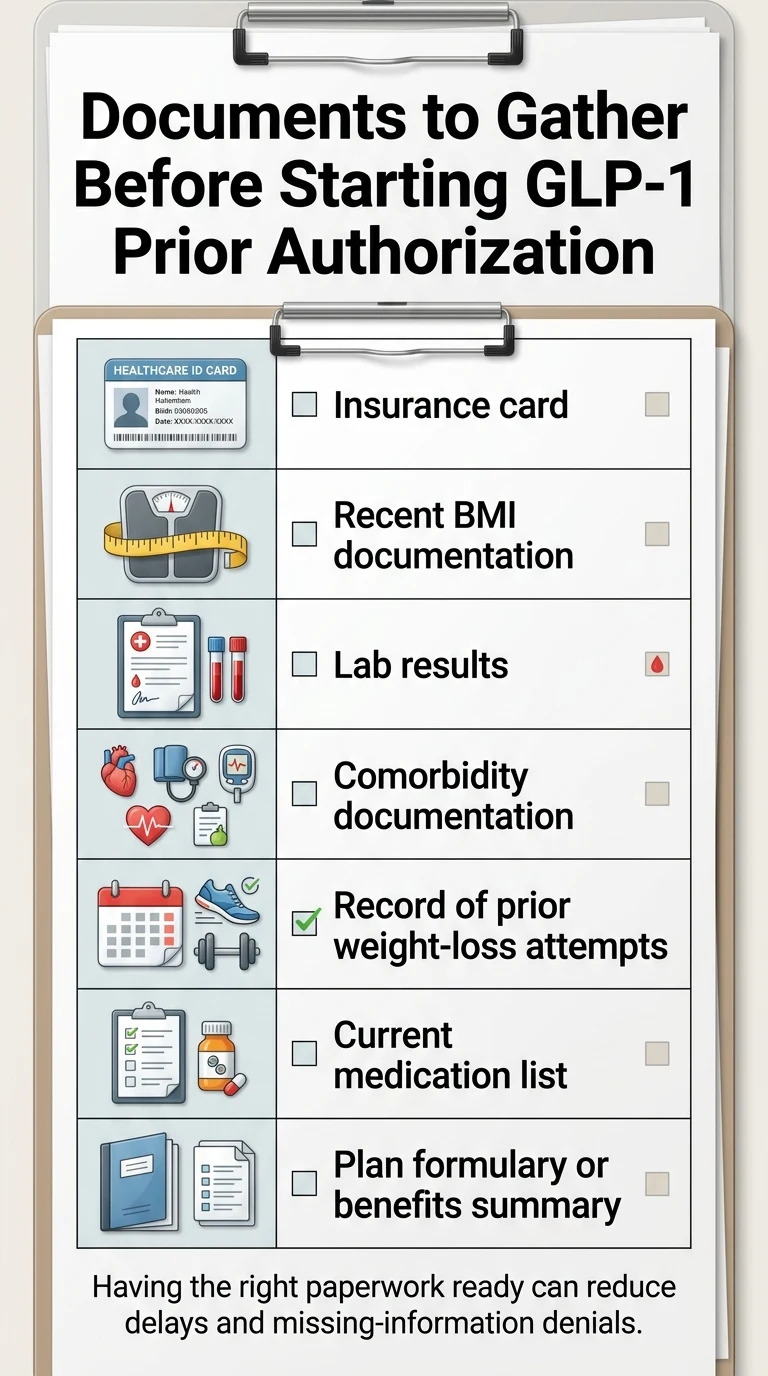
Required for any GLP-1 PA
- Patient demographics and insurance plan information
- The exact drug, dose, and quantity requested (e.g., “Wegovy 2.4 mg, 1 pen, 28-day supply”)
- ICD-10 diagnosis code(s)
- Current weight and height with calculated BMI (and date of measurement)
- Statement of medical necessity
Required for weight-management drugs (Wegovy, Zepbound, Foundayo, Saxenda)
- BMI ≥30 documented, or BMI ≥27 with at least one weight-related comorbidity (type 2 diabetes, hypertension, high cholesterol, OSA, established CVD)
- Some plans now require BMI ≥40 for new starts (UC PPO 2026, Valley Health Plan 2026)
- Documentation of lifestyle modification: 3 to 6 months of structured diet/exercise/behavioral effort within the past 2 years
- For some plans: prior medication trials and outcomes (step therapy through phentermine, Contrave, or Saxenda)
- Reauthorization usually requires documented weight loss of ≥5% from baseline
Required for diabetes GLP-1s (Ozempic, Mounjaro, Rybelsus, Trulicity)
- Confirmed type 2 diabetes diagnosis (ICD-10 E11.x)
- A1c value with date
- Prior diabetes medications tried (many plans require step therapy through metformin)
Common ICD-10 codes you'll see on GLP-1 PAs
| ICD-10 code | Condition | Pathway |
|---|---|---|
| E66.01 | Morbid (severe) obesity due to excess calories | Weight management |
| E66.9 | Obesity, unspecified | Weight management |
| Z68.30–Z68.45 | BMI category codes (secondary) | Used alongside primary diagnosis |
| E11.9 | Type 2 diabetes, unspecified, without complications | Diabetes GLP-1s |
| G47.33 | Obstructive sleep apnea | Zepbound OSA pathway — severity documented separately |
| K75.81 | Nonalcoholic steatohepatitis (NASH/MASH) | Wegovy injection MASH pathway |
| I25.10 | Atherosclerotic heart disease | Wegovy CV indication pathway |
How to submit
- Mail: Navitus Health Solutions LLC, Attn: Prior Authorizations, 1025 West Navitus Dr., Appleton, WI 54913
- Phone: For urgent requests, prescribers can call to initiate
- Fax: Plan-specific; on the Navitus PA form
- Electronic PA: Available through some plan integrations
If denied: the appeal ladder
For commercial plans: Most internal appeals must be filed within 180 days from the denial letter (healthcare.gov). Your appeal should include a stronger Letter of Medical Necessity from your prescriber, any new clinical evidence, and an explicit response to the denial reason. If the internal appeal is denied, you can request external review through your state insurance department.
For Medicare Part D plans: The CMS appeals process moves through plan redetermination → Independent Review Entity → Administrative Law Judge → Medicare Appeals Council → Federal Court. Read your denial letter carefully — the deadline and process are on the letter.
Don't want to chase paperwork?
Ro says its insurance concierge can help fight for coverage and handle prior-authorization paperwork for eligible Ro patients using insurance. Ro's own materials describe coverage work as a 2–3 week process, not a same-day guarantee. Get started for $39, then as low as $74/month with the annual plan paid upfront.
→ Let Ro help with my PA (sponsored affiliate link, opens in a new tab)If your Navitus plan won't cover the GLP-1 you want
Answer capsule
Four legitimate paths exist when your Navitus plan excludes anti-obesity GLP-1s: (1) request a formulary exception with a Letter of Medical Necessity, (2) pursue an alternative FDA-approved indication that genuinely applies, (3) use a cash-pay telehealth provider like Ro that aligns medication pricing with LillyDirect / NovoCare / TrumpRx, or (4) buy directly from the manufacturer through NovoCare (Wegovy) or LillyDirect (Zepbound), or via Sesame's published self-pay pricing.
We cannot guarantee your Navitus plan will cover Wegovy, Zepbound, or Foundayo. Many won't. That's the reality on the public 2026 formularies we checked. But every excluded plan has at least one workable path forward, and the worst thing you can do is wait for an answer that's never coming.
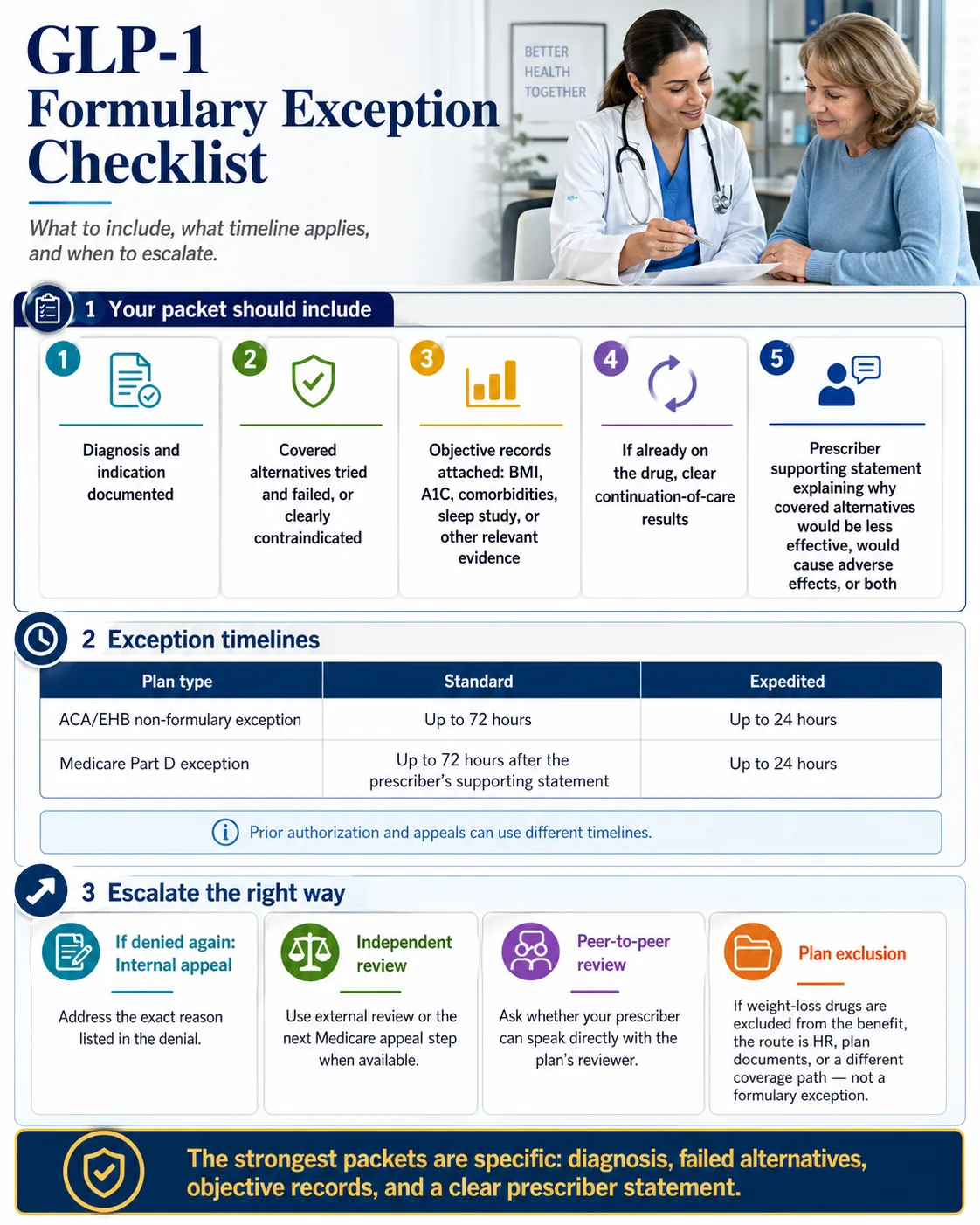
Path 1: Request a formulary exception
Some Navitus plans allow exceptions even when the drug is excluded. Your prescriber files a request with a Letter of Medical Necessity arguing that the excluded drug is medically necessary for your specific situation and that the covered alternatives are inadequate. Success rates vary by plan and condition. This works best when you have a documented contraindication or failure on covered alternatives.
Path 2: Use the alternative-indication pathway (when it genuinely fits)
If you have a real, documented condition that triggers a different FDA-approved use of the same drug, the prescription framing changes:
- Wegovy injection + established CV disease: Approved for major adverse CV event risk reduction. Some plans that exclude weight-loss-only use will cover this.
- Wegovy injection + MASH (moderate-to-advanced fibrosis): Approved August 15, 2025 under accelerated approval. Wegovy tablets are not approved for MASH.
- Zepbound + moderate-to-severe OSA: Approved December 2024. Some plans will cover Zepbound under G47.33 when they won't cover it for E66.01.
Path 3: Cash-pay through Ro
Ro carries FDA-approved Zepbound, Foundayo, and Wegovy at medication prices Ro states are aligned with LillyDirect / NovoCare / TrumpRx, runs your insurance eligibility check for you, and can help with prior authorization if your plan does cover it. Ro Body membership: $39 for the first month, then as low as $74/month with the annual plan paid upfront ($149/month if you pay monthly). Medication is billed separately at the cash-pay rate.
Path 4: Manufacturer-direct cash pay or Sesame self-pay
- NovoCare Wegovy: $199/month for first two fills (0.25 mg / 0.5 mg) through December 31, 2026, then $349/month standard doses, $399/month Wegovy HD. Wegovy pill from $149/month.
- LillyDirect Zepbound: $299/month for 2.5 mg; $399/month for 5 mg; $449/month for 7.5–15 mg via the self-pay journey program.
- Sesame Care: Wegovy pill from $149/month; Wegovy pen from $199/month first two fills then $349/month; Zepbound KwikPen from $299/month; Foundayo from $149/month at starter dose.
The two strongest paths if your Navitus plan is a no-go:
For Zepbound, Foundayo, or Wegovy with provider support — Ro Body membership starts at $39 first month, then as low as $74/month with annual plan paid upfront. Medication priced alongside LillyDirect / NovoCare / TrumpRx.
→ Start with Ro (sponsored affiliate link, opens in a new tab)For transparent dose-by-dose self-pay pricing — Sesame publishes Wegovy pill, Wegovy pen, Zepbound KwikPen, Zepbound vial, Ozempic, and Foundayo pricing — including Costco-member pricing on Wegovy and Ozempic injections.
→ Compare Sesame's prices (sponsored affiliate link, opens in a new tab)Navitus Medicare members and the Medicare GLP-1 Bridge (July 1, 2026)
Answer capsule
The UC Navitus MedicareRx PDP 2026 formulary covers FDA-approved GLP-1s for type 2 diabetes at Tier 2 with prior authorization, but did not list Wegovy, Zepbound, or Foundayo — Medicare generally excludes weight-loss-only drugs from Part D by statute. Starting July 1, 2026, the Medicare GLP-1 Bridge gives eligible Medicare Part D members access to all formulations of Foundayo, all formulations of Wegovy (injection and tablets), and the KwikPen formulation of Zepbound at a flat $50/month copay through December 31, 2027, independent of your plan's formulary.
Who qualifies for the Bridge
Per the CMS Medicare GLP-1 Bridge FAQ:
- You must be an eligible Medicare Part D beneficiary (standalone PDP or MA-PD).
- You must meet clinical criteria at the time of GLP-1 therapy initiation — typically BMI ≥30, or BMI ≥27 with a qualifying weight-related condition.
- Your prescriber submits a prior authorization request to the Bridge program.
What's covered and what's not
- Covered through the Bridge: All formulations of Foundayo, all formulations of Wegovy (injection and tablets), and the KwikPen formulation of Zepbound.
- Not covered through the Bridge: Zepbound single-dose vials and single-dose pens.
- Not covered through the Bridge: GLP-1 prescriptions for indications other than weight reduction. Wegovy for CV disease, Wegovy for MASH, and Zepbound for OSA go through your standard Part D plan, not the Bridge.
How the Bridge interacts with your Navitus MedicareRx formulary
It doesn't. The Bridge operates independently of your Part D plan's formulary. Even if Wegovy, Zepbound, or Foundayo isn't on your Navitus MedicareRx drug list, you can still access them through the Bridge if you meet eligibility criteria.
One important rule: manufacturer coupons and copay assistance programs cannot be applied to Bridge claims. The $50/month is the price.
What comes after the Bridge
CMS extended the Medicare GLP-1 Bridge through December 31, 2027 to collect additional utilization data ahead of potential BALANCE Model implementation in Part D. CMS has described a $245 net price per 30-day supply framework covering Foundayo, Mounjaro, Ozempic, Rybelsus, Wegovy (all formulations), and Zepbound (KwikPen). The full BALANCE Model implementation remains potential rather than guaranteed; check cms.gov/medicare/coverage/prescription-drug-coverage/medicare-glp-1-bridge for the latest status.
If you're a Navitus MedicareRx member and you want a weight-loss GLP-1, your two real paths are: (1) the Bridge, if you qualify (starts July 1, 2026), or (2) cash pay, if you don't.
Risks, side effects, and what to ask your prescriber
Answer capsule
FDA-approved GLP-1s carry real warnings and side effects you need to discuss with your prescriber. The most common side effects are gastrointestinal — nausea, vomiting, diarrhea, constipation. Wegovy, Zepbound, Saxenda, and Foundayo labels carry a boxed warning for thyroid C-cell tumors. Other serious labeled risks include pancreatitis, gallbladder disease, and acute kidney injury from severe dehydration. These drugs should not be combined with each other.
Contraindications to discuss with your prescriber
The FDA-approved GLP-1s covered on this page (Wegovy, Zepbound, Saxenda, Foundayo) carry a boxed warning for thyroid C-cell tumors. You should not start any of them if you have:
- A personal history of medullary thyroid carcinoma
- A family history of medullary thyroid carcinoma
- Multiple Endocrine Neoplasia syndrome type 2 (MEN2)
Other serious warnings to review with your prescriber:
- Pancreatitis — discontinue if suspected.
- Gallbladder disease — risk of acute cholecystitis with rapid weight loss.
- Acute kidney injury — severe dehydration from GI side effects can damage kidneys.
- Severe gastrointestinal disease, including gastroparesis — not recommended or requires caution per many labels.
- Hypoglycemia risk — significantly higher when combined with insulin or sulfonylureas.
- Pregnancy — weight-loss GLP-1s are not for use in pregnancy. Use specific drug label guidance and prescriber direction.
Do not combine GLP-1s
Foundayo's label explicitly states it should not be used concomitantly with another GLP-1 receptor agonist. The same principle applies across the class — combining two GLP-1s is not established as safe and is not approved by the FDA for any combination.
Common side effects across FDA-approved weight-loss GLP-1s:
- Nausea (very common; often improves with time)
- Vomiting
- Diarrhea
- Constipation
- Abdominal pain
- Decreased appetite
- Headache
- Fatigue
What to ask your prescriber
- Do I have any personal or family history that puts me at higher risk?
- What's my BMI and which FDA-approved indication fits my situation?
- What's the right starting dose, and how do you plan dose escalation?
- What do I do if I have severe nausea or vomiting?
- How will we monitor — labs, weight, side effects, anything else?
- What's the plan if I don't tolerate this drug?
- What's the plan if my insurance denies coverage?
Honest tradeoffs we'd tell a friend
Answer capsule
“Best on Navitus” is a function of three things you partially control (your indication, your prescriber's documentation, your willingness to navigate paperwork) and one thing you can't (your plan sponsor's decision on whether to cover weight-loss drugs). Even with everything right on your end, some Navitus-administered plans simply don't cover anti-obesity medications, and switching insurance to chase coverage is rarely a clean win.
- Even covered, GLP-1s aren't free. Tier 2 with PA still means out-of-pocket costs varying by your specific plan's copay structure. If your plan covers Wegovy and your copay is $50/month, that's a win. If it covers Wegovy and your copay is $300/month, that's still a real expense.
- The “best drug” question is partly about what your plan pays for. If your plan covers Saxenda and not Zepbound, Saxenda might be your best practical option even though it's not the strongest weight-loss molecule. The clinically best drug you can't get is worse than the clinically second-best drug you can.
- Compounded GLP-1 products are a different category and outside this page's scope. They are not FDA-approved drugs. They are not the same regulatory class as the medications above. If you're considering compounded options, that's a different conversation — read about it on a page that handles compounded products specifically.
How we built this page (methodology)
The RX Index is a pricing intelligence and comparison resource for GLP-1 telehealth providers. We do not provide medical advice. We do not prescribe. We do not run a pharmacy. We help people interpret what their coverage actually means and route them to legitimate FDA-approved options.
Public Navitus documents reviewed
- State of Wisconsin Group Health Insurance Program 2026 Formulary (wisconsin.edu/ohrwd/benefits/download/formulary.pdf)
- SISC Navitus Prescription Formulary 2026 (bsspjpa.org/navitus-prescription-formulary)
- University of California MedicareRx (PDP) 2026 Formulary (HPMS Approved File ID 00026151 v07, updated 09/26/2025) (medicaresupplement.universityofcalifornia.edu/document/233)
- Navitus Health Solutions Benefit Glossary (navitus.com/who-we-serve/members/benefit-glossary/)
- Navitus Prior Authorization process page (navitus.com/resource/prior-authorization/)
FDA sources reviewed
- Wegovy prescribing information (current label) and FDA MASH approval announcement (August 15, 2025)
- Zepbound prescribing information (current label) and FDA OSA approval (December 2024)
- Foundayo prescribing information (current label)
- Saxenda prescribing information
- Ozempic, Mounjaro, Rybelsus, Trulicity prescribing information
Clinical evidence cited
- Aronne et al., “Tirzepatide as Compared with Semaglutide for the Treatment of Obesity” — SURMOUNT-5 head-to-head trial, New England Journal of Medicine 2025
Commercial pricing sources
- Ro pricing page and GLP-1 Insurance Coverage Checker (ro.co/weight-loss/pricing, ro.co/weight-loss/glp1-insurance-checker)
- Sesame Care GLP-1 medication pricing (sesamecare.com)
- NovoCare Wegovy pricing (novocare.com)
- LillyDirect Zepbound pricing (lilly.com/lillydirect)
Regulatory and policy sources
- CMS Medicare GLP-1 Bridge FAQ (cms.gov/medicare/coverage/prescription-drug-coverage/medicare-glp-1-bridge)
- CMS BALANCE Model page (cms.gov/priorities/innovation/innovation-models/balance)
- Valley Health Plan 2026 weight-loss coverage update (valleyhealthplan.org)
- CVS Caremark GLP-1 formulary page for industry context (business.caremark.com)
- HealthCare.gov internal appeals process
Refresh cadence: Monthly through Q3 2026 (the Medicare Bridge launched July 1 and program details continue to evolve). Quarterly after that.
Frequently asked questions
Does Navitus cover Wegovy in 2026?
Some Navitus-administered plans cover Wegovy with prior authorization, but the three public 2026 Navitus formularies we reviewed treat Wegovy differently in the anti-obesity section: Wisconsin lists it as 100%/EXC, SISC lists it as EXC, and the UC MedicareRx formulary document we reviewed did not list Wegovy. The UC MedicareRx PDP does not cover Wegovy for weight loss because Medicare statutorily excludes weight-loss-only drugs, though the Medicare GLP-1 Bridge (live since July 1, 2026) opens a separate $50/month pathway for eligible beneficiaries.
Does Navitus cover Zepbound in 2026?
Wisconsin lists Zepbound as 100%/EXC in its anti-obesity section, SISC lists it as EXC, and the UC MedicareRx formulary document we reviewed did not list it. Zepbound is also FDA-approved for moderate-to-severe obstructive sleep apnea (December 2024) -- if you have documented OSA, that pathway may create coverage on plans that exclude weight-loss-only use.
Does Navitus cover Foundayo?
Foundayo (orforglipron) is FDA-approved for adult weight management. Wisconsin lists Foundayo as 100%/EXC in its anti-obesity section, SISC lists it as EXC, and it was not located in the UC MedicareRx formulary document. Eligible Medicare Part D members can access Foundayo at $50/month through the Medicare GLP-1 Bridge, which began July 1, 2026.
Does Navitus cover Ozempic for weight loss?
Ozempic is FDA-approved for type 2 diabetes, not weight loss. The public Navitus examples list Ozempic in diabetes categories with prior authorization, quantity limits, and/or diagnosis restrictions. Using Ozempic for weight loss without a diabetes diagnosis is off-label and will typically be denied if the plan requires the T2D diagnosis on the claim.
What does 100%/EXC mean on a Navitus formulary?
EXC stands for excluded product -- a drug listed in the formulary but not available at a reduced copayment or coinsurance under normal conditions, per Navitus's benefit glossary. The 100% prefix on Wisconsin's formulary indicates you would pay 100% of the cost. In practical terms, your plan is not paying for it.
What does QL-RDX mean on a Navitus formulary?
QL means quantity limit. RDX means restricted to diagnosis. Combined, QL-RDX means the plan limits both the quantity dispensed per fill and the diagnostic context under which the plan will pay.
What tier is Mounjaro on Navitus?
On the UC Navitus MedicareRx 2026 PDP formulary, Mounjaro is Tier 2 with prior authorization and a quantity limit of 4 auto-injectors per 28 days. In the Wisconsin and SISC public examples, Mounjaro appears with QL-RDX diagnosis restrictions rather than the same Tier 2 wording. Your specific plan can differ.
How do I get prior authorization with Navitus?
Your prescriber submits a PA request through the channels listed on the Navitus PA form for your plan -- typically mail, fax, phone for urgent requests, or electronic PA where supported. Per Navitus's prescriber resources, most non-urgent requests are reviewed within two business days; urgent requests are reviewed within one business day (24 hours).
Can I appeal a Navitus denial?
Yes. For commercial plans, internal appeals typically must be filed within 180 days from the denial letter. For Medicare Part D plans, appeal timing and procedures are different and listed on your denial letter. The CMS Part D appeals process moves through plan redetermination, Independent Review Entity, Administrative Law Judge, Medicare Appeals Council, and Federal Court.
Is the Medicare GLP-1 Bridge available to all Medicare members?
The Bridge is available to eligible Medicare Part D beneficiaries (standalone PDP or MA-PD enrollees) who meet clinical criteria -- typically BMI 30 or higher, or BMI 27 or higher with a qualifying weight-related condition at the time of GLP-1 therapy initiation. It does not require your Part D plan to opt in. It is not a universal benefit for every Medicare member.
Are compounded semaglutide or compounded tirzepatide FDA-approved?
No. Compounded versions are not FDA-approved drugs. This page covers FDA-approved branded GLP-1s only.
What's the cheapest FDA-approved GLP-1 right now?
For starter doses: Foundayo through Sesame starts at $149/month, Wegovy pill at 1.5 mg or 4 mg starts at $149/month through Sesame or NovoCare, and Zepbound 2.5 mg through LillyDirect starts at $299/month. These are starter prices that typically rise as you escalate doses.
Can I use a Wegovy savings card with my Navitus plan?
The Wegovy Savings Offer applies only to commercially insured patients with Wegovy coverage -- meaning your plan has to be paying for at least part of the drug. It does not apply to Medicare, Medicaid, or fully cash-pay scenarios. Manufacturer coupons cannot be applied to Medicare GLP-1 Bridge claims either. Check the eligibility rules on novocare.com.
Where do I find my exact Navitus formulary?
Go to memberportal.navitus.com if you are an existing member. For pre-enrollment lookups, your plan-sponsor's site at benefitplans.navitus.com/[plan-name] usually has the formulary PDF available without a login. Medicare members use medicarerx.navitus.com.
Still not sure which path is right for your situation?
We built a 60-second quiz that asks five questions about your insurance, indication, budget, and preferences — and routes you to the option most likely to work. It's free and doesn't ask for any personal health information.
→ Start the free matching quizThe RX Index is a pricing intelligence and comparison resource for GLP-1 telehealth providers. We do not provide medical advice, prescribe medications, or run a pharmacy. The information on this page is for educational purposes and reflects publicly available 2026 Navitus formulary documents and FDA labels as of the last verified date. Your individual plan may differ. Always confirm coverage directly with Navitus and discuss medication options with a licensed prescriber.
Your situation changes the answer
Find My GLP-1 Path
The right GLP-1 provider isn't the same for everyone. It depends on your state, your insurance and formulary, whether you want an FDA-approved or compounded medication, your preferred route (injection or oral), and your budget. Because a general answer can't resolve those for you, use The RX Index's Find My GLP-1 Path tool to get a personalized provider match with source-verified pricing before you choose.
- What it asks: your state, insurance situation, medication preference, budget, and support needs
- What you get: a personalized shortlist of GLP-1 providers matched to your situation, with verified pricing and the right questions to ask
- Cost: free · about 2 minutes · no signup