
How to Read a GLP-1 Prescribing Information Label
Last verified: May 12, 2026, against current FDA-approved labels on Drugs@FDA and DailyMed — The Rx Index Editorial Team
Independent disclosure: We are not affiliated with Novo Nordisk, Eli Lilly, Sanofi, AstraZeneca, the FDA, the National Library of Medicine, or DailyMed. This guide explains how to read labels. It does not recommend a drug or a dose.
You opened a prescribing information label for a GLP-1 like Ozempic, Wegovy, Mounjaro, or Zepbound — and 30+ pages of small type, dotted lines, and a black box warning stared back. Here's how to read it fast: it's an FDA-approved document with three layers (a front summary called Highlights, a Table of Contents, and the Full Prescribing Information) organized into up to 17 numbered sections set by federal regulation. For most patients, only five of those sections matter.
Before you start reading, there's a trap most people miss. The word “label” can mean four different documents, and you're probably looking at the wrong one. We'll fix that first, then walk you through every part you actually need — section by section, with side-by-side data pulled directly from the current FDA labels for eight high-search GLP-1 brands.
Quick locator: which section answers your question?
| Your question | Section |
|---|---|
| Is this approved for my condition? | Section 1 |
| What's the dose? Missed-dose rule? | Section 2 |
| What does the strength on the box mean? | Section 3 |
| Who shouldn't take it? | Section 4 |
| What serious warnings should I know? | Boxed Warning + Section 5 |
| What side effects were reported? | Section 6 |
| Drug interactions? | Section 7 |
| Pregnancy, kids, kidneys, liver? | Section 8 |
| How do I store it? | Section 16 |
| How do I actually inject the pen? | Instructions for Use (attached) |
| What should my doctor have told me? | Section 17 + Medication Guide |
Who this is for: patients, caregivers, and pharmacy staff who have a real FDA prescribing information document for a GLP-1 in front of them and want to understand it without becoming a clinician.
Who this is not for: anyone using this page as a substitute for talking to a prescriber or pharmacist about their personal dose, symptoms, or fit for treatment. This page explains how to read the document. The document itself is the authoritative source for your specific medicine.
What we actually verified
We opened the current FDA-approved Prescribing Information for each of the eight GLP-1 brands covered in this guide on Drugs@FDA, cross-checked against DailyMed, and built every table from those primary sources.
Verified firsthand: the three-layer label structure under 21 CFR 201.57, the 17-section regulatory framework, the current revision date for every product row in our master table, the boxed-warning subject and wording differences (Foundayo's is materially different), the Section 4 contraindications for every product row, the missed-dose rules, and the most recent FDA actions affecting GLP-1 labeling through April 2026.
The 4 documents people call “the label” (and which one you're holding)
A GLP-1 prescription comes with up to four different documents, and people call all of them “the label.” Only one is the FDA prescribing information. The other three are the Medication Guide (a patient-facing safety summary), the Instructions for Use (the step-by-step pen guide), and the pharmacy label (the sticker the pharmacy puts on your carton with your name and dispensing directions).
| Document | Who it's for | Where you find it | What it answers |
|---|---|---|---|
| Prescribing Information (PI / USPI) | Doctors, nurses, pharmacists | The main FDA PDF on Drugs@FDA; first thing you see | What the drug is, what it's approved for, how to dose it, warnings, side effects — the master document |
| Medication Guide | You, the patient | Attached at the end of the PI; sometimes printed separately at pickup | A plain-language safety summary written for patients |
| Instructions for Use (IFU) | You, if you're injecting | Attached after the Medication Guide; comes in the carton | How to actually use the pen: priming, sites, storage, needle disposal |
| Pharmacy label / container label | You, this specific prescription | The sticker on your carton or bottle, plus the printout from the pharmacy | Your name, your dose, when to take it, refill info, pharmacy phone number |
A quick test to identify what you have
- Prescribing Information:You see 'HIGHLIGHTS OF PRESCRIBING INFORMATION' at the top and section numbers like '1 INDICATIONS AND USAGE' inside.
- Medication Guide:The title says 'Medication Guide' or 'Patient Information' and the language sounds like it's talking directly to you ('Do not take if…').
- Instructions for Use:It's mostly pictures and arrows showing pen steps.
- Pharmacy label:It has your name, your prescriber's name, a refill count, and short directions like 'Inject 0.25 mg under the skin once weekly.'
If you can't tell, open the current PI directly on Drugs@FDA or DailyMed. Search the brand name, click the result, and you're looking at the official document.
Medication Guide vs. Instructions for Use: which answers what
Medication Guide
FDA-approved safety information for patients: what the drug is, what serious side effects to watch for, what to tell your doctor, and the do-not-use list. Read it once before your first dose.
Question: “Should I be worried about this symptom?”
Instructions for Use (IFU)
Step-by-step for the device: how to attach the needle, how to prime the pen, where to inject, how to dispose of the needle, how to store. Read it the first time you handle the pen.
Question: “Did I prime this thing correctly?”
Why this matters: A lot of “I'm confused about my label” questions are really “I'm reading the pharmacy sticker and expecting it to explain side effects” or “I'm reading the Medication Guide and expecting it to give me titration tables.” Each document has a job. Match the question to the right document and the confusion mostly goes away.
How to read a GLP-1 prescribing information label: the 3 layers and 17 sections
Every FDA prescribing information document — for any prescription drug, not just GLP-1s — is built in three layers. Layer 1 is “Highlights of Prescribing Information,” the summary at the top. Layer 2 is the Table of Contents. Layer 3 is the Full Prescribing Information, organized into up to 17 numbered sections set by federal regulation (21 CFR 201.57). The structure is the same for Ozempic, Wegovy, Mounjaro, Zepbound, Saxenda, Rybelsus, Trulicity, and Foundayo.
The 17 sections, plain English, with the GLP-1 angle
| # | Section | What's in it | What to look for on a GLP-1 label |
|---|---|---|---|
| — | Boxed Warning | The FDA's strongest warning, displayed in a black border at the top | Risk of thyroid C-cell tumors (class concern based on rodent studies of pharmacologically active GLP-1s) |
| 1 | Indications and Usage | What the FDA approved this drug to treat | Glycemic control in T2D / chronic weight management / heart disease risk / kidney outcomes / sleep apnea (Zepbound) / noncirrhotic MASH (Wegovy) — varies by drug |
| 2 | Dosage and Administration | Starting dose, titration, missed-dose rules, switching, injection sites | The titration schedule by week, the missed-dose window for your drug, where to inject (abdomen / thigh / upper arm) |
| 3 | Dosage Forms and Strengths | What forms and strengths the drug comes in | Pen vs. KwikPen vs. single-dose vial vs. multi-dose vial vs. tablet — and how each is labeled |
| 4 | Contraindications | Absolute 'do not use' situations | Personal or family history of medullary thyroid cancer (MTC); MEN 2 syndrome; serious hypersensitivity to the active ingredient |
| 5 | Warnings and Precautions | Serious risks to know and watch for | Pancreatitis, gallbladder disease, hypoglycemia, kidney injury, diabetic retinopathy, severe GI reactions, ileus, pulmonary aspiration during anesthesia |
| 6 | Adverse Reactions | Side effects reported in clinical trials and after approval | Nausea, vomiting, diarrhea, constipation, abdominal pain, injection-site reactions, post-marketing reports |
| 7 | Drug Interactions | Other medicines that matter | Delayed gastric emptying can change how oral drugs are absorbed; hypoglycemia risk with insulin or sulfonylureas; tirzepatide and oral birth control |
| 8 | Use in Specific Populations | Pregnancy, breastfeeding, kids, older adults, kidney/liver issues | Pregnancy guidance (semaglutide labels often say stop ≥2 months before planned pregnancy); pediatric ages approved |
| 9 | Drug Abuse and Dependence | Whether the drug has abuse potential | Not applicable to GLP-1s — usually skipped on these labels |
| 10 | Overdosage | What overdose looks like and how it's managed | Mainly severe nausea and vomiting; supportive care |
| 11 | Description | The chemical structure and inactive ingredients | Molecular formula, what's in the pen besides the active drug |
| 12 | Clinical Pharmacology | How the drug works in the body | Mechanism, absorption, half-life, how it's cleared |
| 13 | Nonclinical Toxicology | Animal study results | The rodent thyroid C-cell tumor data behind the boxed warning |
| 14 | Clinical Studies | The trials that supported approval | Which trials supported glycemic control, weight loss, MACE reduction, MASH improvement, etc. |
| 15 | References | Source citations | Rarely populated for GLP-1s |
| 16 | How Supplied / Storage and Handling | Pack sizes, NDC numbers, storage rules | Refrigerate before first use; room-temperature window after first use; light protection |
| 17 | Patient Counseling Information | What your prescriber should tell you | The official counseling script; references the Medication Guide and IFU |
Highlighted rows are the sections most patients need first. Once you learn this structure once, you can read any drug's label — not just a GLP-1.
The 5 sections most GLP-1 patients actually need
Out of 17 sections, most patients only need five: Section 1 to confirm what the drug is approved to treat, Section 2 for the dose and missed-dose rules, Section 4 to check for hard contraindications, Section 5 to scan the warnings list, and Section 17 plus the attached Medication Guide and Instructions for Use for patient-facing counseling and how to inject. The other 12 sections matter — they're just more useful to your prescriber and pharmacist than to you.
How to use the 5-section triage — scan in this order:
- 1Top of Highlights → Confirm you have the right drug, the right form (injection vs. tablet), and check the revision date at the very bottom of Highlights. If the date is old, pull a fresh copy.
- 2Section 1 → Confirm the drug is approved for your situation. Clinicians can prescribe off-label, but Section 1 tells you what the FDA reviewed and approved.
- 3Section 2 → Find your starting dose, your titration schedule, and the missed-dose rule. Write down the rule.
- 4Section 4 → 30 seconds. If you're in this list, the drug isn't for you. The list is short: MTC history, MEN 2, hypersensitivity.
- 5Section 5 → Scan the bold headers (Pancreatitis, Acute Gallbladder Disease, Hypoglycemia, etc.). Read fully any that match a condition or situation you have.
- 6Section 17 + Medication Guide + IFU → Read the Medication Guide before your first dose. Read the IFU before your first injection if you're on a pen.
That's the plan. Everything else is reference. You don't need to read Sections 9–15 unless you're curious or have a specific question.
What the boxed warning on a GLP-1 actually means
Every product in this guide's comparison table carries a thyroid C-cell tumor boxed warning, but the wording is not identical, and not every FDA-approved GLP-1 receptor agonist on the market has the same warning. For most GLP-1s, the label states that in rodents, the active molecule caused thyroid C-cell tumors, and that it is unknown whether the drug causes thyroid C-cell tumors, including medullary thyroid carcinoma (MTC), in humans. Foundayo (orforglipron) is the exception: its label explicitly says orforglipron is not pharmacologically active in rats or mice and did not produce tumors in rodents; the boxed warning is based on a GLP-1-class concern, not on orforglipron-specific rodent data.
WARNING: RISK OF THYROID C-CELL TUMORS
Typical wording across Ozempic, Wegovy, Mounjaro, Zepbound, Saxenda, Rybelsus, and Trulicity labels:
“In rodents, [drug] causes thyroid C-cell tumors. It is unknown whether [drug] causes thyroid C-cell tumors, including medullary thyroid carcinoma (MTC), in humans as the human relevance of [drug]-induced rodent thyroid C-cell tumors has not been determined. [Drug] is contraindicated in patients with a personal or family history of MTC or in patients with Multiple Endocrine Neoplasia syndrome type 2 (MEN 2). Counsel patients regarding the potential risk of MTC and symptoms of thyroid tumors (e.g., a mass in the neck, dysphagia, dyspnea, persistent hoarseness).”
Boxed warning subjects across the 8 products
| Drug | Boxed warning subject | Wording notes |
|---|---|---|
| Ozempic (semaglutide injection) | Risk of Thyroid C-Cell Tumors | Says semaglutide caused tumors in rodents |
| Wegovy (semaglutide injection / tablet) | Risk of Thyroid C-Cell Tumors | Says semaglutide caused tumors in rodents |
| Rybelsus (semaglutide tablet) | Risk of Thyroid C-Cell Tumors | Says semaglutide caused tumors in rodents |
| Mounjaro (tirzepatide injection) | Risk of Thyroid C-Cell Tumors | Says tirzepatide caused tumors in rodents |
| Zepbound (tirzepatide injection) | Risk of Thyroid C-Cell Tumors | Says tirzepatide caused tumors in rodents |
| Saxenda (liraglutide injection) | Risk of Thyroid C-Cell Tumors | Says liraglutide caused tumors in rodents |
| Trulicity (dulaglutide injection) | Risk of Thyroid C-Cell Tumors | Says dulaglutide caused tumors in rodents |
| Foundayo (orforglipron tablet) | Risk of Thyroid C-Cell Tumors | Says orforglipron is NOT pharmacologically active in rodents and did NOT produce tumors; warning is a GLP-1-class concern |
Source: Current FDA-approved labels on DailyMed and Drugs@FDA, verified May 2026.
Why this pattern matters: Seven of the eight products carry essentially the same molecule-specific rodent-tumor warning. That tells you the warning is a class-wide regulatory disclosure for active GLP-1s — not a “this brand is more dangerous than that brand” signal. The contraindication that follows protects a specific subset of people (those with MTC history or MEN 2), not the general population.
How to read dose, strength, mg/mL, and units without making a mistake
Dose, strength, concentration, volume, and units are five different things, and mixing them up has caused real injuries — sometimes serious ones. On an FDA-approved branded pen, the device handles most of the math. The unit/mg/mL confusion shows up most often with vials — especially compounded vials. The FDA has explicitly warned that compounded semaglutide dosing errors involving confusion between mL, mg, and units have caused patients to receive overdoses, with some receiving five to ten times the intended dose.
| Term | What it means | Example wording on a GLP-1 |
|---|---|---|
| Dose | How much drug you take at one time | "Inject 0.25 mg once weekly" |
| Strength | How much drug is in this product (per delivered dose OR per container — Section 3 specifies which) | "0.25 mg pen" or "2 mg / 3 mL pen" |
| Concentration | Drug per volume of liquid | "10 mg / 2.4 mL" (= 4.17 mg per mL) |
| Volume | The amount of liquid | "Inject 0.5 mL" |
| Units | Markings on a U-100 insulin syringe (1 unit = 0.01 mL) | "Draw up 25 units" |
The trap: the same number can mean three different things
Take “5 mg / 0.5 mL.” That exact wording can describe:
- 1.A single-dose vial designed to deliver one 5 mg injection, where you use the whole 0.5 mL and discard any unused portion. (How the Zepbound single-dose vial is labeled.)
- 2.A multi-dose pen that contains 5 mg of drug in 0.5 mL of liquid total, and dials out a smaller dose each week.
- 3.A compounded vial where you draw up a fraction of the total volume each dose.
Three completely different products, same number, three different ways to use them. The Section 3 language and the Instructions for Use tell you which one you have.
The 3-line decode worksheet — fill this in before you inject
1. The drug and concentration is: mg per mL (or “fixed dose pen”)
2. My prescribed dose is: mg (or units, if compounded vial with U-100 syringe)
3. My device is: (branded fixed-dose pen / multi-dose pen / single-dose vial / multi-dose vial + U-100 syringe / tablet)
If any of these three lines is blank or unclear, do not inject. Call the pharmacy or the prescriber.
Section Locator: where to find the answer to your specific question
Most patient questions about a GLP-1 map to one or two specific sections. Use this table to jump straight to the section number in your drug's PI, then open the current document on DailyMed or Drugs@FDA. Subsection numbers can shift between drugs, but the main section number is consistent.
| Your question | Section to read | What you'll find |
|---|---|---|
| What is this drug FDA-approved to treat? | Section 1 | The exact indications, BMI thresholds, age limits |
| How do I take it? Titration schedule? | Section 2 | Starting dose, weekly/monthly increases, maintenance |
| I missed a dose — what now? | Section 2 (missed-dose subsection) | The window of time + what to do if you're outside it |
| Where do I inject? | Section 2 (administration) | Abdomen, thigh, upper arm; rotate sites |
| What does '5 mg / 0.5 mL' mean for my product? | Section 3 + IFU | Available forms, strengths, concentrations — single-dose vs. multi-dose |
| Who shouldn't take it? | Section 4 | Hard contraindications (short list) |
| What serious warnings matter? | Section 5 | Pancreatitis, gallbladder, kidney, GI, hypoglycemia, anesthesia, retinopathy |
| What are the side effects? | Section 6 | Common in trials; post-marketing reports |
| Can I take it with my other medications? | Section 7 | Oral drug absorption, insulin/sulfonylurea risk, oral contraceptive interaction (tirzepatide) |
| I'm pregnant or planning pregnancy | Sections 5 + 8.1 | Some labels recommend stopping ≥2 months before planned pregnancy |
| I'm breastfeeding | Section 8.2 | Specific language varies by drug — check your label |
| I have kidney disease | Sections 5 + 8.6 | Acute kidney injury risk; product-specific renal guidance |
| I have liver disease | Section 8.7 | Hepatic impairment guidance |
| Upcoming surgery / anesthesia | Section 5 | Tell your surgical team you're on a GLP-1 |
| How do I store it? | Section 16 | Refrigeration before use; room-temp window after |
| How do I actually inject the pen? | Instructions for Use (end of PI) | Step-by-step with diagrams |
| What should my doctor tell me? | Section 17 + Medication Guide | The patient counseling script |
| When was this label last updated? | End of Highlights + Recent Major Changes | 'Revised: MM/YYYY' + a list of recent changes |
Master comparison: 8 GLP-1 labels side by side
We pulled the current FDA-approved Prescribing Information for eight high-search GLP-1 brands and compared the fields patients ask about most: revision date, boxed warning subject, Section 4 contraindications, missed-dose window, and FDA-approved indications. The missed-dose rules and approved uses vary in ways patients should know about.
| Drug (generic) | Maker | Most recent revision | Section 4 contraindications | Missed-dose window | FDA-approved indication (Section 1) | Source |
|---|---|---|---|---|---|---|
| Ozempic (semaglutide injection) | Novo Nordisk | 10/2025 | Personal/family hx of MTC; MEN 2; serious hypersensitivity to semaglutide | Within 5 days of missed dose | T2D glycemic control; reduce MACE in T2D + CVD; reduce eGFR decline / end-stage kidney disease / CV death in T2D + CKD | DailyMed |
| Wegovy (semaglutide injection / tablet) | Novo Nordisk | 3/2026 | Personal/family hx of MTC; MEN 2; known hypersensitivity to semaglutide | Injection: take if next dose >2 days away; skip if <2 days. Tablets: skip, take next dose the following day | Reduce MACE in CVD + obesity/overweight; chronic weight management (adults BMI ≥30 or ≥27 with comorbidity; pediatric ≥12); noncirrhotic MASH with F2–F3 fibrosis (injection, accelerated approval) | DailyMed |
| Mounjaro (tirzepatide injection) | Eli Lilly | 4/2026 | Personal/family hx of MTC; MEN 2; serious hypersensitivity to tirzepatide | Within 4 days (96 hours) of missed dose | T2D glycemic control in adults and pediatric patients ≥10 | DailyMed |
| Zepbound (tirzepatide injection) | Eli Lilly | 4/2026 | Personal/family hx of MTC; MEN 2; serious hypersensitivity to tirzepatide | Within 4 days (96 hours) of missed dose | Chronic weight management (adults BMI ≥30 or ≥27 with comorbidity); moderate-to-severe OSA in adults with obesity | DailyMed |
| Rybelsus / Ozempic tablets (semaglutide) | Novo Nordisk | 1/2026 | Personal/family hx of MTC; MEN 2; hypersensitivity to semaglutide | See current Section 2 (oral, daily dosing — distinct rule from injection) | T2D glycemic control | DailyMed (Rybelsus) |
| Saxenda (liraglutide injection) | Novo Nordisk | 2/2026 | Personal/family hx of MTC; MEN 2; serious hypersensitivity to liraglutide or excipients. (Pregnancy removed from Section 4 in 05/2025; now in Section 8.1) | If >3 days elapsed, restart titration at 0.6 mg daily | Chronic weight management (adults BMI ≥30 or ≥27 with comorbidity; pediatric ≥12) | DailyMed |
| Trulicity (dulaglutide injection) | Eli Lilly | 3/2026 | Personal/family hx of MTC; MEN 2; prior serious hypersensitivity to dulaglutide | Take if ≥72 hours before next scheduled dose; otherwise skip | T2D glycemic control in adults and pediatric ≥10; reduce MACE in T2D + CVD or multiple CV risk factors | DailyMed |
| Foundayo (orforglipron tablet) | Eli Lilly | Initial label, 4/1/2026 | Personal/family hx of MTC; MEN 2; serious hypersensitivity to orforglipron | See current Section 2 (oral, daily dosing; no food/water restrictions) | Chronic weight management in adults with obesity or overweight + comorbidity | Foundayo PI (Lilly) |
What this table shows you in one glance
- Same warning subject, mostly similar wording, one important exception. Seven of the eight labels describe thyroid C-cell tumors caused by the active molecule in rodents. Foundayo's molecule didn't cause tumors in rodents because it isn't pharmacologically active in those species.
- Missed-dose rules vary. Ozempic 5 days, Mounjaro and Zepbound 4 days, Saxenda 3 days (with full titration restart), Trulicity uses a “72 hours before next scheduled dose” rule. If you miss a Saxenda dose by more than 3 days, the label has you restart at 0.6 mg and titrate back up.
- Approved uses are not interchangeable. Ozempic is not FDA-approved for weight loss. Mounjaro is not FDA-approved for weight loss. The active ingredients may be the same across brand pairs — the approved use is what makes the brands legally distinct.
Now that you know what's in the label — find a provider.
Ro's care team can review your chart, check your insurance, and walk you through which FDA-approved GLP-1 fits your situation.
How to know if you're reading the current GLP-1 label
GLP-1 labels get updated — sometimes a lot. To confirm you have the current version, look for three things: the revision date at the very end of Highlights (“Revised: MM/YYYY”), the Recent Major Changes block near the top of Highlights, and a match against the version on Drugs@FDA or DailyMed.
Current revision dates (verified May 2026)
| Drug | Revision date |
|---|---|
| Ozempic injection PI | Revised: 10/2025 |
| Wegovy injection/tablet PI | Revised: 3/2026 |
| Mounjaro PI | Revised: 4/2026 |
| Zepbound PI | Revised: 4/2026 |
| Saxenda PI | Revised: 2/2026 |
| Rybelsus / Ozempic tablets PI | Revised: 1/2026 |
| Trulicity PI | Revised: 3/2026 |
| Foundayo PI | Initial label, 4/2026 |
Drugs@FDA vs. DailyMed vs. the manufacturer site
Drugs@FDA
FDA's database with approval history and labeling PDFs. Best for regulatory history.
DailyMed
NLM's viewer for the most recent in-use labeling submitted to FDA. Cleaner reading interface; easier to jump between sections.
Manufacturer site
Typically links to the same PI, sometimes alongside marketing content. The underlying document is the same; the wrapper isn't.
30-second currency check
- ☐ Does the Revision date on your copy match what's on DailyMed and Drugs@FDA today?
- ☐ Is there a Recent Major Changes block, and does it list anything in the last 6 months?
- ☐ Can you find the boxed warning, Section 4, and Section 2 in under a minute? (If not, you may have a marketing summary, not the actual PI.)
How to read Section 2 (dosing, titration, missed dose)
Section 2, “Dosage and Administration,” is the most practical section on the label and the one patients return to most often. The biggest patient-relevant trap in Section 2 is mistaking the starting dose for the maintenance dose — many GLP-1 starting doses are explicitly labeled as “not effective” for the approved use, and exist only to help your body adjust before you titrate up.
Starting dose vs. maintenance dose — the most common patient confusion
- Zepbound:Starts at 2.5 mg weekly for 4 weeks. The label states 2.5 mg is for initiation and is not an approved maintenance dosage.
- Rybelsus:Starts at 3 mg daily for 30 days. The label states 3 mg is not effective for glycemic control — it's there to let your body adjust.
- Saxenda:Starts at 0.6 mg daily and increases weekly to 3 mg daily. Lower doses are for titration only.
Missed-dose rules in plain English (verified from current labels)
| Drug | Missed-dose rule |
|---|---|
| Ozempic injection | Take within 5 days of the missed dose. If more than 5 days have passed, skip and take the next dose on the regular day. |
| Mounjaro / Zepbound (tirzepatide) | Take within 4 days (96 hours). If more than 4 days have passed, skip it. |
| Saxenda (liraglutide) | If more than 3 days have elapsed since your last dose, restart titration at 0.6 mg daily. Don't just take a full 3 mg dose after a gap. |
| Trulicity | If there are at least 72 hours before your next scheduled dose, take the missed dose. Otherwise skip it. |
| Wegovy injection | If the next scheduled dose is more than 2 days away, take the missed dose as soon as possible; if less than 2 days away, skip it. |
| Wegovy tablets | If you miss a daily dose, skip it and take the next dose the following day. |
Source: current FDA-approved labels on DailyMed, verified May 2026.
Why injection-site rotation matters
The label tells you to inject in the abdomen, thigh, or upper arm — and to rotate sites. This isn't aesthetic advice. Repeated injection into the same site can cause skin reactions and, in rare cases, a condition called cutaneous amyloidosis that's been documented in the Saxenda label. Rotate.
Decoding Section 5 (Warnings and Precautions) — the long list that worries people
Section 5 is the longest patient-relevant section on a GLP-1 label, and it's where most of the news headlines come from. For GLP-1s, the typical Section 5 entries include: thyroid C-cell tumors (pointing back to the Boxed Warning), acute pancreatitis, acute gallbladder disease, hypoglycemia when combined with insulin or insulin secretagogues, acute kidney injury (usually from vomiting/diarrhea-related dehydration), diabetic retinopathy complications, hypersensitivity reactions, severe gastrointestinal adverse reactions, and — added across many GLP-1 labels in 2024 and 2025 — pulmonary aspiration during general anesthesia or deep sedation.
What's been added or changed recently
- Ileus:Added to the Ozempic label in September 2023 based on post-marketing reports. Ileus is a condition where the intestines stop moving food along normally — it can be life-threatening in severe cases.
- Pulmonary aspiration:Added to many current GLP-1 labels in 2024 and 2025. The labels generally state that available data are insufficient to inform mitigation recommendations, including whether modifying preoperative fasting or temporarily stopping the drug would reduce aspiration risk. Tell your surgical team.
- Suicidal Behavior and Ideation:Previously listed on Saxenda, Wegovy, and Zepbound. After a comprehensive FDA review found no increased risk, the FDA requested removal from affected U.S. labels. Wegovy's label shows it was removed in 02/2026.
How to read a Section 5 entry without spiraling
Each Section 5 subsection follows a pattern: what was observed, in which population, the suspected mechanism if known, and the clinical action (discontinue, monitor, counsel, consider). When you read it, look for the clinical action line. That's the practical part. “Discontinue if pancreatitis is suspected” tells you the rule. The trial-rate paragraph above it is context, not instructions.
How to read Section 7 (drug interactions) and Section 8 (special populations)
Section 7 lists clinically significant drug interactions. For GLP-1s, the three patient-relevant interactions are: (1) hypoglycemia risk when combined with insulin or sulfonylureas; (2) absorption of oral medications can be affected because GLP-1s slow gastric emptying; (3) the tirzepatide and oral birth control interaction — Mounjaro and Zepbound labels instruct patients to switch to a non-oral contraceptive or add a barrier method for 4 weeks after starting and after each dose increase.
Section 7 — the interactions that matter most to patients
| Interaction | Where you'll see it | What it means |
|---|---|---|
| Insulin / sulfonylureas | Section 5 + Section 7 | Combined use can cause hypoglycemia. Your clinician may lower the insulin or sulfonylurea dose when starting a GLP-1. |
| Oral medications (general) | Section 7 | Delayed gastric emptying can change how oral drugs are absorbed. Discuss with your prescriber any oral drug you take regularly. |
| Oral contraceptives on tirzepatide | Section 7 / 8 (Mounjaro, Zepbound) | Switch to non-oral contraception or add a barrier method for 4 weeks after initiation and 4 weeks after each dose increase. |
| Levothyroxine on oral semaglutide | Section 7 (Rybelsus / Ozempic tablets) | Semaglutide tablets increased levothyroxine exposure by 33% in a drug-interaction study; clinical or laboratory monitoring may be needed. |
Section 8 — the subsections, standardized
What about compounded semaglutide and tirzepatide? Their labels are not the same
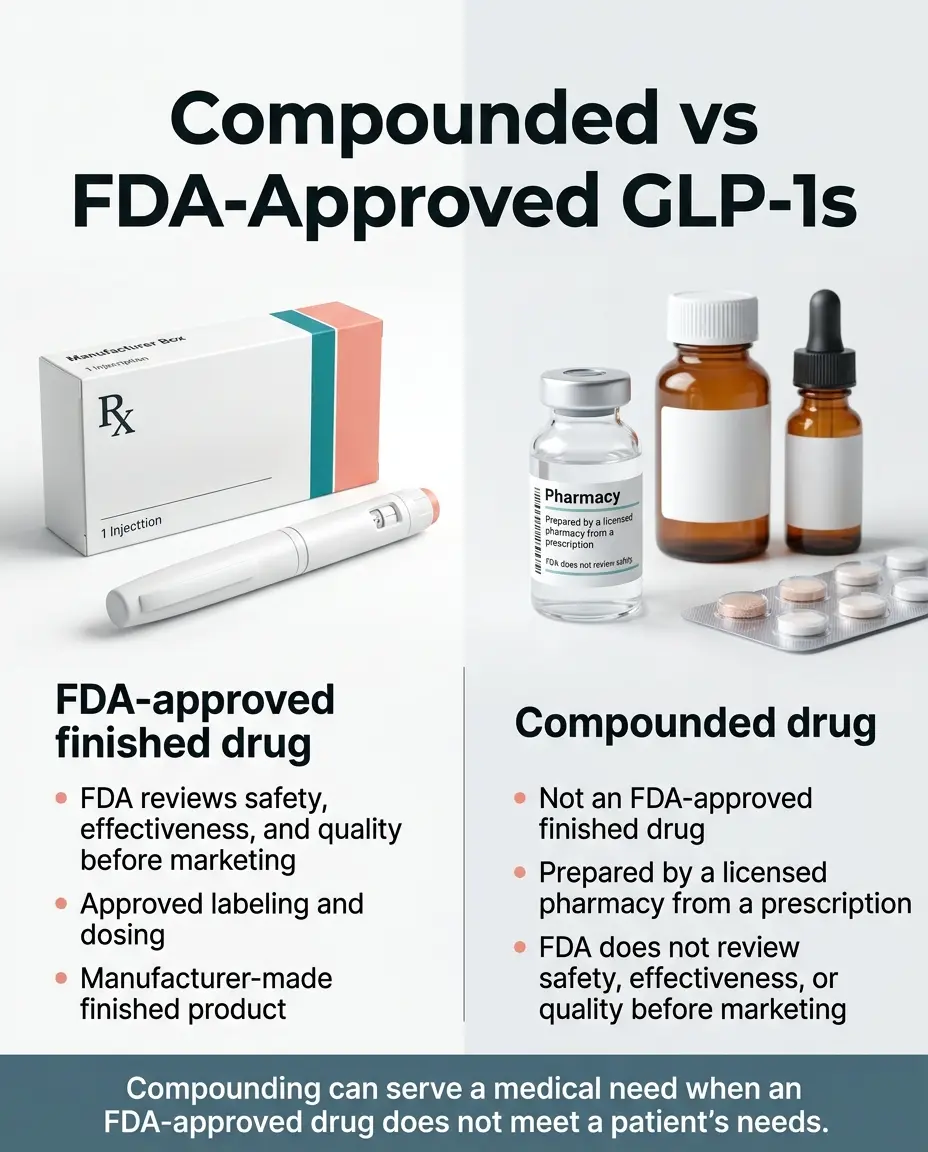
Compounded semaglutide and compounded tirzepatide do not have FDA-approved prescribing information. What ships with a compounded product is a compounding pharmacy product label and patient instructions written by the compounder or the prescribing telehealth provider — not an FDA-approved Boxed Warning, not Section 4 contraindications under 21 CFR 201.57, and not a Recent Major Changes log.
What you do NOT get with a compounded GLP-1
- × No FDA-approved Boxed Warning
- × No FDA-approved Section 4 contraindications structure
- × No Recent Major Changes log
- × No FDA-approved Instructions for Use for the vial/syringe
- × No FDA premarket review for safety, effectiveness, or quality
What the FDA has said about dosing errors
The FDA has issued an alert about compounded semaglutide dosing errors involving confusion between milliliters, milligrams, and units. In some reports, patients received five to ten times the intended dose — with some requiring hospitalization.
How to read a compounded GLP-1 label safely
- 1Identify the active ingredient and concentration. 'Semaglutide 2.5 mg/mL' tells you it's 2.5 milligrams of semaglutide in every milliliter of liquid.
- 2Identify your prescribed dose in milligrams — not milliliters, not units.
- 3Identify the device. A U-100 insulin syringe? A larger syringe? A pen?
- 4Use the FDA-approved branded label only for molecule-level safety information (boxed warning topic, common side effects, drug interactions, pregnancy guidance). Do not assume the branded dose schedule applies to your compounded vial.
- 5If anything is unclear, call the prescribing telehealth provider or compounding pharmacy. Do not self-convert. Do not guess.
What's changed across GLP-1 labels recently
GLP-1 labels have changed substantively in the last 24 months. The most patient-relevant changes:
| Change | Date | Source |
|---|---|---|
| Ileus added to Ozempic Section 5 | September 2023 | FDA post-marketing label update |
| Pulmonary aspiration during anesthesia added to many current GLP-1 labels | 2024–2025 | Current PIs on DailyMed (Ozempic, Wegovy, Mounjaro, Zepbound, Saxenda, Trulicity, Rybelsus / Ozempic tablets, Foundayo) |
| Saxenda pregnancy contraindication removed from Section 4; pregnancy moved to Section 8.1 | 05/2025 | Current Saxenda PI Recent Major Changes block |
| Severe GI Adverse Reactions updated on Ozempic | 2025 | Ozempic PI Recent Major Changes |
| Foundayo (orforglipron) FDA-approved | April 1, 2026 | FDA press release; Lilly announcement |
| FDA requests removal of Suicidal Behavior and Ideation warning from Saxenda, Wegovy, Zepbound | 2025–2026 (Wegovy showed removal 02/2026) | FDA Drug Safety Communication |
| Tirzepatide oral contraceptive guidance reinforced | 2024–2025 | Current Mounjaro and Zepbound PIs |
| Mounjaro and Zepbound labels revised | 4/2026 | DailyMed |
| Trulicity label revised | 3/2026 | DailyMed |
| Wegovy label revised (multiple supplements; MASH indication included under accelerated approval) | 3/2026 | DailyMed |
| Saxenda label revised | 2/2026 | DailyMed |
How to spot future changes early
- Subscribe to FDA Safety Alerts at fda.gov/safety/medwatch.
- Check the Recent Major Changes block on your drug's PI quarterly.
- Watch DailyMed for re-submitted Structured Product Labeling.
- Watch for “Dear Healthcare Provider” letters from manufacturers for class-wide news.
What to do if your prescription label doesn't match the package, the PI, or what you were told
If the drug name, dose, strength, concentration, device, route, frequency, or instructions don't match what your prescriber told you, stop. Do not “correct” it yourself, and do not adjust the dose to make it work. Keep the product and packaging exactly as you received them, take clear photos, then call the dispensing pharmacy or prescriber.
Mismatch checklist
- Is the product name exactly what your prescriber said?
- Is the active ingredient correct (semaglutide / tirzepatide / liraglutide / etc.)?
- Is it the right form (injection vs. tablet vs. pen vs. vial)?
- Does the dose strength match the prescription?
- Does the frequency match (weekly vs. daily)?
- Does the concentration make sense for the volume you're being asked to inject?
- Is the device correct (pen vs. U-100 syringe)?
- Is the expiration / use-by date clear and not expired?
- Is the pharmacy or manufacturer source legitimate?
- Is there a Medication Guide and IFU included?
- Any spelling errors, suspicious addresses, or unusual packaging?
Reporting to MedWatch
If you experience a serious adverse reaction, a suspected product-quality problem, or a labeling/packaging error, you can report it at fda.gov/medwatch or by phone at 1-800-FDA-1088. MedWatch reporting does not replace urgent care or a clinical conversation.
Common mistakes patients make when reading a GLP-1 label
Confusing Section 4 with Section 5
Section 4 = absolute 'do not use.' Section 5 = 'be careful, monitor, talk to your clinician.' Pancreatitis history, gastroparesis, and chronic kidney disease are typically Section 5 precautions on GLP-1 labels — not Section 4 contraindications. The Section 4 list on the products in this guide is short: MTC history, MEN 2, hypersensitivity. (Saxenda used to list pregnancy in Section 4; it was removed in 05/2025.)
Reading only Highlights
By regulation, every Highlights section literally says: 'These highlights do not include all the information needed to use [drug] safely and effectively.' Highlights is a map, not the territory.
Using a stale PDF
A PDF you downloaded two years ago is probably out of date. The Ozempic label was updated in September 2023 (ileus added) and again in 2024–2025. Wegovy was revised in 3/2026. Mounjaro and Zepbound in 4/2026. Always check the Revision date on the document you have, then compare to DailyMed.
Assuming same boxed warning = same wording or same risk profile
Seven of the eight products in this guide carry essentially the same molecule-specific rodent-tumor warning. Foundayo carries the warning subject on a different basis (orforglipron isn't pharmacologically active in rodents and didn't cause tumors there). The differences between GLP-1s also show up in Section 1 (approved uses), Section 2 (dose schedule), and Section 5 (drug-specific warnings).
Treating compounded product labels as FDA-approved
Compounded GLP-1 product information is not FDA-approved labeling. The molecule's safety profile is described in the branded FDA-approved labels. The specific product you have — its concentration, dose, instructions, and quality — is governed by the compounding pharmacy and the prescribing clinician.
Glossary: plain-English translations of GLP-1 label jargon
| Term | What it means | Where it appears |
|---|---|---|
| USPI | United States Prescribing Information — the full FDA-approved label document | Whole document |
| Highlights of Prescribing Information | The front summary at the top of the PI | Top of PI |
| Full Prescribing Information (FPI) | The 17-section detailed labeling that follows Highlights | Body of PI |
| Boxed Warning | The FDA's most prominent warning; appears in a black-bordered box | Top of Highlights |
| Indication | An FDA-approved use of the drug | Section 1 |
| Contraindication | A condition that makes the drug unsafe to use; absolute 'do not use' | Section 4 |
| Adverse Reaction | An undesirable effect reasonably associated with the drug | Section 6 |
| Postmarketing Experience | Reports collected after FDA approval (not from registration trials) | Section 6 |
| Medullary Thyroid Carcinoma (MTC) | A rare thyroid cancer arising from C-cells | Boxed Warning, Section 4, Section 5 |
| MEN 2 | Multiple Endocrine Neoplasia syndrome type 2 — an inherited condition linked to MTC | Boxed Warning, Section 4 |
| C-cells | Parafollicular cells of the thyroid; produce calcitonin | Boxed Warning, Section 13 |
| Ileus | A condition where the intestines stop moving food along normally | Section 5 / Section 6 (where present) |
| Pulmonary aspiration | Inhalation of stomach contents into the lungs; a risk during anesthesia | Section 5 (current GLP-1 labels) |
| Gastroparesis | Delayed stomach emptying | Section 5 / Section 6 |
| Insulin secretagogue | A class of diabetes drugs (e.g., sulfonylureas) that increase insulin release | Section 5, Section 7 |
| Hypoglycemia | Low blood sugar | Section 5, Section 7 |
| eGFR | Estimated glomerular filtration rate; a measure of kidney function | Section 1 (Ozempic CKD indication), Section 14 |
| MACE | Major Adverse Cardiovascular Events — cardiovascular death, non-fatal heart attack, non-fatal stroke | Section 1, Section 14 |
| MASH | Metabolic dysfunction-associated steatohepatitis (formerly NASH) | Section 1 (Wegovy injection, accelerated approval) |
| OSA | Obstructive sleep apnea | Section 1 (Zepbound) |
| SPL | Structured Product Labeling — the electronic format manufacturers submit to the FDA | Behind the scenes |
| DailyMed | NLM's labeling viewer (dailymed.nlm.nih.gov) | External |
| Drugs@FDA | FDA's drug information database (accessdata.fda.gov) | External |
| 21 CFR 201.57 | The federal regulation specifying PI content and format | Behind the scenes |
| PLR | Physician Labeling Rule (2006); set the modern PI format | Behind the scenes |
| NDC | National Drug Code — the unique identifier for a packaged drug | Section 16, carton |
| Medication Guide | FDA-approved patient-facing safety summary, attached at the end of the PI | End of PI |
| Instructions for Use (IFU) | FDA-approved step-by-step patient instructions for the device | End of PI / in the carton |
Frequently asked questions
Is a prescribing information label the same as my prescription label?
No. The prescribing information is the FDA-approved professional label for the drug product. Your prescription label is the pharmacy's patient-specific sticker with your name, your dose, and your dispensing directions. Both matter; they answer different questions.
What section of a GLP-1 label tells me the dose?
Section 2, 'Dosage and Administration.' It contains starting dose, titration schedule, missed-dose rules, switching instructions, and where to inject. Your personal prescribed dose still comes from your prescriber and your pharmacy label.
What section tells me whether a GLP-1 is approved for weight loss, diabetes, OSA, cardiovascular risk, kidney outcomes, or MASH?
Section 1, 'Indications and Usage.' Approved uses are not interchangeable across brands. Ozempic is approved for type 2 diabetes (and certain CVD and CKD outcomes). Wegovy injection is approved for chronic weight management, MACE reduction in people with CVD plus obesity or overweight, and noncirrhotic MASH with F2–F3 fibrosis in adults under accelerated approval. Zepbound is approved for chronic weight management and moderate-to-severe OSA in adults with obesity. Always check the exact label.
What does mg/mL mean on a GLP-1 label?
Milligrams of drug per milliliter of liquid. It is a concentration, not a dose. '5 mg/0.5 mL' means there are 5 milligrams of drug in 0.5 mL of liquid total. Depending on whether the product is a single-dose vial, a multi-dose pen, or a compounded vial, that wording can mean very different things in practice. Always match the product name and device to the Instructions for Use before drawing or injecting.
Do GLP-1 pens require unit conversion?
No. FDA-approved GLP-1 pens (Ozempic, Wegovy injection, Mounjaro, Zepbound prefilled pens and KwikPen, Saxenda, Trulicity) are designed around labeled doses and device instructions. You do not convert mg to units on a pen — you dial or select the labeled dose. Unit/mg/mL confusion shows up mostly with vials, especially compounded vials, and the FDA has issued safety warnings about exactly that pattern.
Are compounded GLP-1 labels FDA-approved?
No. Compounded GLP-1 products do not have FDA-approved prescribing information. The FDA does not conduct premarket review of compounded drugs. Use the FDA-approved branded label for molecule-level safety information, but follow your prescribing clinician's specific instructions for your compounded product.
What is a boxed warning?
The boxed warning is the FDA's most prominent warning, displayed in a black-bordered box at the top of Highlights. On the eight GLP-1 products in this guide, the boxed warning is about thyroid C-cell tumors — described as a rodent finding for seven products, and described differently for Foundayo (whose molecule is not pharmacologically active in rodents and did not cause tumors there).
What is a contraindication, and how is it different from a warning?
A contraindication (Section 4) is an absolute 'do not use' rule. A warning or precaution (Section 5) is something to know about and monitor, but the drug may still be appropriate. For most GLP-1s in this guide, MTC history and MEN 2 are Section 4 contraindications; pancreatitis, gallbladder disease, and severe GI reactions are Section 5 warnings.
Why does my GLP-1 label say my starting dose is 'not effective'?
Many GLP-1 labels are explicit that the starting dose exists to help your body adjust during titration, not to achieve the labeled benefit. Zepbound 2.5 mg, Rybelsus 3 mg, and Saxenda lower doses are all examples. The label shows the approved titration ladder; your prescriber decides when you move up.
Where do I find pregnancy information?
Section 8.1 (Pregnancy) and any related reproductive-potential language in Section 5 or Section 8.3. Some labels recommend stopping the drug at least 2 months before a planned pregnancy because of a long washout period. Saxenda used to list pregnancy as a Section 4 contraindication; that was removed in 05/2025 and pregnancy now lives in Section 8.1.
Where do I find oral contraceptive warnings?
Section 7 (Drug Interactions) and sometimes Section 8.3. The Mounjaro and Zepbound labels specifically instruct patients on oral contraceptives to switch to non-oral or add a barrier method for 4 weeks after starting tirzepatide and 4 weeks after each dose escalation.
Where do I find storage instructions?
Section 16, 'How Supplied / Storage and Handling,' plus the product-specific Instructions for Use. Refrigeration before first use is standard; the room-temperature window after first use varies by drug.
Which is more current — DailyMed or Drugs@FDA?
Use both. DailyMed (NLM) shows labeling currently submitted to the FDA and in use; Drugs@FDA (FDA) shows the FDA-approved label PDF along with approval and supplement history. For day-to-day reading, DailyMed is cleaner. For regulatory history, Drugs@FDA is more complete.
What is the difference between Ozempic's PI and Wegovy's PI if they're both semaglutide?
Different approved indications (Section 1) — Wegovy adds chronic weight management, MACE reduction in CVD + obesity/overweight, and MASH; Ozempic adds T2D-related cardiovascular and kidney outcomes. Different dose ceilings and titration schedules (Section 2). Different clinical trials referenced (Section 14). Same active molecule, different FDA-approved use, different label.
What if I'm supposed to have surgery while I'm on a GLP-1?
Tell your surgical team. Section 5 of many current GLP-1 labels now includes a subsection on pulmonary aspiration during general anesthesia or deep sedation. Your team will decide whether to modify fasting instructions, hold a dose, or adjust the timing of your procedure.
Should I be worried about suicidal thoughts on a GLP-1?
The FDA conducted a comprehensive review and found no increased risk of suicidal ideation or behavior with GLP-1 receptor agonists. The FDA requested removal of the Suicidal Behavior and Ideation warning from U.S. labels that previously included it (Saxenda, Wegovy, Zepbound); Wegovy's current label shows that removal in 02/2026. As always, talk to your clinician about any new or worsening mood changes — and check the current label for the most up-to-date language.
How often is a GLP-1 label updated?
Active GLP-1 labels are updated several times a year. After initial approval, manufacturers are required to update the PI when new information becomes available that makes the label inaccurate or misleading. Check the Recent Major Changes block on the current label to see what has been updated. By regulation, each listing stays in the block for at least one year after the change.
How we built this guide
We opened the current FDA-approved Prescribing Information PDF on Drugs@FDA and DailyMed for each of the eight GLP-1 products covered here. We pulled the revision date, boxed warning wording, Section 4 contraindications, Section 1 indications, and Section 2 missed-dose rules directly from those documents. We did not paraphrase regulatory language where exact wording mattered — we used the labels' own wording.
We did not invent an author. We do not employ a “medically reviewed by” line we can't verify. This guide is editorial — a navigation tool for a federally-regulated document — and we are transparent about that.
We will keep it current. Quarterly we'll re-verify the revision dates, the Recent Major Changes blocks, and any class-wide additions. The “Last verified” date at the top is your check on whether we've done our job.
This guide is published by the editorial team at therxindex.com, an independent pricing and information resource for GLP-1 medications. We are not affiliated with any manufacturer, the FDA, or any regulatory body. This guide is not medical advice and does not replace your conversation with your prescriber or pharmacist. If anything on this page ever conflicts with the current FDA-approved label for your specific drug, follow the label.
Related guides on The Rx Index
Sources
Primary regulatory sources:
- 21 CFR 201.57 — Specific requirements on content and format of labeling for human prescription drug and biological products
- FDA, “Frequently Asked Questions about Labeling for Prescription Medicines”
- FDA, “FDA's Concerns with Unapproved GLP-1 Drugs Used for Weight Loss”
- FDA, “FDA Alerts Health Care Providers, Compounders and Patients of Dosing Errors Associated with Compounded Semaglutide”
- FDA Drug Safety Communication: removal of suicidal behavior warning from GLP-1 RA labels
- FDA MedWatch (fda.gov/medwatch)
Current FDA-approved labels (verified May 12, 2026 on DailyMed):
- Ozempic (semaglutide injection) — Revised 10/2025
- Wegovy (semaglutide injection / tablet) — Revised 3/2026
- Rybelsus / Ozempic tablets (semaglutide) — Revised 1/2026
- Mounjaro (tirzepatide injection) — Revised 4/2026
- Zepbound (tirzepatide injection) — Revised 4/2026
- Saxenda (liraglutide injection) — Revised 2/2026
- Trulicity (dulaglutide injection) — Revised 3/2026
- Foundayo (orforglipron tablet) — Initial label, 4/2026
Last verified: May 12, 2026.
Published: · Last reviewed:
Last verified: May 12, 2026.
Your situation changes the answer
Find My GLP-1 Path
The right GLP-1 provider isn't the same for everyone. It depends on your state, your insurance and formulary, whether you want an FDA-approved or compounded medication, your preferred route (injection or oral), and your budget. Because a general answer can't resolve those for you, use The RX Index's Find My GLP-1 Path tool to get a personalized provider match with source-verified pricing before you choose.
- What it asks: your state, insurance situation, medication preference, budget, and support needs
- What you get: a personalized shortlist of GLP-1 providers matched to your situation, with verified pricing and the right questions to ask
- Cost: free · about 2 minutes · no signup