
Step Therapy for Wegovy: Real Plan Rules, Exception Paths, and How to Appeal a Denial
By The RX Index Editorial Team — The RX Index is a pricing intelligence and comparison resource for GLP-1 telehealth providers.
Published:
Last verified:
Sources reviewed: CVS Caremark/Aetna PA with Limit 4774-C P08-2025 v4; Cigna Coverage Policy IP0206; Cigna CNF_684; UnitedHealthcare PA Notifications (commercial and non-formulary CV/MASH); BCBS FEP via CVS Caremark; TRICARE / Express Scripts Wegovy PA form; FDA prescribing information for Wegovy injection and tablets.
The Bottom Line in 60 Seconds
Step therapy for Wegovy means your insurance wants proof you completed an earlier step before they pay for Wegovy. That step is usually one of three things: a 3–6 month documented weight-loss program, a trial of a cheaper anti-obesity medication, or a documented reason a cheaper medication is unsafe for you.
Wegovy® (semaglutide) is FDA-approved as injection and tablets, with a boxed warning and specific contraindications that should be evaluated by a clinician — this page is editorial guidance, not medical advice. Always work with your prescriber.
Quick Decoder — What Your Denial Probably Means
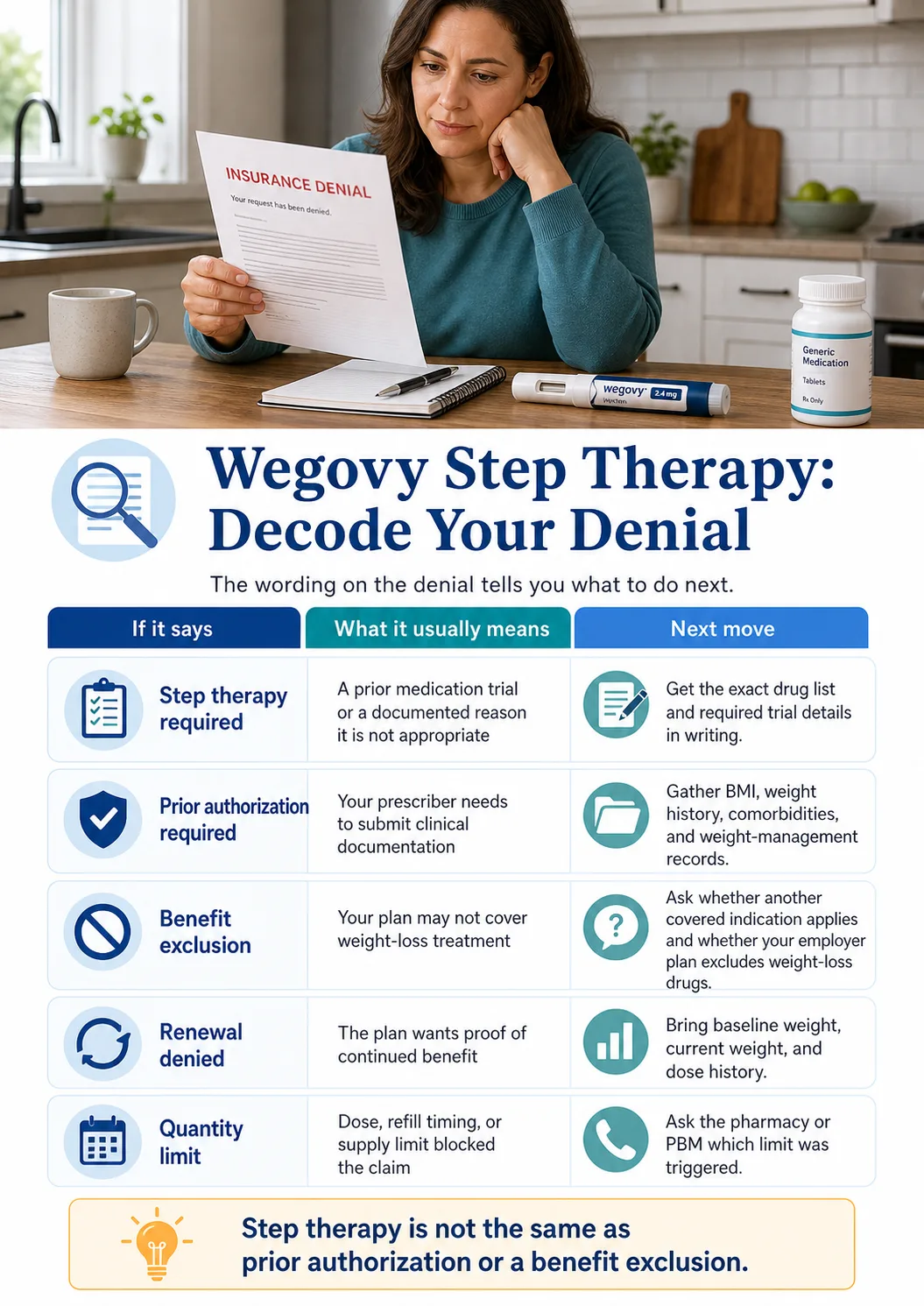
| If your denial says… | It probably means… | Your next move |
|---|---|---|
| “Step therapy required” | Try a cheaper drug first OR document why you can't | Get the exact drug list and trial duration in writing |
| “Prior authorization required” | Paperwork is missing, not necessarily a drug trial | Pull BMI, comorbidity, and weight-program records |
| “Benefit exclusion” | Plan does not cover weight-loss drugs at all | Check if CV or MASH indication applies; ask HR |
| “Renewal denied” | You did not meet the continuation rule (often 5% weight loss) | Pull baseline weight + current weight + dose history |
| “Non-formulary” / “tier exception needed” | Wegovy isn't on the preferred drug list | File a formulary exception, not a step therapy appeal |
| “Quantity limit” | Dose, refill timing, or supply limit triggered the block | Ask the pharmacy which specific limit fired |
What “Step Therapy for Wegovy” Actually Means
Step therapy is your insurer asking you to prove you completed a required step before they cover Wegovy. The step can be a prior medication trial, a documented weight-management program, a documented contraindication, or proof of an FDA-approved indication the plan covers. It is not the same as prior authorization, and it is not the same as a benefit exclusion — and which one you're facing changes everything about your next move.
Insurance companies use step therapy because Wegovy lists at $1,349.02 per month before insurance discounts. Step therapy lets the plan say: “Try something cheaper first, and if it doesn't work, we'll cover Wegovy.”
Step therapy vs. prior authorization vs. benefit exclusion
Most “Step Therapy” Denials Aren't Really Medication Step Therapy: The 6 Things Plans Actually Require
When we read public PA criteria across the major insurers, we found six different things plans bundle under the “step therapy” banner. Knowing which one your plan is asking for is the difference between getting Wegovy in two weeks and waiting six months.
The 3–6 month documented weight management program
This is what Aetna's public Wegovy PA Policy 4774-C asks for. Coverage requires participation in a comprehensive weight-management program with behavioral modification, reduced-calorie diet, increased physical activity, and continuing follow-up for at least 6 months before drug therapy. Cigna's public weight-loss GLP-1 policy (IP0206) asks for at least 3 months of behavioral modification and dietary restriction.
This is the #1 denial reason in patient forums — readers think they need a drug trial; they actually need records of:
- Dietitian or weight-loss counselor visits
- Structured program participation (Weight Watchers, Noom, hospital-based program)
- Doctor visits where weight, diet, and exercise were discussed
- Calorie tracking logs and activity logs
The cheaper-medication trial (true step therapy)
This is what most people picture. Your plan asks you to try one (or sometimes more) of these for a set period:
TRICARE's current public Wegovy PA form spells this out clearly: it asks if the patient tried 3 months of generic phentermine-class drugs and failed to lose 5% of baseline weight, or whether the patient has a contraindication or adverse reaction documented. True cheaper-drug step therapy is less common in commercial plans than people assume.
The BMI + comorbidity proof
Every public Wegovy PA criteria we reviewed requires:
- BMI ≥ 30 (obesity), OR
- BMI ≥ 27 plus at least one weight-related health condition
Common qualifying comorbidities: type 2 diabetes, high blood pressure, high cholesterol, sleep apnea, established cardiovascular disease. Wrong or incomplete ICD-10 coding causes denials labeled “step therapy” or “not medically necessary” even when the patient clearly qualifies.
The 5% renewal threshold
This blocks people who already got Wegovy approved before. Most plans (Aetna, Cigna, UnitedHealthcare, BCBS FEP, TRICARE — every public policy we reviewed) require proof the patient lost at least 5% of baseline body weight (or maintained that loss) to renew coverage.
If you're being denied at renewal, gather: your starting weight, your most recent weight, doses taken and dates, and any plateau explanation from your prescriber. If you didn't hit 5%, you can still appeal — the strongest appeals show ongoing benefit beyond weight (improved A1c, lower blood pressure, better sleep).
The benefit exclusion
This is the one no amount of step therapy paperwork will fix. Some plans simply do not cover weight-loss medications at all. Words that signal exclusion: “not a covered benefit,” “weight management excluded,” “obesity drug exclusion.”
Three real options:
- Check if a different FDA-approved indication applies. Wegovy is approved for cardiovascular risk reduction and for MASH (liver condition) with fibrosis.
- Talk to HR. For self-funded employer plans, the employer plan sponsor controls the benefit design.
- Use a self-pay path. NovoCare's published self-pay pricing for the Wegovy pen starts at $199/month for the first two monthly fills (intro offer through December 31, 2026), then $349/month. The Wegovy pill is $149/month for 1.5 mg and 4 mg through August 31, 2026.
The quantity limit
Do You Have to Try Phentermine Before Wegovy?
Phentermine (and similar stimulant-class drugs) carries real safety considerations. Your prescriber decides whether it's appropriate. Reasons a clinician might document phentermine as contraindicated or inappropriate include cardiovascular conditions, uncontrolled hypertension, hyperthyroidism, glaucoma, MAOI use, history of substance use disorder, or a previous adverse reaction.
If a phentermine trial was required and your prescriber agrees it's appropriate, the documentation needs:
- Medication tried, start and stop dates, dose if known, duration
- Outcome (specifically: weight change at the end of the trial)
- Adverse reaction or reason stopped, if applicable
- Contraindication if applicable
- Why Wegovy is the right next step
Verified Payer-by-Payer Requirements: What the Major Insurers Actually Ask For
Verified as of . Plan rules change. Confirm against your specific plan's documents or denial letter before you act.
| Plan / Source policy | True medication fail-first? | What the verified criteria say | Renewal rule | Best next move |
|---|---|---|---|---|
| Aetna (CVS Caremark PA 4774-C, P08-2025 v4) | Not in the public Wegovy policy | 6-month comprehensive weight-management program (behavioral modification + reduced-calorie diet + increased activity + follow-up), BMI ≥30 or ≥27 with comorbidity. Initial approval: typically 8 months (adult injection, weight mgmt), 6 months (tablets), 7 months (pediatric), 12 months (CV/MASH). | 12-month continuation with ≥5% baseline weight loss + continued program participation | Most “step therapy” Aetna denials = missing program documentation. Attach detailed program records. |
| Cigna / Evernorth (IP0206 + CNF_684) | Generally no in public Wegovy section | Initial adult Wegovy weight-loss approval 8 months (IP0206), 7 months (CNF_684 — verify which applies). Requires 3+ months behavioral modification + dietary restriction, BMI ≥30 or ≥27 with comorbidity. | 1 year continuation if currently on Wegovy, ≥5% baseline weight loss, continued behavior modification | Verify the exact Cigna plan policy — self-funded employer plans often differ. |
| UnitedHealthcare (commercial weight-loss PA) | Sometimes | Coverage only on plans that elected weight-loss product coverage. Initial Wegovy auth is 5 months. BMI ≥30 or ≥27 + comorbidity. Some UHC plans use BMI ≥40 threshold. | ≥5% baseline weight loss + lifestyle modification. 12-month continuation. | First confirm whether your UHC plan covers weight-loss meds at all. |
| UHC non-formulary (CV/MASH-only policy) | No — this is a benefit exclusion path | Weight-loss meds are a benefit exclusion. Wegovy allowed only for established cardiovascular disease (with obesity/overweight) or MASH with fibrosis. | 12-month authorization when CV or MASH criteria met | Do NOT file a step therapy appeal. Ask whether CV or MASH indication applies. |
| BCBS FEP (via CVS Caremark) | Not a cheaper-drug fail-first in public criteria | Requires chronic weight-management diagnosis, BMI criteria, comprehensive weight-management program, no dual GLP-1 therapy, no dual PA weight-loss medication. Initial 6-month approval. | 12-month renewal requires ≥5% baseline weight loss or maintained loss | If you're on another GLP-1 or another covered weight-loss med, the dual-therapy rule is the real blocker. |
| TRICARE (Express Scripts PA form) | Yes — verified | Asks if adult patient tried 3 months of generic phentermine, benzphetamine, diethylpropion, or phendimetrazine and failed to lose 5% baseline weight, OR has documented contraindication or adverse reaction. Initial approval 12 months. TRICARE no longer covers GLP-1s for weight management for TRICARE For Life, direct-care-only, and certain NATO/PFP beneficiaries after Aug 31, 2025. | Annual renewal requires ≥5% baseline weight loss after full dose titration | If a generic stimulant is unsafe for you, document the contraindication directly. |
| Custom employer / Medicaid / state plans | Plan-specific | Self-funded employer plans on any insurer can layer step therapy not in the public commercial criteria. State Medicaid GLP-1 weight-loss coverage varies and several states have restricted coverage in 2025–2026. | Varies | Don't assume “Aetna covers Wegovy” means your Aetna plan does. Pull your Summary Plan Description. |
Insurance paperwork is your bottleneck? Let Ro check your coverage first.
Ro's free GLP-1 Insurance Coverage Checker contacts your insurance plan, identifies eligibility details, and shows whether prior authorization may be required — before you commit to anything. The free coverage checker doesn't submit treatment requests or write prescriptions.
Check Wegovy Coverage Through Ro — Free → (sponsored affiliate link, opens in a new tab)Medication and membership billed separately if you continue with Ro.
Prior Medication History That May Help Your Case
Your past prescription history can strengthen a Wegovy step therapy exception or appeal — but whether it satisfies the requirement depends on your plan's specific criteria. Pull your records regardless — they often shorten what your prescriber has to file.
| Medication you may have taken | How it could help your case | What to gather |
|---|---|---|
| Ozempic (semaglutide, off-label for weight) | Documents prior GLP-1 exposure and outcome | Pharmacy fill history, dates, doses, A1c if checked, weight at start and stop |
| Saxenda (liraglutide) | Documents prior GLP-1 weight-management trial | Fill history, dates, doses, weight outcome, side effects if any |
| Trulicity (dulaglutide) | Documents prior GLP-1 class exposure | Fill history, dates, A1c response, weight response |
| Rybelsus (oral semaglutide) | Documents prior oral semaglutide exposure | Fill history, dates, doses, outcome |
| Phentermine (Adipex-P, Lomaira) | Often the named Tier 1 step on plans requiring true step therapy | Dates, dose, duration, weight change, side effects, reason stopped |
| Contrave | Often a named step on plans requiring true step therapy | Dates, dose, duration, weight change, side effects, reason stopped |
| Qsymia | Often a named step on plans requiring true step therapy | Dates, dose, duration, weight change, side effects, reason stopped |
| Orlistat (Xenical, OTC Alli) | Often a named step; OTC Alli purchase records can substantiate | Receipts or pharmacy fill history, duration, side effects, reason stopped |
How to pull the records that prove it:
- Call every pharmacy you've used in the last 5 years and ask for a complete fill history (CVS, Walgreens, Costco, Walmart, mail-order). Most patient portals have it under “prescription history.”
- Note for each prior medication: drug and dose, start and stop dates, why you stopped, any side effects you remember.
- Hand this to your prescriber before they file the PA.
What “failed” actually means:
- You took it for the required duration (often 3 months) and lost less than 5% of body weight
- You couldn't tolerate the side effects — this typically supports an intolerance or adverse-reaction exception
- You discovered a contraindication
- A serious adverse reaction made you stop
“I forgot to refill” or “it was too expensive” usually doesn't count.
State Step Therapy Override Laws — Does Your State Protect You?
| State | Override law? | Standard response | Emergency | Notable feature |
|---|---|---|---|---|
| Colorado | Strong protections | Per state rule | Per state rule | One of the strongest patient-protection frameworks |
| New York | Yes (2026 law) | 72 hours | 24 hours | Limits step therapy to ≤2 drugs in same therapeutic category; deemed-approval remedy if plan misses deadline |
| New Jersey | Yes (Jan 1, 2026 reform) | 72 hours | 24 hours | Newest comprehensive law; expanded guardrails including state Medicaid |
| California | Yes | 72 hours | 24 hours (serious jeopardy) | SB 40 (2026) prohibits step therapy specifically for insulin |
| Texas | Yes (SB 680) | 72 hours | 24 hours | Required exception process |
| Illinois | Yes | 72 hours | 24 hours | Required exception process |
| New Mexico | Yes | 72 hours | 24 hours | Required exception process |
| Indiana, Kansas, Virginia | Yes | 72 hours | 24 hours | Strong general framework |
| Georgia, Oklahoma, Wisconsin | Yes (effective 2020+) | 72 hours | 24 hours | Standard reform package |
| Washington | Yes (effective 2021) | 72 hours | 24 hours | Required exception process |
| States with no reform (~21 states) | Insurer policy controls | Varies | No statutory requirement | About 21 states fall here |
The fully-insured vs. self-funded trap
Your employer plan is one of two things:
- Fully-insured: your employer buys insurance from a carrier. The carrier accepts financial risk. Your state's insurance laws generally apply, including step therapy reform.
- Self-funded: your employer pays claims directly. The carrier just administers the plan. Federal ERISA law applies. Most state step therapy reform laws don't.
About 60% of large employer plans are self-funded. Your insurance card looks the same either way. The phrase to use with HR: “Is our medical plan fully-insured or self-funded for ERISA purposes?”
How to File a Step Therapy Exception Request for Wegovy
A Step Therapy Exception Request is a formal document your prescriber submits asking the insurer to waive the step therapy requirement. It must cite at least one of seven recognized exception categories. Federal Medicare Advantage rules require a 72-hour response. Most state reform laws require similar timelines for state-regulated commercial plans.
The seven recognized exception categories
1. Prior failure
You took it before for the required duration and didn't get adequate response. Pharmacy fill records prove duration; chart notes prove outcome.
2. Contraindication
A medical reason makes the drug unsafe. Your prescriber must determine and document the contraindication — do not self-diagnose.
3. Intolerance / adverse reaction
You tried it and had side effects you couldn't manage. Document the drug, dose, dates, specific reaction, and that you stopped because of it.
4. Expected adverse reaction
Based on your medical history (genetic, prior similar drugs), the prescriber reasonably expects you to have an adverse reaction.
5. Expected non-response
Your clinical history suggests the step drug won't work — for example, you've already failed multiple weight-loss medications in the same class.
6. Currently stable on Wegovy
You're already on Wegovy under a previous insurer or self-pay, and switching would jeopardize your treatment. Critical for renewals after insurance changes.
7. Best clinical interest
Your prescriber documents that the step drug is not in your best interest based on current clinical evidence (cardiovascular indication, established CV disease, MASH, etc.).
Your prescriber's letter — what it needs to include
- Patient name, DOB, insurance ID
- Diagnosis with ICD-10 codes
- Specific FDA-approved Wegovy indication (weight loss, CV risk reduction, or MASH)
- Current BMI, height, weight, baseline weight history
- Comorbidities with ICD-10 codes
- Previous weight-management efforts (program records)
- Previous medication trials with specific dates, doses, durations, and outcomes
- The specific exception category being claimed (from the seven above)
- Clinical risk of delay
- Direct request: “I am requesting approval of Wegovy for [patient name] under exception category [#].”
- Prescriber's signature, NPI, contact info, and attachments list
| Decision path | Typical timeline |
|---|---|
| State-regulated commercial plan in a reform state | Insurer must respond within the state-specified window (typically 72 hours; 24 hours emergency) |
| Medicare Advantage | Federal CMS rules require 72-hour standard response |
| Self-funded employer plan (ERISA) | Plan-specific; ERISA rules generally require ~15 days for pre-service claims |
| TRICARE | Express Scripts handles per their published timeline |
How to Appeal a Wegovy Step Therapy Denial
Letter of Medical Necessity — the pattern that works
Paragraph 1 — Patient summary
“I am writing to request approval of Wegovy (semaglutide) for my patient [name], who is a [age]-year-old with [diagnosis] and BMI [#]. Coverage was denied on [date] citing [exact denial reason].”
Paragraph 2 — Why Wegovy specifically
Cite FDA labeling for the indication. Reference the STEP 1 trial (~14.9% mean weight loss at 68 weeks) and the SELECT trial (20% reduction in major adverse cardiovascular events).
Paragraph 3 — Why the step therapy requirement should be waived
State the specific exception category from the seven above. Document evidence (prior fills, contraindication, etc.).
Paragraph 4 — Clinical risk of delay
Continued obesity, worsening of comorbidities, cardiovascular event risk, mental health impact.
Paragraph 5 — Direct request
“I respectfully request approval of Wegovy at the prescribed dose with [#] months of authorization.”
| Appeal step | Typical timeline |
|---|---|
| Internal appeal (pre-service) | 30 days |
| Internal appeal (post-service) | 60 days |
| Internal appeal (urgent) | 72 hours |
| Peer-to-peer review | Often 7–14 days from request |
| External review (standard) | 45 days |
| External review (expedited) | 72 hours |
| State DOI complaint | Varies by state and complaint type |
A redditor on r/WegovyWeightLoss described their successful appeal as “understanding their own policies better than they did.” The pattern across successful appeals: read the insurer's medical policy line by line, quote it back, and show how your situation maps to coverage criteria.
If your prescriber's office won't handle the paperwork, Ro will.
Ro's insurance concierge contacts your plan and handles GLP-1 paperwork after you start care. Membership starts at $39 for the first month, then as low as $74/month with annual prepay ($149/month standard). Medication is billed separately.
Check Wegovy Coverage Through Ro → (sponsored affiliate link, opens in a new tab)No payment to run benefits. Medication and membership billed separately if you continue with Ro.
What if Your Plan Excludes Wegovy Entirely?
A benefit exclusion means your plan does not cover weight-loss medications at all — no amount of step therapy paperwork will fix it. Your real options are: check whether a different FDA-approved indication gets you covered, advocate for benefit changes through HR, or use a self-pay path while you sort out long-term coverage.
The cardiovascular indication path
Wegovy is FDA-approved to reduce major cardiovascular events (heart attack, stroke, cardiovascular death) in adults with established cardiovascular disease and either obesity or overweight. The SELECT trial in 17,604 patients showed a 20% reduction in major adverse cardiovascular events compared to placebo.
If you have a prior heart attack, prior stroke (not a TIA), documented peripheral arterial disease, or established CV disease — and obesity or overweight — ask your prescriber whether the PA should be submitted under the cardiovascular risk reduction indication when your chart supports it.
The MASH indication path
In August 2025, the FDA approved Wegovy for the treatment of metabolic dysfunction-associated steatohepatitis (MASH) with moderate to advanced liver fibrosis. If you have documented MASH with fibrosis and a hepatologist or gastroenterologist involved in your care, your plan may cover under this indication.
The HR conversation
If you have a self-funded employer plan with weight-loss exclusion, the path runs through HR, not the insurance carrier. The employer plan sponsor may control the benefit design even when the insurer administers it.
- Ask HR for the Summary Plan Description (SPD) and current formulary
- Bring evidence of clinical need and demand from coworkers
- Ask whether GLP-1 weight-loss coverage is on the open enrollment table
- Push during the next annual benefits review
FDA-approved Wegovy self-pay options (as of May 4, 2026)
| Option | Price | Notes |
|---|---|---|
| Wegovy pen via NovoCare | $199/mo for first 2 fills, then $349/mo | Intro offer through December 31, 2026 (0.25 mg or 0.5 mg starting doses) |
| Wegovy HD 7.2 mg pen | $399/mo | Via NovoCare |
| Wegovy pill (1.5 mg / 4 mg) | $149/mo (4 mg → $199/mo after Aug 31, 2026) | Through August 31, 2026 |
| Wegovy pill (9 mg / 25 mg) | $299/mo | Via NovoCare |
You can start on self-pay and continue the insurance fight on a parallel track. If your appeal succeeds, you switch to insurance-covered fills. Treatment progress doesn't reset. See our best telehealth for Wegovy guide for a full breakdown of self-pay paths.
How Long Does the Step Therapy Process Take?
A first prior authorization decision usually takes 1–7 business days when documentation is complete. If you can't wait, parallel cash-pay through Ro or NovoCare lets you start treatment while the paperwork plays out.
| Step | Realistic timeline | What slows it down |
|---|---|---|
| Benefits verification | Same day to 3 days | Wrong PBM, outdated formulary |
| First PA submission | 1–14 days | Missing BMI, comorbidity, or program records |
| Step therapy exception decision | 72 hours (reform state) to 14 days | Inadequate exception documentation |
| Internal appeal decision | 15–30 days | Vague appeal letter |
| Peer-to-peer review | 7–14 days from request | Scheduling between prescriber and medical director |
| External review (standard) | 45 days | Independent reviewer queue |
| External review (expedited) | 72 hours | Medical urgency must be documented |
| Pharmacy fill after approval | 1–7 days | Stock + dose availability |
Your 7-Day Wegovy Step Therapy Action Sprint
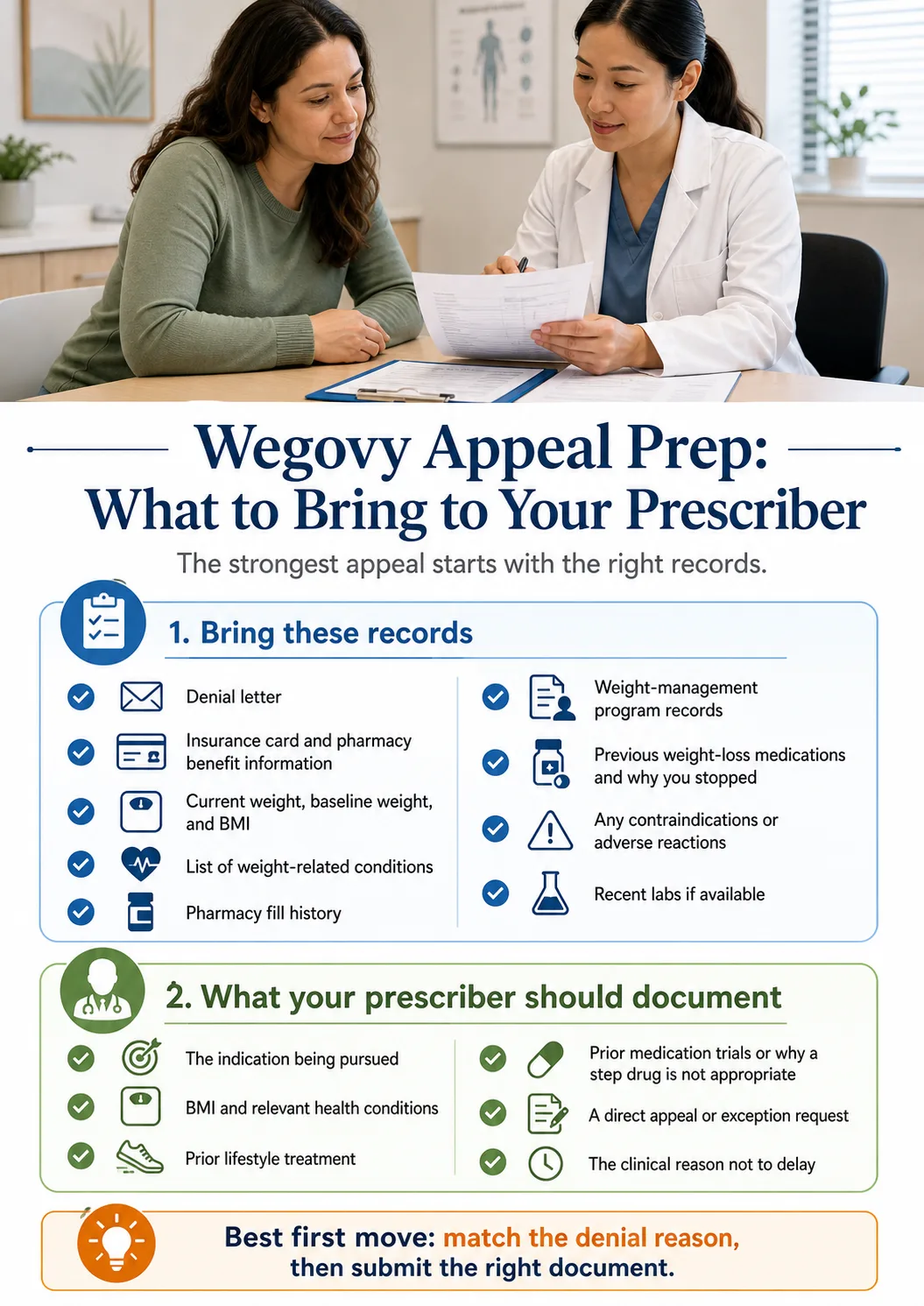
Document Checklist for Your Prescriber
The single most common reason Wegovy step therapy denials don't get reversed is incomplete documentation — and the patient doesn't know what the doctor needs.
What to bring to your appointment
- ✓Original denial letter (paper or screenshot)
- ✓Insurance card (front and back)
- ✓Pharmacy benefit card if separate
- ✓Current weight, height, and BMI
- ✓Baseline weight before any weight-loss intervention
- ✓List of comorbidities and dates of diagnosis
- ✓Pharmacy fill history (last 5 years)
- ✓Weight-management program records (dietitian, gym, structured program receipts, logs)
- ✓Previous weight-loss medications: drug, dates, doses, duration, why stopped
- ✓Any documented contraindications or adverse reactions
- ✓Recent labs if available (A1c, lipid panel, BMP)
What your prescriber needs to write
- ✓Diagnosis section: ICD-10 codes, BMI documentation
- ✓Indication section: which FDA-approved Wegovy indication and supporting documentation
- ✓Lifestyle modification section: documented program participation
- ✓Medication history section: previous trials with dates, doses, durations, outcomes
- ✓Exception rationale section: which of the seven categories applies and why
- ✓Clinical risk section: what happens if treatment is delayed
- ✓Direct request section: specific medication, dose, duration of approval requested
When (and When Not) to Use a Telehealth Provider
A telehealth provider is worth the money when your bottleneck is paperwork and your current doctor's office won't handle it. It's not worth the money if your current prescriber is actively appealing well, your plan has a hard benefit exclusion no provider can fix, or you have specialty medical needs requiring in-person care.
When a telehealth provider helps
- Your current prescriber's office refuses to handle prior authorizations
- You don't have a current weight-loss prescriber and need one fast
- You want one place to handle prescribing AND insurance paperwork
- You want to start parallel self-pay while your appeal runs
When a telehealth provider can't help
- Your plan has a hard benefit exclusion (no provider can override your employer's plan design)
- Your current doctor is actively appealing well
- You need specialty in-person care for safety reasons
| Feature | Ro | Sesame Care |
|---|---|---|
| Free coverage check before commitment | Yes — GLP-1 Insurance Coverage Checker contacts your plan and identifies eligibility details; doesn't submit treatment requests or write prescriptions | Pay-per-visit model; no separate free coverage check on the public site at time of review |
| Insurance paperwork support | Yes — Ro's insurance concierge works with insurance and handles paperwork for GLP-1 coverage after a patient starts care | Providers can assist with insurance paperwork; not a centralized concierge team |
| Membership / platform price | $39 first month, then as low as $74/month with annual prepay ($149/month standard) | Success by Sesame as low as $59/month annually |
| FDA-approved Wegovy access | Yes — Wegovy pen and Wegovy pill | Yes — Wegovy pen, plus Zepbound, Ozempic, Mounjaro, Foundayo, Saxenda |
| Other FDA-approved GLP-1s | Zepbound, Zepbound KwikPen, Foundayo, Ozempic | Broad branded formulary including all major GLP-1s |
| Government insurance (Medicare/Medicaid/TRICARE) | Ro says it can't help coordinate GLP-1 coverage for government insurance plans | Verify current government-plan restrictions |
| Last verified | May 4, 2026 | May 4, 2026 |
Ro — when it's the right pick
Ro's GLP-1 Insurance Coverage Checker provides a free benefits review. Ro's insurance concierge contacts your plan and handles GLP-1 paperwork after you start care. Membership starts at $39 first month, then $149/month standard (as low as $74/month with annual prepay). Wegovy pen self-pay via Ro/NovoCare starts at $199/month (intro pricing for first 2 monthly fills through December 31, 2026), then $349/month. Wegovy pill starts at $149/month for 1.5 mg and 4 mg through August 31, 2026.
The honest tradeoff: Ro is not the cheapest telehealth path. But if your bottleneck is paperwork your doctor's office won't handle, Ro's insurance concierge is doing the exact work you're stuck on. The membership often pays for itself in a single covered fill (Wegovy lists at $1,349.02/month before insurance discounts).
Check Wegovy Coverage Through Ro → (sponsored affiliate link, opens in a new tab)No payment to run benefits. Medication and membership billed separately.
Sesame Care — when it's the right pick
Lower monthly platform fees than Ro. Provider choice (you pick from a list of clinicians). Pay-as-you-go visit options. Success program includes ongoing care, labs, messaging, and access to FDA-approved GLP-1 medications. Providers can assist with insurance paperwork, though workflow is provider-by-provider rather than a centralized concierge.
When to pick Sesame over Ro: you want lower monthly cost, you want to choose your specific provider, you have a clear-cut insurance situation or are paying cash, you don't need white-glove paperwork management.
See Sesame Care's GLP-1 Options → (sponsored affiliate link, opens in a new tab)Medication not included in care fee. Billed separately.
Safety and Medical Limits While Fighting Your Denial
Insurance rules don't decide whether Wegovy is medically right for you.
Wegovy carries a boxed warning related to thyroid C-cell tumors and is contraindicated in people with personal or family history of medullary thyroid carcinoma or Multiple Endocrine Neoplasia syndrome type 2. The FDA prescribing information also lists serious warnings for pancreatitis, gallbladder disease, kidney injury, severe hypoglycemia in patients with type 2 diabetes, and others.
- ⚠Don't start a step medication just to satisfy insurance if it's medically inappropriate for you. Document the contraindication with your prescriber instead.
- ⚠Don't combine Wegovy with another semaglutide product (Ozempic, Rybelsus) or any other GLP-1 receptor agonist (Trulicity, Saxenda, Mounjaro/Zepbound). BCBS FEP's public criteria explicitly require no dual GLP-1 therapy and no dual PA weight-loss medication.
- ⚠Don't share Wegovy pens or split doses without prescriber direction.
- ⚠If you're pregnant, planning to be pregnant, or breastfeeding, discuss with your prescriber. Wegovy is generally not recommended during pregnancy.
This page is editorial guidance about insurance process. It is not medical advice. Your prescriber's clinical judgment governs whether Wegovy is right for you.
What We Actually Verified for This Guide
Last verified: · Next planned re-verification: August 4, 2026.
Insurer and PBM policies verified:
- ✅CVS Caremark/Aetna PA with Limit 4774-C P08-2025 v4 ©2026
- ✅Cigna Coverage Policy IP0206 (Weight Loss GLP-1 Agonists)
- ✅Cigna National Formulary Coverage Policy CNF_684
- ✅UnitedHealthcare PA Notification (Weight Loss Medications, commercial)
- ✅UnitedHealthcare PA Notification (Non-Formulary Wegovy CV/MASH-only)
- ✅BCBS FEP criteria via CVS Caremark
- ✅TRICARE / Express Scripts Wegovy PA form (current public version)
Clinical and regulatory sources verified:
- ✅FDA prescribing information for Wegovy injection and Wegovy tablets
- ✅FDA Wegovy MASH approval (August 2025)
- ✅SELECT trial cardiovascular outcomes data (NEJM)
- ✅STEP 1 trial weight-loss efficacy data (NEJM)
- ✅CMS consumer appeals materials and Medicare GLP-1 Bridge
- ✅KFF analysis of 2024 ACA Marketplace claims and appeals
- ✅State step therapy reform laws (NY, NJ, CA, CO, TX, IL, NM, WA and others)
What we did not verify and you must check yourself:
- Your specific employer plan's customized formulary and any self-funded carve-outs
- Your specific state Medicaid GLP-1 coverage policy
- Your prescriber's individual willingness to file step therapy exception requests
- Whether a step medication is medically appropriate for your specific health history
- Whether your plan is fully insured or self-funded (ask HR)
Frequently Asked Questions
Does CVS Caremark require step therapy for Wegovy?+
Does Aetna require step therapy for Wegovy?+
Does Cigna require step therapy for Wegovy?+
Does UnitedHealthcare require step therapy for Wegovy?+
Does BCBS require step therapy for Wegovy?+
Does TRICARE require step therapy for Wegovy?+
Does Ozempic count as step therapy for Wegovy?+
Can I appeal a Wegovy step therapy denial?+
Can my doctor override step therapy for Wegovy?+
How long is the step therapy trial for Wegovy?+
What if I cannot wait 3 months for step therapy?+
What if my plan excludes Wegovy entirely?+
Is Wegovy covered by Medicare?+
What's the fastest legitimate way to get Wegovy approved?+
Related guides
Still Not Sure Which Path Is Right for You?
Your situation is one of six things — usually documentation, sometimes a true medication trial, sometimes a benefit exclusion that no paperwork solves. The next move depends on which one. Take 60 seconds to find your path.
No commitment. The free coverage checker doesn't prescribe medication or submit treatment requests.
Your situation changes the answer
Find My GLP-1 Path
The right GLP-1 provider isn't the same for everyone. It depends on your state, your insurance and formulary, whether you want an FDA-approved or compounded medication, your preferred route (injection or oral), and your budget. Because a general answer can't resolve those for you, use The RX Index's Find My GLP-1 Path tool to get a personalized provider match with source-verified pricing before you choose.
- What it asks: your state, insurance situation, medication preference, budget, and support needs
- What you get: a personalized shortlist of GLP-1 providers matched to your situation, with verified pricing and the right questions to ask
- Cost: free · about 2 minutes · no signup