
Blue Cross Zepbound Coverage · Verified April 21, 2026
Blue Cross Zepbound Prior Authorization: What Actually Gets Approved (and Denied) in 2026
Published: · Last updated:
The RX Index is a pricing intelligence and comparison resource for GLP-1 telehealth providers. We do not provide medical advice.
The short answer
Blue Cross Zepbound coverage depends on your specific plan and why the medication is prescribed. First identify the obstacle: missing prior-authorization evidence, a drug excluded from the formulary, or a weight-loss benefit excluded by the plan. A formulary exclusion may have an exception process; a published PA policy does not itself establish coverage. Use the pharmacy-benefits number on your card to confirm the applicable rule and next step.
The plan matrix below is a selection of published examples, not a coverage determination for your employer group. Your prescriber assesses clinical suitability; your plan decides coverage.
Start with your pharmacy-benefits team. An optional provider coverage report is separate from prescribing, a PA submission, or the plan’s final coverage decision.
Check your Blue Cross Zepbound coverage free →
Ro calls your insurer directly and sends a personalized coverage report — free, no commitment.
Run Ro’s GLP-1 Insurance Coverage Checker → (sponsored affiliate link, opens in a new tab)Free personalized coverage report.
Which path are you on right now?
Answer capsule: People searching this topic arrive in one of six different states. Each needs a different next move. Find yourself below, and we’ll route you to the section that answers your situation.
| Your situation | Start here |
|---|---|
| Pharmacy said "PA required" — no denial yet | PA criteria section |
| Your first PA was denied | Denial decoder |
| Renewal was denied after months on Zepbound | Why renewals fail |
| You have FEP Blue (federal employee) | The plan matrix |
| You have OSA and want that pathway | Sleep apnea section |
| Your plan said "benefit exclusion" | Exclusion options |
If you read nothing else on this page, read the plan matrix and the denial decoder. Those two sections do most of the work.
PA denial, formulary exclusion, or benefit exclusion?
A PA denial concerns clinical criteria or the evidence submitted. A drug formulary exclusion means Zepbound is not routinely covered on the drug list; an exception may still be available. A category benefit exclusion means the plan excludes a whole benefit or indication. These are not interchangeable.
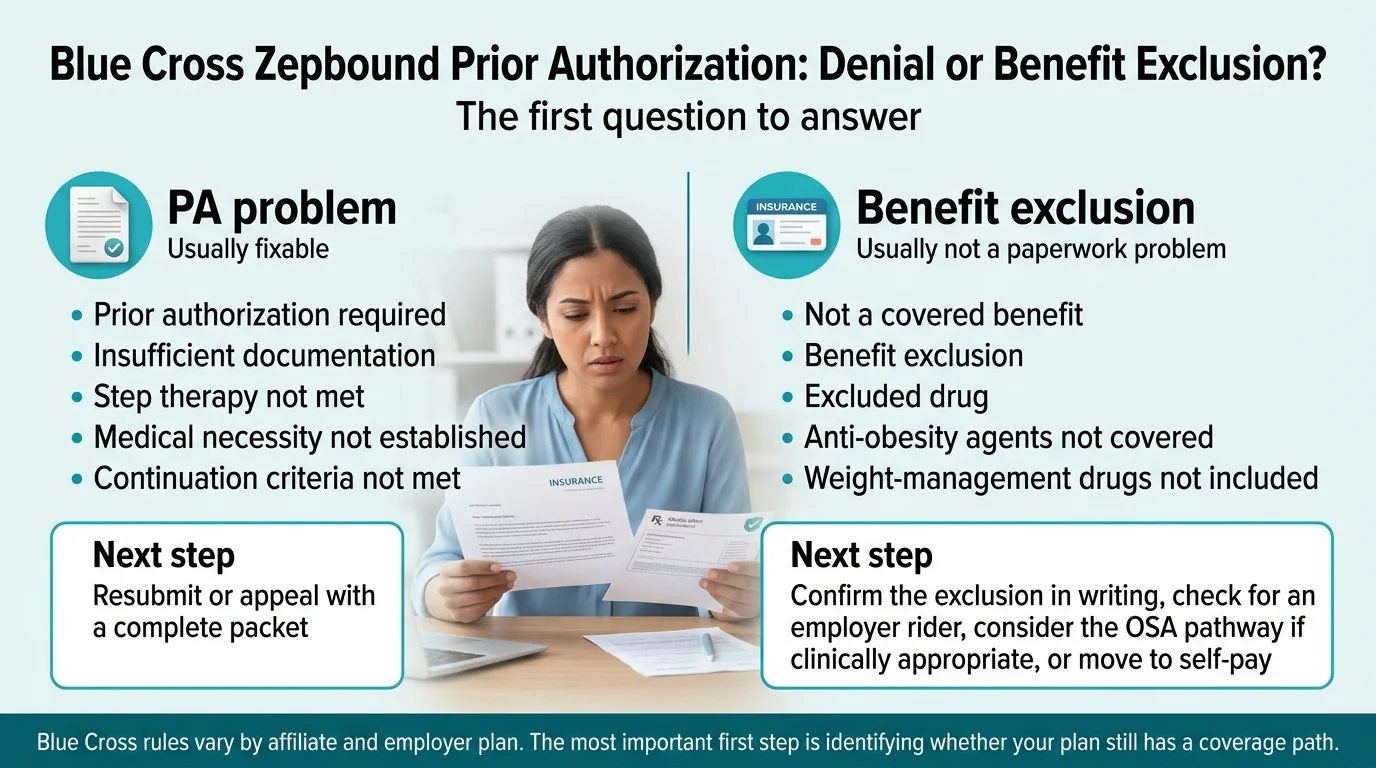
- PA problem: “Insufficient documentation,” “step therapy not met,” or “continuation criteria not met.” Ask your prescriber to address the specific missing evidence or request review.
- Drug formulary exclusion: “Excluded drug,” “managed-not-covered,” or absent from the formulary. Ask whether a formulary exception exists. FEP Standard, Basic, and Focus publish exception processes; applicable PA criteria still apply after an approved exception.
- Category benefit exclusion: “Weight-management medications are not a covered benefit.” Ask for the governing plan provision, employer rider options, and the denial’s review rights. BCBS Massachusetts’ April 21, 2026 checked FAQ says its affected 2026 exclusions cannot be appealed; that is not a universal rule for every excluded drug or Blue plan.
A “PA” tag on a published list does not establish your employer plan’s benefit. Confirm your exact option with the pharmacy-benefits number on your card, using the phone script below.
Ro offers an optional free coverage report. The report is separate from paid member care and PA support; it does not submit treatment requests, prescribe, or guarantee coverage.
Run Ro’s free GLP-1 Coverage Check → (sponsored affiliate link, opens in a new tab)What your prescriber should submit
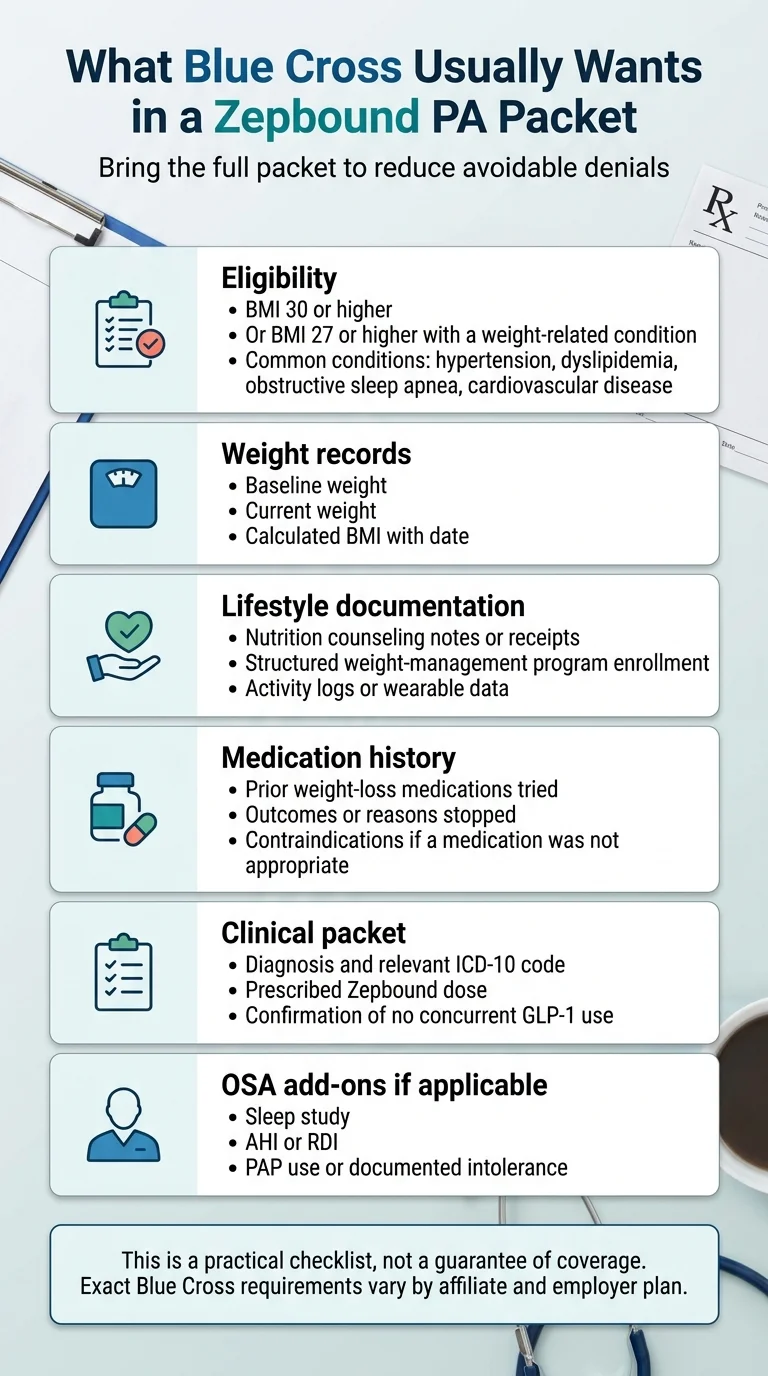
Answer capsule: Across current Blue Cross plan documents, the recurring asks are consistent: a qualifying BMI, baseline and current weight, 3 to 6 months of documented lifestyle effort, proof you’re not combining Zepbound with another GLP-1, and sometimes a trial of cheaper weight-loss medications. The OSA pathway adds a sleep study and PAP-related records.
BMI and comorbidity
The standard criteria, mirrored from FDA labeling and Eli Lilly’s published Zepbound PA Resource Guide:
- •BMI ≥30 kg/m² (obesity) is a clinical weight-management indication.
- •BMI ≥27 to <30 kg/m² (overweight) is a clinical indication with at least one weight-related comorbidity: type 2 diabetes, hypertension, dyslipidemia (high cholesterol), obstructive sleep apnea, or established cardiovascular disease.
FDA-labeled eligibility is not an insurance determination. A plan may have different PA thresholds or may exclude the benefit entirely.
Bring the ICD-10 codes to the appointment:
| ICD-10 code | Diagnosis |
|---|---|
| E66.01 | Morbid (severe) obesity due to excess calories, BMI ≥40 |
| E66.811 / E66.812 / E66.813 | Obesity Class 1 / 2 / 3 |
| E66.9 | Obesity, unspecified |
| I10 | Essential hypertension |
| E11.9 | Type 2 diabetes mellitus without complications |
| E78.5 | Hyperlipidemia, unspecified |
| G47.33 | Obstructive sleep apnea (adult) |
A denial citing “BMI not documented” usually means the chart has your weight and height but the PA coordinator didn’t explicitly calculate and state the BMI in the submission. Fixable with one corrected note.
Baseline weight, current weight, and real numbers
Most Blue plans want a baseline weight from before Zepbound and a current weight on the form. Missing baseline weight can prevent the reviewer from assessing treatment response. Get your full weight history to the submitting office.
Lifestyle modification proof (3 to 6 months)
What Blue plans actually want — not a checkbox:
- •Recurring nutrition counseling or medical nutrition therapy appointments (notes or receipts)
- •Participation in a structured weight-management program (employer-based, hospital-based, or commercial like Noom, WW, or Teladoc)
- •Wearable device summary reports (for example, 20+ minutes elevated heart rate, at least 3 times a week, for ≥1 month)
- •Patient food and exercise logs signed off by your provider
Highmark’s current Zepbound PA form makes the burden explicit: one document from the diet category and one from the physical activity category are required. These are Highmark-specific examples, not a rule for every Blue plan. Use the evidence categories and duration in your own plan’s applicable form.
No concurrent GLP-1 use
The reviewed PA forms ask for confirmation you aren’t currently taking another GLP-1 (Wegovy, Ozempic, Mounjaro, Saxenda, Rybelsus) while starting Zepbound. This is both a safety rule and a coverage rule.
What a clean PA packet looks like
- •Demographics, recent height, baseline and current weight, calculated BMI with dates
- •Applicable diagnosis and comorbidities, with ICD-10 codes documented by your clinician
- •Lifestyle-program records for the duration and evidence categories your plan requires
- •Prior weight-loss medication history with dates, doses, outcomes, and reasons stopped (or contraindications)
- •Current plan form, prescriber rationale, signature, and submission contact details
- •Prescribed Zepbound dose and FDA-approved indication (weight management or OSA)
- •Attestation of no concurrent GLP-1 use
For OSA, add the sleep-study and PAP-related records specified in the OSA section. For renewal, add treatment-response and continuation records from the renewal section. The prescriber submits the request; a patient checklist does not guarantee approval.
If this is too much for your doctor’s office to wrangle → Ro’s insurance concierge assembles the packet, submits it, and tracks the decision. Ro Body membership is $39 for the first month, then as low as $74/month with an annual plan paid upfront.
Let Ro handle the PA paperwork → (sponsored affiliate link, opens in a new tab)How long review can take
There is no universal Blue Cross PA timeline. Blue Shield of California’s member Drug Prior Authorizations page, checked April 16, 2026, describes a typical 24–72 hour drug PA review window once submitted. This example is not a deadline for another affiliate or a promise of approval.
Benefits verification and record-gathering occur before plan review; prescription fulfillment happens afterwards. Ro’s Weight Loss Program and Insurance workflow, checked April 16, 2026, describes two to three weeks end to end. That is provider-stated service timing, not the insurer’s review clock.
Ask the pharmacy-benefits team to confirm receipt, whether the request is complete, when its clock starts, and the applicable standard or expedited deadline. Follow up against that deadline and keep the reference number. Your prescriber should determine whether clinical urgency supports expedited review; do not automatically resubmit on a fixed day.
Preferred-product or step-therapy denial
A plan may prefer another product or require prior treatment trials. Ask for the exact preferred-product list and criteria that apply to your option. Have your prescriber document medications tried, dates, doses, outcomes, intolerance, or contraindications. A clinical rationale may support an exception request; it does not automatically satisfy step therapy or guarantee approval.
FEP requires two separate questions: is a formulary exception available for your excluded or managed-not-covered drug, and which PA criteria apply if it is approved? The July 1, 2026 Zepbound PA policy, rechecked October 1, 2026, includes chronic weight-management requirements concerning two oral anti-obesity medications. Your prescriber must assess the applicable trial, inadequate-response, intolerance, or contraindication evidence. Meeting a PA checklist alone does not override exclusion.
Use the FEP documents in the matrix and ask the pharmacy-benefits team for the exception and PA forms rather than relying on an older preferred-product list.
Why Blue Cross Zepbound Renewals Get Denied
Answer capsule: Renewals fail for a different reason than first approvals. The reviewed policies ask for treatment-response evidence and continued program participation. Some use a 5% weight-loss threshold, but the measurement period and continuation requirements are plan-specific. First confirm the benefit remains available and obtain your own continuation criteria.
The 5% rule
This is a published example, not a universal Blue Cross gate. BCBS Massachusetts’ commercial medical policy requires maintaining 5% weight loss from baseline. FEP Blue’s 2026 policy uses the same 5% gate for the applicable weight-management continuation path. An FEP formulary exception and applicable PA are separate requirements. BCBS Michigan’s standard path also uses 5%. This is why missing baseline weight breaks renewals. Without it, there’s nothing to measure 5% against.
The common renewal traps
- •No baseline weight in the chart. Ask the original prescribing office for dated records if you changed clinicians.
- •Inconsistent weighing conditions. Morning vs evening, clothed vs unclothed, before vs after a meal — small variances push you above or below the cutoff. Weigh consistently (morning, empty bladder, same clothing) through the initial approval period.
- •Refill gaps. Document refill gaps and their reasons so your prescriber can address any plan-specific adherence requirement.
- •Program participation lapsed. If your plan required enrollment in Teladoc’s weight management program, Noom, or a similar structure, lapsing mid-cycle can sink the renewal even if your weight loss is fine.
- •Dose not at maintenance. Some plans require a maintenance dose (5 mg, 10 mg, or 15 mg per FDA labeling) at renewal review.
If you’re close but not at 5%
If you’ve lost 3 to 4% at renewal, don’t panic. Have your prescriber include:
- •Improvement in comorbid markers (blood pressure, A1C, lipid panel, sleep apnea AHI)
- •Functional improvements (reduced joint pain, improved mobility, better sleep quality)
- •Attestation that you are continuing to lose weight (trajectory matters, not just the renewal-day number)
- •A Letter of Medical Necessity arguing clinical benefit beyond scale weight
Additional clinical benefits may support your prescriber’s review request, but they do not necessarily replace an explicit continuation threshold.
Your renewal packet checklist
- •Baseline weight with date (from start of Zepbound)
- •Current weight with date
- •Weight trajectory (chart or list of weights through the approval period)
- •Continued lifestyle program evidence (nutrition appointments, program enrollment, wearable data)
- •Current Zepbound dose and refill history
- •Letter of Medical Necessity if you’re under 5%
Does Sleep Apnea Make Blue Cross Zepbound Approval Easier?
Answer capsule: Sometimes, but not automatically. Zepbound was FDA-approved in December 2024 for moderate-to-severe obstructive sleep apnea in adults with obesity — a separate indication from weight management. Some Blue plans that cover the OSA indication still cover it even when weight-loss use is tightened. Others treat Zepbound as an anti-obesity agent and exclude it for every indication.
What the OSA pathway asks for
- •A formal OSA diagnosis with AHI (apnea-hypopnea index) ≥15 events per hour on either polysomnography or a home sleep apnea test
- •BMI ≥30 (FDA label criterion for the OSA indication)
- •PAP (positive airway pressure) trial or adherence records where required by the applicable plan; use its exact duration and usage criteria
- •OR documented intolerance or clinical failure of PAP therapy
- •Often: sleep specialist involvement
- •ICD-10 code G47.33 on the form
When this pathway works
- •Your plan covers Zepbound for OSA under its own criteria
- •You actually have moderate-to-severe OSA (AHI ≥15)
- •You’ve either done PAP or have a documented reason you can’t
When it does not work
- •Your plan excludes "anti-obesity agents" globally. BCBS Massachusetts’ Focused formulary and several 2026 formularies classify Zepbound as an anti-obesity agent and exclude it for every indication, including OSA.
- •South Carolina Blues excluded plans. South Carolina Blues states plainly that if a plan does not cover weight-loss medications, Zepbound will not be covered regardless of sleep apnea or cardiovascular disease.
- •IBX Select/Value members. Coverage of Zepbound for OSA ended for new prescriptions May 1, 2025 and for existing members at renewal or by August 1, 2025.
- •Your AHI is below 15. Mild OSA (5 to 14 events/hour) generally doesn’t qualify for the Zepbound OSA indication.
Your prescriber should confirm the diagnosis and whether Zepbound is clinically appropriate; this is not a self-diagnosis or coverage workaround. Confirm the OSA benefit and applicable criteria separately. If both indications are excluded, ask about any exception or review rights before considering the alternatives below.
How to Decode Your Blue Cross Zepbound Denial Letter
Answer capsule: Use the full written denial to identify the reason, governing criteria, and review rights. The table suggests evidence to discuss with your prescriber, not evidence guaranteed to overturn a denial.
Request the full written denial letter. Not the verbal summary from the rep. Not the portal notification. The full letter contains your specific appeal deadline (which varies by plan) and the precise reason — both required to craft the response.
The Blue Cross Zepbound Denial Decoder
| Language on your denial letter | What it usually means | What to send next |
|---|---|---|
| “Prior authorization is required” (notice, not a denial) | Clinical criteria haven’t been reviewed yet. Your doctor hasn’t submitted the PA, or it’s still in queue. | Your prescriber submits the PA with plan criteria, diagnosis, BMI, and documentation. |
| “Lack of clinical information” / “insufficient documentation” | The plan says required clinical evidence was missing or insufficient. | Chart notes with BMI calculation, 3 to 6 month lifestyle program proof, prior medication history, comorbidity documentation with ICD-10 codes. Resubmit. |
| “No evidence of lifestyle modification” / “comprehensive weight-management program not documented” | The insurer wants receipts. Literally — nutrition counseling notes, program enrollment, activity logs. | Nutrition counseling appointment records, wearable data export, weight-loss program enrollment confirmation, provider-signed food/exercise logs. |
| “Step therapy requirement not met” | Your plan wanted you to try another weight-loss medication first. | Submit prior medication history with dates, doses, duration, outcomes, and reasons stopped. Your prescriber can document a contraindication and request an exception if available; approval is not automatic. |
| “Continuation criteria not met” (renewal denial) | The applicable continuation threshold or treatment evidence was not met, or baseline/current weight is missing or inconsistent. Not all plans use the same threshold. | Baseline weight, current weight, weight trajectory chart, continued program participation evidence, Letter of Medical Necessity if under 5%. |
| “Drug excluded” / “managed-not-covered” | Zepbound is excluded from the drug formulary. This is not necessarily a category benefit exclusion. | Ask about the drug formulary exception process and applicable PA. FEP publishes exception-plus-PA rules; your prescriber assesses and documents the request. |
| “Weight-management medications are not a covered benefit under this plan” | Not a paperwork problem. Your plan’s benefit design does not cover this drug category. | Request the plan provision, employer rider information, and any available review rights. Read the exclusion options below; do not assume all appeals are impossible. |
Appeals levels and timelines
Your denial letter contains your exact appeal deadline. Follow that deadline, not a generic rule. Available review stages, submission methods, and expedited procedures vary by plan and jurisdiction. Keep copies and submission confirmations.
- •Internal appeal (Level 1). You or your doctor files a written appeal with BCBS. This is where a Letter of Medical Necessity from your prescriber does the heavy lifting. Eli Lilly publishes a template for providers to use.
- •Further internal review / peer-to-peer, if available. Ask whether your plan allows another review or a prescriber discussion with its medical reviewer, and whether that discussion changes any appeal deadline.
- •External review, if eligible. Follow the instructions in your denial and plan documents. The applicable process depends on plan type; ask the plan or appropriate regulator which external review rights apply.
What a strong Letter of Medical Necessity contains
- •Patient demographics, height, weight, BMI, and comorbidity diagnoses
- •The specific FDA-approved indication (weight management or OSA)
- •Documented failure of conservative measures (diet, exercise, prior medications)
- •Clinical rationale specifically for Zepbound over alternatives — the SURMOUNT-5 head-to-head trial (NEJM 2025) found Zepbound produced 20.2% body weight reduction vs Wegovy’s 13.7% at 72 weeks
- •Reference to FDA prescribing information
- •Provider signature, NPI, and contact
The procedural trap to avoid
If you got a letter saying your plan is ending GLP-1 coverage on your renewal date (common for BCBS MA, BCBS VT, and others in 2026), distinguish a general benefit-change notice from an individual coverage denial. Ask the plan which review process applies and discuss any request with your prescriber. Do not assume that submitting a PA will override a contract exclusion.
If your denial is a documentation problem, Ro’s insurance concierge handles resubmissions, appeals, peer-to-peer requests, and Letter of Medical Necessity coordination as part of Ro Body membership. Ro Body is $39 for the first month, then as low as $74/month on an annual plan.
Start Ro’s free coverage check first → (sponsored affiliate link, opens in a new tab)If the category benefit is excluded
Answer capsule: If your Blue Cross plan excluded GLP-1s for weight loss as a benefit, clinical documentation alone may not change the contract. Confirm the exclusion and available review rights rather than assuming appeals are impossible. Alternatives to discuss include: check for an employer rider, escalate through HR, pursue the OSA pathway if clinically appropriate, or pivot to cash-pay Zepbound starting at $299 a month through verified direct channels.
1. Confirm the exclusion in writing
Call member services. Ask:
- •“Is Zepbound a benefit exclusion on my specific plan, or is it covered with prior authorization?”
- •“If it’s excluded, is this for weight management only, or for all indications including obstructive sleep apnea?”
- •“Is there any pathway — formulary exception, rider, or otherwise — that would allow coverage?”
Get the rep’s name and the call reference number. Insurance reps make mistakes.
2. Check for an employer rider
For plans like BCBS Massachusetts, employers with 100+ members could purchase a GLP-1 rider to continue weight-loss coverage. Ask HR:
- •“Did we purchase a rider for GLP-1 weight-loss medication coverage for 2026?”
- •“If yes, what are the specific criteria to access that coverage?”
- •“If no, is there an alternative plan in our benefits lineup that still covers GLP-1s for weight management?”
3. Pursue the OSA pathway if clinically appropriate
See the OSA section above. Some plans cover the OSA indication even when weight-loss use is tightened. Not BCBS Massachusetts, not IBX Select/Value, not South Carolina Blues excluded plans — but many others. If you genuinely have OSA with AHI ≥15 and meet the other criteria, this is a real door.
4. Pivot to verified cash-pay Zepbound
Zepbound self-pay pricing recorded in the keeper’s April 21, 2026 source check is shown below, not newly verified in this merger. The source described all six doses as 1 KwikPen or 4 single-dose vials through LillyDirect and other direct-pay channels:
| Zepbound dose | Self-pay price (KwikPen or 4 vials) |
|---|---|
| 2.5 mg | $299/month |
| 5 mg | $399/month |
| 7.5 mg, 10 mg, 12.5 mg, 15 mg | $449/month |
Lilly’s current savings program terms expire December 31, 2026 — verify on the date of purchase.
Ro advertises Zepbound KwikPen cash-pay at the same $299 / $399 / $449 tiers, with a 45-day refill window for the discounted higher-dose refills. Ro Body membership is separate from medication cost: $39 the first month, then as low as $74/month with an annual plan paid upfront, or $149/month on monthly billing.
The Zepbound Savings Card — a separate single-dose pen program. Eli Lilly’s savings card brings eligible commercial-insurance patients to as low as $25/month for the single-dose pen when commercial insurance actually covers the single-dose pen. If commercial insurance does not cover the pen, the savings card brings a 1-month pen fill to as low as $499. Don’t confuse this with the $299/$399/$449 KwikPen and vial cash-pay pricing above — those are separate tracks.
TrumpRx.gov. Launched February 2026 per the White House fact sheet. The site lists Zepbound starting at $299/month; the administration says the average out-of-pocket price is about $346/month. No prior authorization, no step therapy, no insurance required.
HSA/FSA. Zepbound prescribed for obesity or overweight with comorbidity is an HSA/FSA-eligible expense under IRS Publication 502. Using pre-tax dollars effectively lowers the net cost by your marginal tax rate.
5. Compare the total cost before changing paths
Confirm any exception and review rights before abandoning a coverage request. Direct manufacturer self-pay and paid telehealth care are different services: a prescription is still required, medication and membership costs must be counted separately, and the lowest quoted dose price may not be your maintenance-dose price.
See verified cash-pay Zepbound options → Ro advertises Zepbound KwikPen cash-pay starting at $299/month matching LillyDirect tiers, with insurance concierge support retained if you ever want to retry coverage later.
See verified cash-pay Zepbound options → (sponsored affiliate link, opens in a new tab)PA support: who fits and who does not
Answer capsule: If your BCBS plan still has a Zepbound pathway, the next step is to confirm the applicable benefit and forms with your plan. Ro is an optional provider for this search because its free GLP-1 Insurance Coverage Checker calls your insurer directly, and paid members can receive insurance-concierge support. Sesame is a secondary option with some caveats.
Ro — the primary recommendation for Blue Cross Zepbound PA work
Ro may fit commercial-insurance members seeking a prescribing relationship and PA support. You can also call the pharmacy-benefits number on your card and work with your regular prescriber without purchasing a telehealth membership.
- •Free GLP-1 Insurance Coverage Checker. Ro's public page says it contacts insurance and provides a coverage report. The checker supports Wegovy, Ozempic, and Zepbound autoinjector pens, not the Wegovy pill, Foundayo pill, or Zepbound KwikPen. A free report does not submit a treatment request or write a prescription.
- •Insurance concierge. Ro publicly describes benefits verification and PA submission support for eligible paid members. This is a provider-stated service, not proof that your Blue Cross request will be approved. Its April 16, 2026 checked end-to-end service timeline is discussed separately above.
- •Transparent cash-pay backup. If coverage fails or your plan excluded GLP-1s, Ro advertises the Zepbound KwikPen cash-pay path at LillyDirect-matched tiers ($299 / $399 / $449 depending on dose).
- •Ro carries Zepbound and Foundayo (orforglipron). Two FDA-approved Lilly GLP-1s in one account. If Zepbound doesn’t work for you clinically, there’s a path to Foundayo (the once-daily pill) inside the same membership.
Provider-stated versus verified
We checked public provider materials, not a patient’s insurance submission. The merged April 16, 2026 source review documented Ro’s member concierge, end-to-end workflow, and FEHB support; the keeper’s broader provider review was April 21, 2026. The merger evidence narrowly reconfirmed the checker’s supported forms and its separation from paid care, and the membership pricing page. Those checks do not freshly verify every provider statement or an individual plan’s eligibility.
Ro pricing (verified April 21, 2026): Ro Body membership is $39 for the first month, then as low as $74/month with an annual plan paid upfront, or $149/month on monthly billing. Medication cost is separate.
Ro does not bill this membership to Blue Cross. If you already have a prescriber and only need self-pay medication, compare the direct LillyDirect route against membership plus medication. Direct purchase still requires a prescription. Check ongoing billing and cancellation terms before enrolling.
The honest caveat about Ro
Ro does NOT make a benefit exclusion disappear. If your Blue Cross plan excluded GLP-1s for weight loss (BCBS MA Standard/Control, IBX fully-insured, BCBS VT 2026, BCBS Michigan fully-insured large group), Ro’s insurance concierge can verify the exclusion but cannot force coverage. No telehealth provider can.
Ro also doesn’t coordinate coverage for most government plans like Medicare and Medicaid — though FEHB/FEP members can use the insurance concierge. Ro has mixed public reviews including complaints about ongoing monthly fees and cancellation experience. Build that into your math before signing up.
“[Ro] has been invaluable. Initially, my insurance company covered Wegovy, and I was able to get a prescription and a prior authorization. During the Wegovy shortages, we waited — and waited — for it to come back in stock. While I was waiting, I saw that Ro had started offering Zepbound and contacted my care team. They immediately switched my prescription to Zepbound. I had a phone call with one of the physicians, who explained the difference between Zepbound and Wegovy. We decided to move forward with Zepbound, and the team at Ro jumped into action and got the prior authorizations completed through my insurance. I reached out directly to my pharmacy, and it was fast. All of that happened within about a week of contacting Ro and asking about switching my prescription.”
Ready to find out your actual Blue Cross Zepbound coverage?
Free personalized coverage report pulled directly from your insurer.
Run Ro’s free GLP-1 Insurance Coverage Checker → (sponsored affiliate link, opens in a new tab)These existing provider links are optional starting points for Ro’s care or self-pay information. Confirm the medication form, total cost, and plan rules directly. Neither link is a coverage determination.
Check my Blue Cross Zepbound coverage free → (sponsored affiliate link, opens in a new tab)See verified cash-pay Zepbound options → (sponsored affiliate link, opens in a new tab)Sesame Care — the secondary option
Sesame is worth knowing about as a second provider option for FDA-approved medication, especially if you want a marketplace model instead of a membership model. Sesame offers brand-name Wegovy and Zepbound through its network of clinicians.
The honest caveat: Sesame’s public messaging on prior authorization support is inconsistent. Some medication-specific pages say providers can assist with PA paperwork; the broader Sesame FAQ says providers cannot complete prior authorizations. If PA work is your main need, Ro’s workflow is more reliably built for it. Sesame accepts HSA/FSA payment at checkout, which Ro does not — so if you want to pay with pre-tax dollars, Sesame has an edge.
If Sesame fits better for your situation → see Zepbound availability through their provider network.
See Zepbound on Sesame Care → (sponsored affiliate link, opens in a new tab)When your regular doctor is the better call
Use your regular PCP or an in-network obesity medicine clinic when your office visits are already billed through your Blue Cross plan, you already have a clinician willing and equipped to submit a strong PA packet, or you’re on Medicare, Medicaid, or a government plan that Ro doesn’t coordinate. A good PCP with a dedicated PA coordinator is often the best path if your office already has a workflow for GLP-1 PAs.
What to Say When You Call Blue Cross
Answer capsule: Calling member services with the right questions gets you a record of the applicable rules. Write down the rep’s name and the call reference number, and ask the questions below to map out your coverage pathway.
The 5-minute Blue Cross Zepbound phone script
Call the pharmacy-benefits number on the back of your BCBS card. Introduce yourself, then run through these:
- 1.“Is Zepbound — Z-E-P-B-O-U-N-D, generic name tirzepatide — covered on my plan’s formulary?”
- 2.“What tier is Zepbound on, and what is my copay or coinsurance for that tier?”
- 3.“Does Zepbound require prior authorization on my plan?”
- 4.“If Zepbound is excluded, is that a drug formulary exclusion with an exception process, or an excluded category benefit? If an exception is approved, what PA requirements still apply?”
- 5.“Does my plan require step therapy — meaning I have to try other medications first? If yes, which ones?”
- 6.“Is Zepbound covered for weight management, obstructive sleep apnea, or both indications?”
- 7.“Has my employer purchased a rider or exception that affects GLP-1 coverage on my plan?”
- 8.“If my doctor submits a PA today, what’s your typical decision timeline?”
- 9.“Can you send me the PA criteria document in writing, so my doctor’s office has the exact requirements?”
Before you hang up, ask for:
- •The rep’s first name
- •The call reference number
- •Their best estimate of what documentation your doctor’s office will need to include in the PA
What to do with the answers
- •If rep says “covered with PA” → proceed to the PA criteria section and build the packet.
- •If rep confirms a category benefit exclusion → ask about any rider and review rights, then proceed to the exclusion section.
- •If the drug is excluded from the formulary, ask for the exception process and applicable PA form. See the three-way distinction; do not treat this as an automatic category exclusion.
- •If rep says “it depends on your specific plan” and won’t give a definitive answer → escalate to a case manager or run Ro’s free coverage check to get a written answer.
What We Actually Verified
This is the section most pages skip. We keep it visible to show our work.
FEP documents rechecked October 1, 2026:
Standard excluded-drug list, Basic managed-not-covered list, Focus formulary effective October 1, 2026, Focus exception instructions, and Zepbound PA criteria effective July 1, 2026 (reviewed June 11). The exact documents are linked in the matrix. These checks confirm a separate exception-plus-PA process, not routine coverage.
Other keeper source checks retained from April 21, 2026:
- •BCBS Michigan / BCN 2025 coverage change for fully-insured large groups and some self-funded groups (providerinfo.bcbsm.com, bcbsm.com)
- •Highmark BCBS Zepbound PA form, including diet and activity category documentation rules and OSA evidence requirements (providers.highmark.com)
- •BCBS Massachusetts medical policy 572 clinical criteria and the 2026 benefit exclusion language stating coverage cannot be appealed without an employer rider (provider.bluecrossma.com, bluecrossma.org)
- •BCBS Massachusetts 2024 GLP-1 spending data: nearly 20% of pharmacy spend, more than $300 million (BCBSMA provider fact sheet)
- •Independence Blue Cross January 2025 weight-loss GLP-1 exclusion for fully-insured commercial members, and May 2025 OSA coverage end on Select/Value formularies (provcomm.ibx.com)
- •Blue Cross Vermont November 2025 provider newsletter announcing January 2026 exclusion of FDA-approved weight-loss GLP-1s (bluecrossvt.org)
- •BCBS North Dakota April 2026 restricted use list flagging Zepbound as CE/PA with benefit exclusion language (bcbsnd.com)
- •South Carolina Blues GLP-1 utilization management notice: if a plan does not cover weight-loss medications, Zepbound not covered for OSA or CVD (southcarolinablues.com)
- •Blue Shield of California weight-loss drug exclusion fact sheet for commercial PPO/HMO/IFP/small business members (blueshieldca.com)
- •BCBS Texas Medicaid (STAR/CHIP) Zepbound PA fax form (bcbstx.com)
- •Anthem California Medi-Cal 2026 GLP-1 coverage document (providers.anthem.com)
- •FDA approval of Zepbound for moderate-to-severe obstructive sleep apnea in adults with obesity, December 2024 (fda.gov)
- •Eli Lilly current self-pay Zepbound pricing: $299/month (2.5 mg), $399/month (5 mg), $449/month (7.5–15 mg), available as KwikPen or 4 single-dose vials, savings program terms expiring December 31, 2026 (zepbound.lilly.com/savings)
- •Eli Lilly Zepbound Savings Card logic: as low as $25/month when commercial insurance covers the single-dose pen; as low as $499 for a 1-month pen fill when commercial insurance does not cover the pen (zepbound.lilly.com/savings)
- •White House fact sheet on TrumpRx.gov February 2026 launch: Zepbound starting at $299/month, average out-of-pocket approximately $346/month (whitehouse.gov)
- •Ro current pricing ($39 first month, $149/month ongoing, $74/month with annual prepay), free GLP-1 Insurance Coverage Checker, insurance concierge for members, KwikPen cash-pay at $299/$399/$449 with 45-day refill window (ro.co)
- •SURMOUNT-5 head-to-head trial: Zepbound 20.2% vs Wegovy 13.7% body weight reduction at 72 weeks (New England Journal of Medicine, 2025)
Merged source checks retain April 16, 2026: BCBSIL pharmacy communications; Blue Shield California’s member drug PA review timing; and Ro’s end-to-end workflow and FEHB/member-concierge statements. This merger does not freshly verify those policies. The bundle’s narrow Ro checker and pricing checks are described in the provider section, separately from the original provider review.
What this page does not claim:
We are not your prescriber. We do not recommend medications. We are not an insurance broker. We do not file prior authorizations on your behalf. We do not provide medical advice. We do not have visibility into your specific employer’s rider or benefit design. Blue Cross affiliate policies change frequently. Source-check dates are listed above and in the matrix; a merger or editorial date is not a new check of every policy or price.
We could not verify exhaustive state-by-state or employer-specific rules, rider availability at your workplace, or whether any individual PA would be approved. Ro’s paid, provider-published testimonial in the provider discussion was not independently verified and is not a typical-outcome claim.
The RX Index is a pricing intelligence and comparison resource for GLP-1 telehealth providers. We may earn a commission when readers start with Ro, Sesame Care, or other featured providers. This never affects our editorial conclusions. We excluded compounded tirzepatide providers from this page because Zepbound is an FDA-approved brand-name medication.
FAQ: Blue Cross Zepbound Prior Authorization
- Does Blue Cross always require prior authorization for Zepbound?
- No. Some Blue Cross plans require prior authorization, some exclude Zepbound for weight loss entirely as a benefit design, and others use different rules depending on affiliate, employer group, and indication. Check your specific plan's formulary or call member services before assuming PA is your only hurdle.
- Can I appeal a Blue Cross Zepbound denial?
- It depends on the denial reason and your plan's review rights. Missing documentation, step therapy, or medical-necessity denials may be addressed through a corrected request or appeal. A drug formulary exclusion may have a separate exception process, as FEP's documents describe. A category benefit exclusion is different: ask for the applicable plan provision, any employer rider, and the review rights in your written denial. Approval is not guaranteed.
- What BMI does Blue Cross require for Zepbound coverage?
- Several reviewed weight-management policies use BMI 30 or greater, or BMI 27 or greater with a weight-related comorbidity. Blue Shield of California uses BMI 40 or greater plus comprehensive program participation on affected plan types; BCBS Michigan has a separate employer group-benefit path requiring BMI 35 or greater. These are plan-specific examples, not proof of coverage. Confirm your benefit and applicable policy.
- How long does Blue Cross prior authorization take for Zepbound?
- There is no single Blue Cross review clock. Blue Shield of California's member drug PA page, checked April 16, 2026, describes a typical 24-72 hour review window once submitted. Ro's insurance workflow, checked April 16, 2026, describes two to three weeks for its end-to-end process, including benefits checks, submission, follow-up, and fulfillment. Neither is an approval guarantee or a deadline for every Blue plan. Ask your plan when its review clock starts and when to follow up.
- What documents help get a Blue Cross Zepbound PA approved?
- Use your plan's current form and denial requirements. A useful packet includes dated height, BMI, baseline and current weight, applicable diagnosis, required lifestyle-program records, prior medication history with outcomes, and prescriber rationale. For OSA, add the sleep study and any required PAP records; for renewal, add treatment-response and continuation evidence. Exact durations and thresholds vary by plan, and a complete packet does not guarantee coverage.
- Does Blue Cross cover Zepbound for sleep apnea?
- Some plans do, some do not. Zepbound was FDA-approved for moderate-to-severe obstructive sleep apnea in adults with obesity in December 2024. A prescriber must assess the diagnosis and clinical suitability, and the plan must cover the indication. The April 21, 2026 checked examples include affected BCBS Massachusetts exclusions for both indications, Independence Blue Cross's 2025 OSA coverage end on Select/Value formularies, and South Carolina Blues' statement that excluded weight-loss medications are not covered regardless of sleep apnea. OSA is not a guaranteed insurance bypass.
- Does FEP Blue cover Zepbound?
- The documents checked October 1, 2026 list Zepbound as excluded for Standard and managed-not-covered for Basic; it does not appear in the current Focus formulary. These options publish a formulary exception process. If an exception is approved, applicable prior-authorization criteria must also be met. A PA policy alone does not establish coverage. Ask your specific option's pharmacy-benefits team for the exception process and applicable PA form, and have your prescriber assess the request. Approval is not guaranteed.
- What if my doctor's office keeps sending incomplete paperwork?
- Ask your office whether a dedicated PA coordinator can handle the submission, bring the records requested in the denial to your appointment, and confirm which plan form is required. A provider such as Ro offers member PA support, but a free coverage report does not submit a treatment request or guarantee approval.
- If Blue Cross excludes Zepbound, what are my options?
- Four paths: check whether your employer purchased a GLP-1 rider to continue coverage, pursue the OSA indication if you have moderate-to-severe sleep apnea and your plan still covers that indication, switch plans during open enrollment if another carrier in your benefits lineup covers GLP-1s, or move to cash-pay. Zepbound starts at $299 per month through LillyDirect or Ro KwikPen, and TrumpRx.gov launched February 2026 with Zepbound starting at $299 per month.
- Can I use HSA or FSA money to pay for Zepbound if Blue Cross won't cover it?
- Yes. Under IRS Publication 502, prescribed Zepbound used to treat diagnosed obesity, overweight with comorbidity, or obstructive sleep apnea qualifies as an HSA/FSA-eligible medical expense. Keep the prescription, itemized receipt, and ideally a Letter of Medical Necessity tied to your diagnosis. Some providers accept HSA/FSA cards directly at checkout; others including Ro issue itemized receipts for reimbursement.
Related guides on The RX Index
- Best GLP-1 providers that accept insurance (2026) →
- GLP-1 providers that accept Blue Cross →
- Does Medicare cover Zepbound? The three pathways →
- The Medicare GLP-1 Bridge program explained →
- Wegovy pill vs Zepbound: real differences in 2026 →
- How to switch from compounded semaglutide to Zepbound →
- Is Zepbound HSA/FSA eligible? Provider comparison →
- Zepbound for Sleep Apnea: FDA Indication & Coverage →
- How to Appeal a Zepbound Denial: 7 Steps (2026) →
- Letter of Medical Necessity for GLP-1 →
- Aetna Wegovy Prior Authorization: 2026 Checklist & What If Denied →
- Blue Cross Wegovy Prior Authorization Guide →
Your Next Step
First confirm the benefit and review route with your plan, then ask your prescriber about the applicable request. If you want to compare provider models and costs, our quiz can help organize those choices.
Compare provider options
Take our free 60-second matching quiz to compare provider options by preferences and budget. It does not verify Blue Cross eligibility, check your formulary, determine clinical suitability, or promise PA approval.
Take the free 60-second GLP-1 matching quiz →By The RX Index Editorial Team · Last verified: April 21, 2026 · Created from primary Blue Cross plan documents, FDA labeling, manufacturer pricing releases, and verified telehealth provider pages. We do not add a “medically reviewed by” claim because no physician reviewed this editorial content.
Your situation changes the answer
Find My GLP-1 Path
The right GLP-1 provider isn't the same for everyone. It depends on whether you'll use insurance or pay cash, whether you want an FDA-approved or compounded medication, your preferred route (injection or oral), and your budget. Answer a few questions in The RX Index's Find My GLP-1 Path tool to see a suggested provider route and pricing to review before you choose. It does not check your plan's coverage or copay; confirm those in your insurer's member portal or with the pharmacy-benefits number on your card.
- What it asks: your goals, how you plan to pay, and your treatment preferences
- What you get: a suggested provider route and pricing information to review
- Cost: free · about 2 minutes · no signup