Does Medicaid Cover Foundayo? The Honest 2026 Answer
Published: · Last updated:
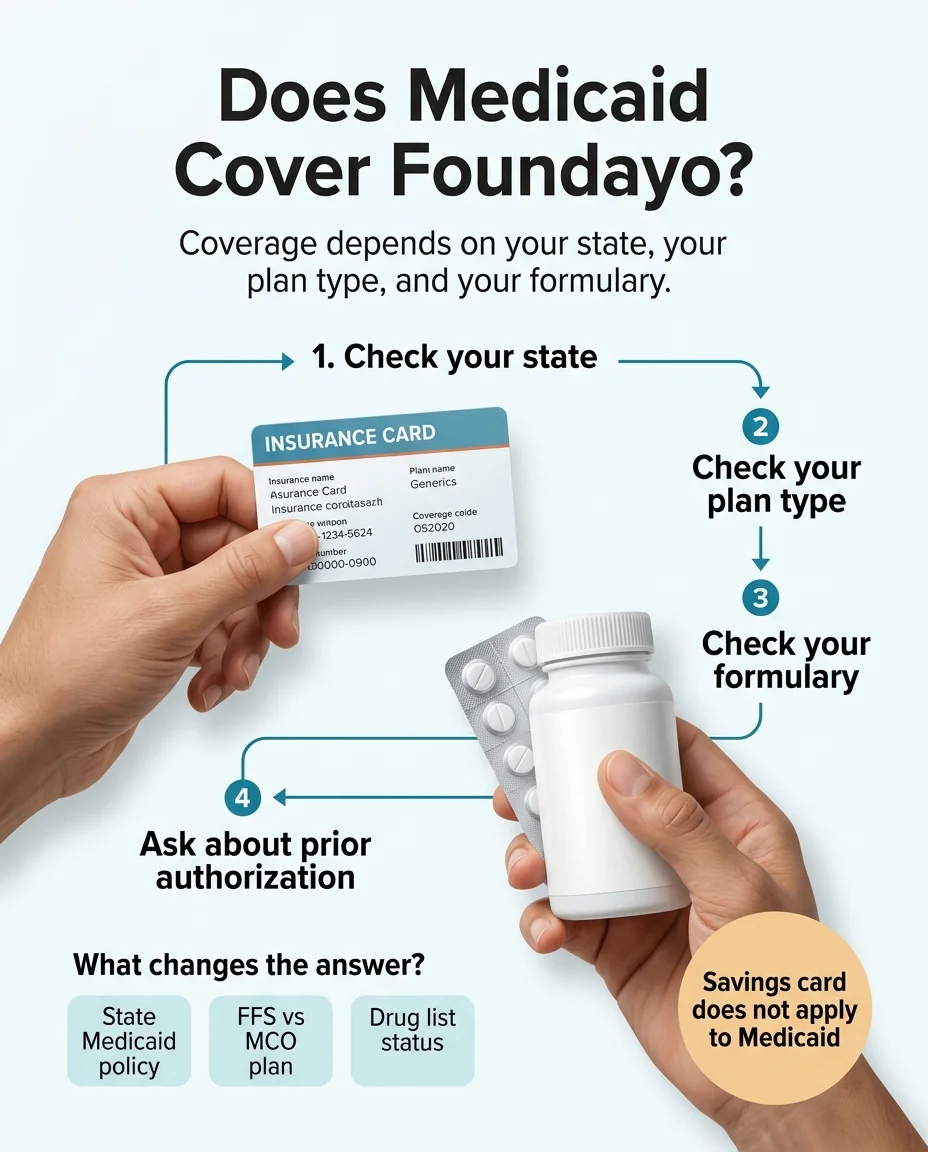
The short version
Foundayo (orforglipron) received FDA approval for chronic weight management on April 1, 2026. Federal law makes weight-loss drug coverage optional for state Medicaid programs, and only 13 state Medicaid fee-for-service programs covered any GLP-1 for obesity as of January 2026 (KFF). We manually pulled seven current 2026 state preferred drug lists and found zero listings for Foundayo — including two PDLs revised after Foundayo’s FDA approval. Two states show early review signals.
That’s going to change. The CMS BALANCE Model opens a voluntary Medicaid coverage pathway starting as early as May 2026. Medicare Part D enrollees get a separate pathway July 1, 2026 at $50/month that includes Foundayo. But “opening” and “scheduled” aren’t “covered.”
The one-screen verdict
| Question | Real answer |
|---|---|
| Does Medicaid cover Foundayo today in most states? | No. |
| How many state Medicaid programs cover any GLP-1 for obesity? | 13, per KFF (January 2026) |
| Is Foundayo on any public Medicaid drug list we checked? | Not in the 7 state PDLs we pulled. Publicly under review in Kansas and Mississippi. |
| Can you use the $25 Foundayo Savings Card with Medicaid? | No. The card excludes all government-plan enrollees by law. |
| When does this start to change? | May 2026 (Medicaid BALANCE Model opt-in window opens) |
| What’s my realistic next step? | Identify your plan type, check the right formulary, then use the call script below. |
For the separate retatrutide question, see does Medicaid cover retatrutide.
The straight answer: does Medicaid cover Foundayo?
Medicaid coverage for Foundayo depends on two things: the state you live in and the specific plan you’re enrolled in — because obesity-drug coverage is a category federal law lets state Medicaid programs exclude. As of April 20, 2026, Foundayo is not on the state Medicaid preferred drug lists we checked.
The answer isn’t “yes” or “no.” It’s “tell me your state and whether you’re on fee-for-service or a managed care organization, and I’ll tell you the actual next step.”
Is Foundayo on any Medicaid drug list yet?
No state Medicaid program has added Foundayo as a covered drug in any of the seven preferred drug lists we checked. We found two public review signals: Kansas lists Foundayo on its public “List of Drugs Under Review,” and Mississippi has Foundayo formally on its May 12, 2026 P&T committee agenda under “Antiobesity Select Agents.”
State PDLs distinguish between preferred (easier to approve), non-preferred (covered but requires PA), and not listed at all (non-formulary, usually requires an exception). Being on a PDL does not mean coverage is automatic.
The Foundayo Medicaid Launch Tracker (April 20, 2026)
| State | Source & date | Other obesity GLP-1s listed | Foundayo listed? | Editorial takeaway |
|---|---|---|---|---|
| North Carolina | NC Medicaid PDL, Apr 1 2026 (revised Apr 13) | Wegovy pen & tablet: preferred. Zepbound, Saxenda: non-preferred. | No | PDL revised after Foundayo approval, still omits it. Review lag, not rejection. |
| Kansas | KS PDL Apr 1 2026 + public “Drugs Under Review” page | Wegovy injection & tablet, Zepbound: preferred. Saxenda: non-preferred. | 🔍 Under Review | Clearest early review signal. Infrastructure exists; Foundayo is already in the public review queue. |
| Michigan | MI PDL effective Apr 1, 2026 | Wegovy, Zepbound: non-preferred. Coverage restricted to morbid obesity only (Jan 1, 2026). | No | Narrowed medical-necessity threshold makes Michigan tougher, not easier. |
| Minnesota | MN Uniform PDL effective Jan 1, 2026 | Saxenda, Wegovy in weight-management section. | No | Uniform PDL reduces FFS-vs-MCO ambiguity. Foundayo still not listed. |
| Tennessee | TennCare PDL effective Apr 1, 2026 | Wegovy injection, Zepbound autoinjector: preferred. Liraglutide, Saxenda: non-preferred. | No | Branded GLP-1s preferred; Foundayo not yet listed. |
| Delaware | DE PDL revised Apr 6, 2026 | Wegovy tablet, Zepbound KwikPen: non-preferred (obesity agents require PA). FFS-MCO split explicit in document. | No | PDL revised after Foundayo approval, still omits it. |
| Virginia | VA PDL effective Apr 1, 2026 | Wegovy, Zepbound in weight-management closed class. | No | Closed class — only listed agents are preferred. Foundayo absent. |
| Mississippi (P&T agenda) | MS P&T Committee agenda, May 12, 2026 | — | 📅 Scheduled for review | Real review step in the pipeline — not coverage, but the clearest near-term decision point. |
- Seven state PDLs, zero Foundayo listings — including two revised after FDA approval. This is review lag, not policy rejection.
- Kansas and Mississippi are the two public review signals to watch. These aren’t coverage decisions — they’re the “we see this drug and we’re looking at it” step.
- If your state already lists Wegovy tablet or Zepbound, the policy infrastructure for obesity GLP-1s is ready. The missing piece is a P&T vote.
Why the answer changes by state and plan type (FFS vs. MCO)
Two people on Medicaid in the same state can get different Foundayo answers because most states deliver Medicaid through a mix of fee-for-service (FFS) — the state pays pharmacy claims directly — and managed care organizations (MCOs) — private insurers contracted to manage benefits. MCOs frequently maintain their own formularies that can be stricter, looser, or just different from the state’s public PDL. Roughly 75% of Medicaid enrollees nationally are in MCOs.
How to tell which one you have in 30 seconds
- Private insurer logo (UnitedHealthcare, Molina, Centene/WellCare, Aetna Better Health, Anthem BCBS, etc.) + “Medicaid” → MCO
- State Medicaid seal only, no private insurer → fee-for-service
- Unsure → call member services: “Am I in fee-for-service Medicaid or a managed care plan, and who handles my pharmacy benefit?”
| Plan type | Where to check Foundayo coverage | Why it matters |
|---|---|---|
| Fee-for-service Medicaid | State Medicaid PDL + state PA criteria document | One public source; FFS PA criteria apply to FFS members only |
| Medicaid MCO | MCO’s own pharmacy formulary (on MCO’s site) + MCO pharmacy benefits help desk | MCO formulary can differ from state PDL; phone call is the fastest definitive answer |
Can your MCO cover Foundayo if the state FFS list doesn’t? Yes, in some cases. When a state’s Uniform PDL applies across MCOs (Minnesota is an example), MCO coverage matches FFS. But in most states, MCOs have some formulary discretion and can cover drugs not on the state’s FFS PDL — especially through non-formulary PA or formulary exception pathways.
Why Medicaid treats Foundayo differently from Ozempic
Under the federal Medicaid Drug Rebate Program, state Medicaid programs must cover nearly all FDA-approved drugs from participating manufacturers — but a short list of drug categories is allowed to be excluded, and “agents when used for weight loss” is one of them. Foundayo is FDA-approved only for chronic weight management, making coverage state-optional. Drugs like Ozempic are mandatory-coverage when prescribed for their FDA-approved diabetes indication.
| Drug | FDA-approved indication(s) | Medicaid coverage rule | Why |
|---|---|---|---|
| Foundayo (orforglipron) | Chronic weight management only | Optional for every indication | Weight-loss drugs are in the excludable category |
| Ozempic (semaglutide) | Type 2 diabetes; cardiovascular risk reduction in T2D adults with CVD | Mandatory for FDA-approved indications | Diabetes drugs are a required covered category |
| Wegovy (semaglutide) | Chronic weight management; cardiovascular risk reduction in obesity/overweight + CVD (since Mar 2024) | Optional for weight loss; Mandatory for CVD indication | CVD indication became mandatory in 2024 |
| Zepbound (tirzepatide) | Chronic weight management; moderate-to-severe OSA in obesity adults (since Dec 2024) | Optional for weight loss; Mandatory for OSA indication | OSA indication became mandatory in 2024 |
If you have CVD plus obesity, or moderate-to-severe OSA plus obesity: your prescriber has a mandatory-coverage pathway with a different drug (Wegovy or Zepbound respectively). We mention this because it might change which drug you and your doctor pursue first.
Can you use the Foundayo Savings Card with Medicaid?
This is written in plain language in the official Foundayo Coverage & Savings terms, and it’s one of the most frustrating parts of being on Medicaid in 2026. You see the “$25/month” figure in ads. You get excited. Then you read the fine print and realize the card was never available to you.
What this rules out (and what remains available):
✕ Not available on Medicaid
- Foundayo Savings Card ($25/month commercial)
- Foundayo Self-Pay Savings Card
- Ro Body membership
- Telehealth platforms that exclude Medicaid (most major ones)
✓ Still available
- Formulary exception through your prescriber
- LillyDirect self-pay cash price ($149–$349/month)
- BALANCE Model (when your state opts in)
- State fair hearing if coverage is denied
Will the BALANCE Model make Foundayo easier to get through Medicaid?
Eventually, yes — but not automatically and not immediately. CMS’s BALANCE Model allows state Medicaid agencies to opt in to negotiated GLP-1 coverage starting as early as May 2026, on a rolling opt-in window through December 2026. Participation is voluntary at three layers (manufacturer, state, and for Medicare, Part D plan sponsor), and CMS explicitly states coverage is not guaranteed for any individual enrollee.
The BALANCE Model timeline
| Date | What happens | Who it affects |
|---|---|---|
| December 23, 2025 | CMS announces the BALANCE Model | Signal event; no coverage yet |
| January 8, 2026 | Manufacturer applications and state Notices of Intent due to CMS | Behind-the-scenes setup |
| As early as May 2026 | First date state Medicaid agencies can opt into BALANCE | Medicaid enrollees in opt-in states |
| May–December 2026 | Rolling state Medicaid opt-in window | State-by-state |
| July 1, 2026 | Medicare GLP-1 Bridge launches — Foundayo at $50/month for eligible Part D enrollees (CMS FAQ) | Medicare Part D (not Medicaid) |
| December 31, 2027 | Medicare GLP-1 Bridge ends (extended 18 months; BALANCE not launching Medicare Part D 2027) | Transition to BALANCE Model for Medicare |
| January 1, 2027 | BALANCE Model launches for Medicare Part D plans | Medicare enrollees in participating Part D plans |
What BALANCE does NOT do:
- ✕ It doesn’t force any state to cover Foundayo. States that cut GLP-1 obesity coverage for budget reasons may or may not opt back in.
- ✕ It doesn’t guarantee individual coverage. Clinical criteria still apply in opt-in states.
- ✕ It doesn’t bypass prior authorization. Utilization management is explicitly part of the negotiated framework.
- ✕ It doesn’t automatically mean Foundayo specifically is covered. Only manufacturers that sign BALANCE agreements are included.
The practical signal to watch: your state Medicaid agency’s BALANCE opt-in announcement (typically issued as a pharmacy bulletin or a P&T committee decision).
How to check your own Medicaid plan in 10 minutes
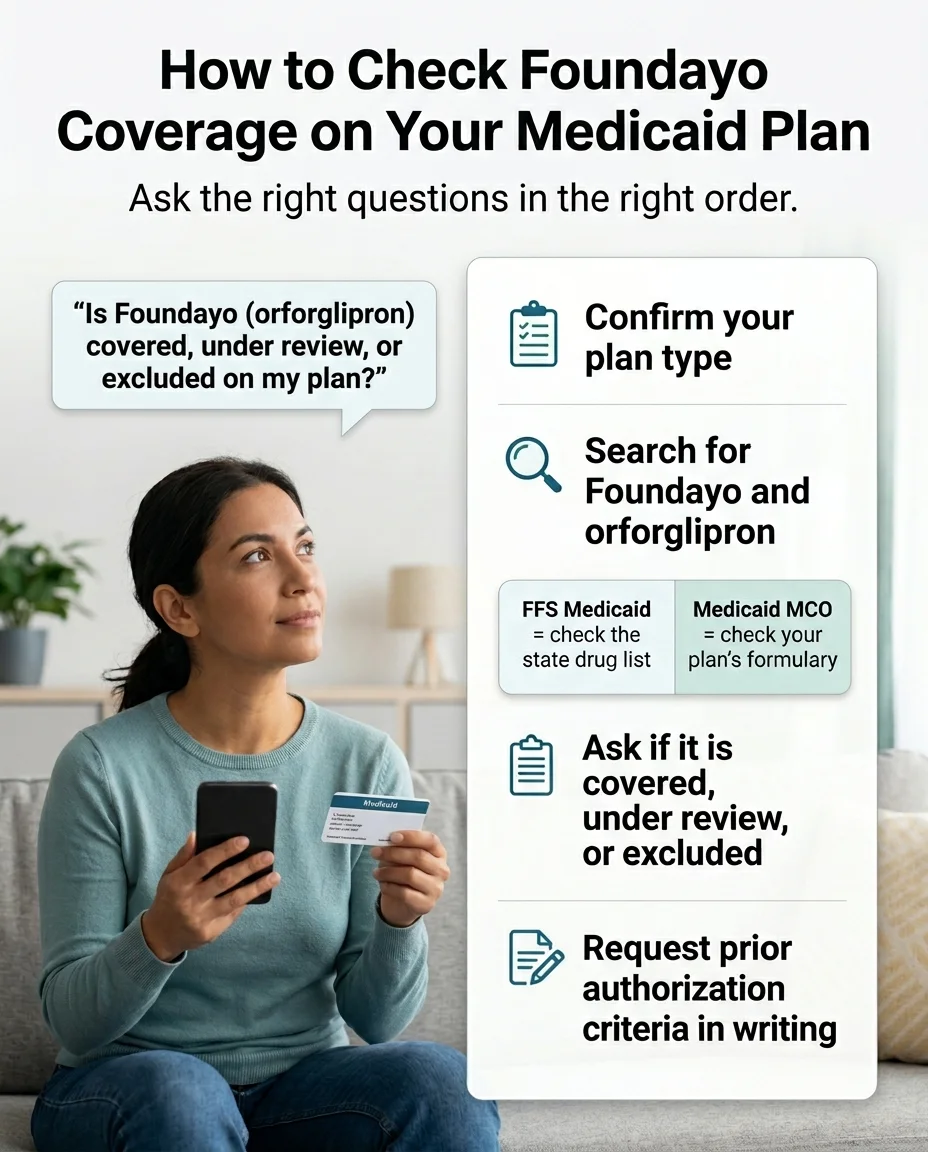
| Step | Action | Detail |
|---|---|---|
| 1 | Identify your plan type | Check your Medicaid card. Private insurer logo = MCO. State seal only = FFS. Unsure = call member services. |
| 2 | Open the right formulary | FFS: state Medicaid pharmacy program page, search “preferred drug list.” MCO: MCO member website, search “formulary” or call member services for the link. |
| 3 | Search for both names | Use Ctrl-F / Cmd-F to search for both Foundayo (brand) and orforglipron (generic). Some PDLs list only one. Searching both avoids false negatives. |
| 4 | Check related obesity GLP-1s | If Foundayo isn’t listed, check Wegovy tablet/injection, Zepbound, Saxenda. If any obesity GLP-1 is listed, a formulary exception for Foundayo has a fighting chance. If none are listed, the plan likely excludes weight-loss drugs entirely. |
| 5 | Call and use this script | Read verbatim: “Is Foundayo (orforglipron), FDA-approved April 1, 2026, covered for chronic weight management? If not, is it under P&T review? What is the prior-authorization criteria for obesity GLP-1 medications on my plan, and can you send me that in writing? My plan ID is [your number].” Get in writing before hanging up: (1) Covered, under review, or excluded. (2) Document name and date showing current status. (3) Whether a formulary exception is available if other obesity GLP-1s are covered. |
If Medicaid says no: the four meanings of “no”
A denial isn’t one thing — it’s four different things, and the right next step depends on which one you got. Before you appeal anything, get the denial reason in writing. This is your right under federal Medicaid rules.
| Denial type | What it usually means | Best next step | Worth appealing? |
|---|---|---|---|
| “Foundayo isn’t on our formulary” | New-to-market — P&T committee hasn’t reviewed it yet | Ask for the non-formulary PA or formulary-exception pathway in writing | Possibly — ask about exception process first |
| “Weight-loss drugs aren’t a covered benefit” | Your state or plan excludes obesity drugs entirely (CA, NH, PA, SC, MA) | Pivot to BALANCE wait, self-pay, or reconsider with your prescriber | Generally no — it’s a policy-level exclusion |
| “Prior authorization is incomplete” | Fixable paperwork problem — usually missing BMI, comorbidity labs, or lifestyle-modification history | Resubmit with complete documentation (see playbook below) | Yes — most winnable denial type |
| “MCO criteria stricter than state PDL” | Your MCO added step therapy, BMI thresholds, or requirements not on the state list | Request MCO’s exact PA criteria in writing; appeal through MCO’s grievance process if criteria are met | Often yes — especially when criteria are unclear |
The prior-authorization appeal playbook
If your denial is “prior authorization incomplete” or an MCO criteria issue, you have a real path. Common documentation anchors (confirm specific requirements with your plan in writing first):
| Documentation | What plans look for |
|---|---|
| BMI measurements | Evidence of sustained weight, not a single reading — typically from recent office visits |
| Comorbidity labs | A1c (T2D), blood-pressure readings (hypertension), sleep study (OSA), CVD documentation, dyslipidemia labs — whatever matches your clinical picture and the Foundayo FDA label criteria |
| Lifestyle modification history | Some plans require a specified duration. Wisconsin’s published criteria are one documented example: participation in a weight-loss treatment plan within the prior six months. |
| Letter of medical necessity | From your prescriber, tying your specific clinical picture to the FDA-approved indication |
For a step-by-step guide to the Foundayo prior authorization process, see: Foundayo Prior Authorization Guide →
If Foundayo specifically won’t work: what’s more likely to be covered today
If you want an oral GLP-1 pill specifically and your state’s Medicaid covers weight-loss drugs, Wegovy tablet (oral semaglutide) is currently the only branded oral obesity GLP-1 we found publicly listed as preferred on 2026 state Medicaid PDLs — specifically in North Carolina (preferred), Kansas (preferred), and Delaware (non-preferred with PA).
We’re not telling you to ask your doctor for a different drug just because it’s easier to get. Foundayo and the Wegovy pill are different medications with different dosing, side-effect profiles, and clinical trial results. But if the question is “which obesity pill am I most likely to actually get covered on Medicaid this year,” the evidence today points to Wegovy tablet in a handful of states.
| Medication | 2026 Medicaid listing status (states we checked) | What it means for you |
|---|---|---|
| Wegovy tablet (oral semaglutide) | NC: preferred; KS: preferred; DE: non-preferred (PA required) | Strongest oral-pill coverage signal currently verifiable on 2026 Medicaid documents |
| Wegovy injection (semaglutide) | Listed across multiple PDLs, often preferred | Mainstream obesity GLP-1 pathway; often requires PA |
| Zepbound pen/KwikPen (tirzepatide) | NC: non-preferred; KS: preferred; MI: non-preferred; TN: preferred; DE: non-preferred; VA: closed-class | Most widely listed branded obesity GLP-1 across 2026 documents; preferred/non-preferred varies |
| Saxenda (liraglutide) | Listed on multiple PDLs, generally non-preferred | Older-generation GLP-1; often non-preferred due to newer agents |
| Foundayo (orforglipron) | Not listed as covered in any of the 7 PDLs we checked. Under review in Kansas; on Mississippi May 12, 2026 P&T agenda. | Likely to be added in states with active obesity GLP-1 infrastructure as P&T committees review it |
If Medicaid isn’t going to work — your realistic paths
If your state Medicaid doesn’t cover Foundayo and a formulary exception is unlikely, your realistic choices are: (1) wait for BALANCE in your state, (2) self-pay through LillyDirect, or (3) transition to commercial insurance if your life situation is changing. Here are straight numbers on each.
We won’t pretend $149/month is affordable if you’re on Medicaid. For most Medicaid-income households, it isn’t. But we’d rather tell you the real numbers than route you to a product that isn’t a fit.
| Path | Likely cost | Timing | Reality check |
|---|---|---|---|
| Wait for BALANCE | $0–$50/month copay range in opt-in states | Earliest May 2026; realistic for most states late 2026–2027 | Best long-term answer for most Medicaid readers. Short-term move: document your BMI, comorbidities, and lifestyle-modification history now so your prescriber is ready. |
| Self-pay through LillyDirect | $149–$349/month depending on dose and refill cadence | Available now | May work as a one-month bridge or for a household member willing to cover during a specific health window. Not sustainable long-term for most Medicaid incomes. |
| Transition to commercial insurance | As low as $25/month with the Savings Card + commercial coverage | When your life situation changes | New job with employer insurance, income change triggering marketplace eligibility, loss of Medicaid through post-PHE unwinding. ACA marketplace plans have 90-day SEPs after loss of Medicaid. |
LillyDirect self-pay pricing by dose (verified April 2026)
| Dose | LillyDirect self-pay price |
|---|---|
| 0.8 mg (starter) | $149/month |
| 2.5 mg | $199/month |
| 5.5 mg and 9 mg | $299/month |
| 14.5 mg and 17.2 mg | $299/month if refilled within 45 days; $349/month otherwise |
| Marketing claim | What it actually means (verified) |
|---|---|
| “Foundayo starting at $25/month” (Lilly marketing) | Only with commercial insurance + Foundayo Savings Card. Medicaid, Medicare, and government-plan enrollees not eligible. |
| “Foundayo starting at $149/month” (LillyDirect) | $149 applies to the 0.8 mg starter dose only. Higher doses scale to $299–$349/month. |
| “Free home delivery” (LillyDirect) | True — LillyDirect ships at no additional cost. |
| Ro membership for Medicaid enrollees | Ro does not accept Medicaid members into Ro Body or the cash-pay membership (ro.co/weight-loss/insurance). |
If you’re losing Medicaid coverage soon
If you’re about to lose Medicaid due to post-PHE unwinding, a recertification failure, an income change, or aging out, your Foundayo access strategy shifts from Medicaid navigation to commercial insurance navigation — which typically unlocks the $25/month Savings Card for the first time and opens telehealth routes that currently exclude Medicaid enrollees.
- Confirm your disenrollment date in writing from your state Medicaid agency. This determines when you transition from “government insurance enrollee” (ineligible for Lilly’s commercial savings programs) to “commercial insurance enrollee” (eligible).
- Shop the marketplace before the transition date. ACA marketplace plans have 90-day special enrollment periods after loss of Medicaid. Check each plan’s formulary for Foundayo before enrolling.
- Check your commercial coverage options before your disenrollment date, not after — so you can compare plans and choose one that covers Foundayo.
Ro’s free GLP-1 Insurance Coverage Checker runs against your commercial plan’s Foundayo coverage at no cost. Note: Ro does not accept current Medicaid enrollees into Ro Body. This CTA is for readers transitioning to commercial coverage. (Partner link.)
Frequently asked questions
Does Medicaid cover Foundayo in every state?
No. Coverage is state-dependent because federal law treats weight-loss drugs as an optional coverage category. About 13 state Medicaid programs covered any GLP-1 for obesity under fee-for-service as of January 2026 per KFF, and Foundayo itself wasn’t on any of the seven state Medicaid PDLs we checked for this article.
Is Foundayo on any Medicaid formularies yet?
Not in the seven current state Medicaid PDLs we checked (NC, KS, MI, MN, TN, DE, VA) as of April 2026. Kansas has Foundayo on its public Medicaid “List of Drugs Under Review,” and Mississippi’s Division of Medicaid has Foundayo on its May 12, 2026 P&T committee agenda — two public early-review signals.
Can you use the Foundayo Savings Card with Medicaid?
No. The Foundayo Savings Card terms explicitly exclude anyone enrolled in Medicaid, Medicare, Medicare Part D, Medicare Advantage, Medigap, DoD, VA, TRICARE, or any state prescription drug assistance program. This is driven by federal anti-kickback rules that apply to all manufacturers — not a Lilly-specific decision.
Is checking the state PDL enough, or do I need to check my MCO too?
If you’re in Medicaid managed care, check both. MCOs often use their own formulary and PA criteria that differ from the state’s public PDL. About 75% of Medicaid enrollees nationally are in MCOs. The fastest definitive answer is to call your MCO’s pharmacy benefits help desk directly.
Can my MCO cover Foundayo if the state FFS list doesn’t?
In many states, yes — MCOs can have formulary discretion beyond the state PDL, including through non-formulary PA or formulary exception pathways. In states with a Uniform PDL that applies across MCOs (Minnesota is an example), MCO coverage generally matches FFS. Always check the MCO’s own formulary document before assuming the state PDL is the last word.
Will BALANCE automatically cover Foundayo?
No. The BALANCE Model is voluntary at every level — manufacturers choose whether to negotiate, states choose whether to opt in, and Medicare Part D plans choose whether to participate. CMS explicitly states the model does not guarantee coverage for any individual. Lilly’s BALANCE participation for Foundayo specifically will become clearer as CMS publishes participant lists through 2026.
If my state covers Wegovy or Zepbound, does that mean it covers Foundayo too?
Not automatically, but the policy infrastructure for obesity GLP-1s exists in those states. New-to-market drugs default to non-preferred or unlisted status until the state’s P&T committee reviews them on its regular cadence. States that cover other obesity GLP-1s are the most likely to add Foundayo as review cycles land.
What should I ask my Medicaid plan on the phone?
“Is Foundayo (orforglipron), FDA-approved April 1, 2026, covered for chronic weight management? If not, is it currently under P&T review? What is the prior-authorization criteria for obesity GLP-1 medications on my plan, and can you send me that criteria in writing?” Then ask for the document name and date showing the current status.
Can I get Foundayo for diabetes through Medicaid?
Not currently. Foundayo is FDA-approved only for chronic weight management in adults with obesity or overweight plus a weight-related condition. Medicaid must cover GLP-1s prescribed for type 2 diabetes (which is why semaglutide/Ozempic is widely covered for T2D), but this pathway doesn’t apply to Foundayo today. Lilly is running T2D trials; a future label expansion would change this.
Could Foundayo coverage change later this year?
Yes, in three ways. Individual state Medicaid programs will add Foundayo as P&T committees review it throughout 2026. BALANCE Model state opt-ins between May and December 2026 will create negotiated coverage pathways in participating states. And if Lilly secures a future FDA indication expansion (type 2 diabetes, for example), mandatory Medicaid coverage for that indication would open automatically. We review this page regularly.
How much is Foundayo if Medicaid won’t cover it?
LillyDirect self-pay: $149/month for the 0.8 mg starter dose, $199/month for 2.5 mg, $299/month for 5.5 mg and 9 mg, and for the 14.5 mg and 17.2 mg doses either $299/month with a 45-day refill cadence or $349/month regular price. These prices are published directly by Lilly and are available to cash-pay patients regardless of insurance status.
Still not sure what path makes sense for your situation?
Stay on Medicaid and wait for BALANCE, pursue a formulary exception, transition to commercial coverage, consider Wegovy tablet, or go cash-pay — our matching quiz walks you through your situation in about a minute.
Take our free 60-second GLP-1 matching quiz →Related guides
- Does Insurance Cover Foundayo? Commercial, Medicare, and Medicaid — for readers with commercial or mixed coverage situations
- Foundayo Prior Authorization Guide — what to ask, what to document, what to appeal
- Does Medicare Cover Foundayo? Bridge & BALANCE Model (2026) — the Medicare-specific pathway separate from Medicaid
- Foundayo Cost Without Insurance: Full Pricing Guide — self-pay pricing for all six doses, every pharmacy route
- Foundayo Patient Assistance Program: 4 Real 2026 Paths — LillyDirect, Savings Card, Medicare Bridge, PAN Foundation
- Foundayo Savings Card 2026: $25, $149, or $349? — commercial insurance lanes (not available to Medicaid)
How we built this page
The RX Index is a pricing intelligence and comparison resource for GLP-1 telehealth providers. For this article, we relied on primary regulatory sources and one authoritative secondary source. For the Medicaid coverage landscape, we used KFF’s January 2026 Medicaid GLP-1 Coverage analysis. For federal policy, we pulled from the CMS BALANCE Model page, the CMS Medicare GLP-1 Bridge FAQ, and the December 23, 2025 CMS press release. For state-level verification, we manually pulled current 2026 PDF documents from North Carolina, Kansas, Michigan, Minnesota, Tennessee, Delaware, and Virginia, plus the public Kansas “List of Drugs Under Review” page and Mississippi’s May 12, 2026 P&T committee agenda.
What we couldn’t verify: Every “Not listed” or “Under review” cell reflects the absence of a listing in the specific document we checked as of April 20, 2026. State Medicaid agencies can issue bulletins between PDL revisions, MCOs maintain their own formularies, and policy changes on a weekly basis. Specific PA and appeal criteria vary by plan — the examples in this article (Wisconsin’s documented weight-loss-treatment-plan requirement, Delaware’s FFS-vs-MCO split) are cited to show real patterns, not universal rules. Always confirm your specific plan’s requirements in writing.
This page is reviewed when primary sources materially change — particularly when CMS publishes BALANCE participant lists, when states announce Foundayo PDL changes, or when Lilly updates its coverage or self-pay terms. Last verified: April 20, 2026.
This page is informational only. It is not medical advice and is not a substitute for a conversation with your prescriber or your Medicaid plan. Affiliate disclosure: this page contains a link to LillyDirect and one to Ro (for readers transitioning from Medicaid to commercial insurance). Affiliate relationships do not influence our state-level Medicaid coverage reporting, BALANCE Model analysis, or editorial recommendations.
Your situation changes the answer
Find My GLP-1 Path
The right GLP-1 provider isn't the same for everyone. It depends on whether you'll use insurance or pay cash, whether you want an FDA-approved or compounded medication, your preferred route (injection or oral), and your budget. Answer a few questions in The RX Index's Find My GLP-1 Path tool to see a suggested provider route and pricing to review before you choose. It does not check your plan's coverage or copay; confirm those in your insurer's member portal or with the pharmacy-benefits number on your card.
- What it asks: your goals, how you plan to pay, and your treatment preferences
- What you get: a suggested provider route and pricing information to review
- Cost: free · about 2 minutes · no signup