
GLP-1 Providers That Accept Wellcare: What Actually Works in 2026
· Last updated: May 1, 2026 · By The RX Index Editorial Team
The short answer (read this first)
If you have Wellcare and want a GLP-1, your best path depends on your diagnosis, not your provider. Wellcare Medicare Part D won't cover a GLP-1 for weight loss alone in 2026 — but it may cover one for type 2 diabetes, cardiovascular risk reduction, obstructive sleep apnea, or noncirrhotic MASH with moderate-to-advanced liver fibrosis when your specific plan's formulary lists the drug and your prescriber documents the indication.
Starting July 1, 2026, the separate Medicare GLP-1 Bridge will give eligible Part D members access to Wegovy, Foundayo, and Zepbound KwikPen for weight management at a flat $50/month copay — but only if you meet specific BMI and clinical criteria CMS published in March 2026.
If you fit a covered indication today, the strongest first step is a Wellcare in-network prescriber — your PCP, an endocrinologist, an obesity-medicine doctor, a cardiologist, or a sleep-medicine doctor. Form Health and knownwell are two online clinics that publicly accept Medicare and most major insurance — both are worth verifying for your specific Wellcare plan before booking.
The part most pages on this query get wrong: no major cash-pay GLP-1 telehealth platform — Ro, Sesame, Hims, Hers, and similar — directly bills Wellcare for the medication. Your pharmacy bills Wellcare. The telehealth platform writes the prescription. Whether you're covered depends on what's on your plan's formulary, not which website you used to see the doctor.
| If this is you | Start here | Don't start here |
|---|---|---|
| Wellcare Medicare Advantage with type 2 diabetes, OSA, established CVD, or noncirrhotic MASH | An in-network Wellcare prescriber. Form Health or knownwell after verifying your specific plan. | A cash-pay-only telehealth platform before checking your network. |
| Wellcare PDP + Original Medicare with a covered indication | A Medicare-accepting prescriber + Wellcare formulary check + prior authorization. | Assuming a telehealth platform can bill your Part D plan. |
| You only have weight-related concerns (no T2D, OSA, CVD, MASH) | Check your eligibility for the July 1, 2026 Medicare GLP-1 Bridge. Or a cash-pay FDA-approved branded option. | Spending months on prior authorization for an indication you don't have. |
| You were already denied | Read the denial reason, then file a coverage determination exception, an appeal, or move to a cash-pay path. | Reapplying with the same paperwork. |
| Wellcare Medicaid (your state) | Check your state's Wellcare Medicaid drug list and provider directory first — rules vary by state. | Booking a national telehealth platform that may not take state Medicaid. |
| Wellcare D-SNP (dual eligible) | Call Member Services. Ask how Medicare and your state Medicaid drug benefits coordinate. | Assuming all dual-eligible members have the same coverage. |
Not sure which row is yours?
We map your plan type, diagnosis, BMI, and denial status to the right next step in under a minute.
What we actually verified
- ✓Wellcare's own 2026 Medicare GLP-1 coverage guidance (wellcare.com)
- ✓Wellcare 2026 Value Script PDP formulary tier, prior authorization, and quantity limits for Ozempic, Mounjaro, Rybelsus, and Trulicity
- ✓Wellcare 2026 Value Script PDP Summary of Benefits — Tier 6 cost share after deductible
- ✓Wellcare 2026 GLP-1 prior authorization criteria document (sampled May 2026)
- ✓CMS Medicare GLP-1 Bridge program — March 2026 FAQ with three-tier eligibility criteria
- ✓CMS Part D coverage determination and appeal timelines
- ✓Provider-by-provider insurance policies for Ro, Sesame Care, Form Health, knownwell, PlushCare, Hims, Hers
- ✓FDA guidance on unapproved GLP-1 drugs and promotional claim restrictions
- ✓KFF state Medicaid GLP-1 coverage tracker (January 2026 update)
Last verified: May 1, 2026. We re-verify this page on the 1st of each month because Wellcare formularies update monthly and CMS Bridge process details are still rolling out through 2026. By The RX Index editorial team. This page is not medical advice — verify your plan and discuss treatment with your clinician. Affiliate disclosure.
“Accepts Wellcare” can mean four different things — and that's where most searches go wrong
When someone types “GLP-1 providers that accept Wellcare,” they usually picture an in-network doctor's office that takes their insurance card. In the GLP-1 world, that mental model breaks down fast — because four separate things have to be true for a GLP-1 to actually be covered. Mixing them up is what burns time, money, and patience.
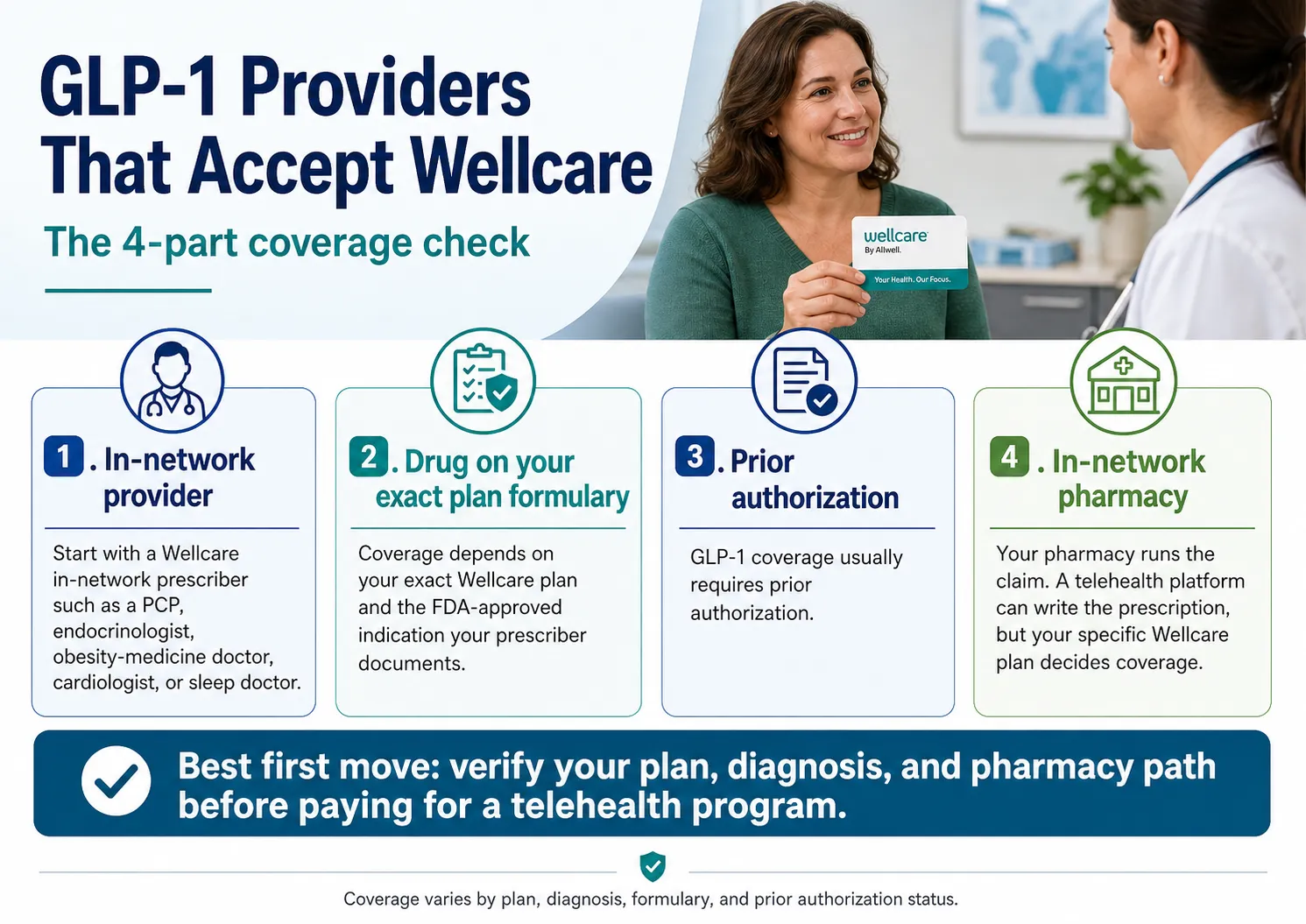
Here are the four meanings hiding inside “accepts Wellcare”:
This is the only meaning that matches a normal doctor's office. It applies to your PCP, an endocrinologist, an obesity-medicine specialist — anyone with a Wellcare contract.
Wellcare publishes a different formulary for each plan (Wellcare Value Script, Wellcare Classic, Wellcare D-SNP, Wellcare Medicaid by state, and so on). A drug being “covered by Wellcare” in general doesn't mean it's covered by your specific plan.
Even when a drug is on your formulary, Wellcare almost always requires prior authorization (PA) for GLP-1s. PA is a paperwork process where your doctor proves the medication is medically necessary for an FDA-approved indication on your plan.
Wellcare's preferred mail-order service is Express Scripts Pharmacy, and Wellcare lists Evernorth EnGuide Pharmacy as the dedicated mail-order provider for GLP-1 medications. Filling at an out-of-network pharmacy can blow up an otherwise approved claim.
| Provider path | Visit in-network? | Medication on formulary? | PA criteria can be met? | Pharmacy path verified? |
|---|---|---|---|---|
| In-network Wellcare PCP, endocrinologist, or specialist | ✅ | Plan-specific | Strongest documentation path | ✅ |
| Form Health (online) | ⚠️ Verify your specific plan | Plan-specific | Yes — Form helps with PA | ✅ |
| knownwell (online) | ⚠️ Verify your specific plan | Plan-specific | Yes — knownwell helps with PA | ✅ |
| Sesame Care (online) | ❌ Program fee is always cash | Plan-specific | Yes — provider-handled PA | ✅ |
| Ro (online) | ❌ Membership is cash | Plan-specific | Insurance concierge for commercial plans only | ✅ for medication |
| Hims / Hers (online) | ❌ Cash | Plan-specific | Limited PA support | ✅ for medication |
| Cash-pay compounded providers | ❌ Cash only | ❌ Not a Wellcare formulary path | N/A | N/A |
Last verified May 1, 2026. “Plan-specific” means the answer depends on your exact Wellcare plan ID and state — verify before booking.
What this means practically: a telehealth platform like Ro can write you a prescription, but Ro doesn't sit inside any of those four boxes. Ro doesn't bill Wellcare for the visit. Ro's insurance concierge — by Ro's own published policy — does not coordinate coverage for government insurance plans, including Wellcare. The pharmacy is the entity that actually runs your Wellcare claim.
Does Wellcare cover GLP-1 medications for weight loss?
Answer capsule
No, not under normal Medicare Part D rules. GLP-1s may be covered when prescribed for an FDA-approved indication other than weight loss — type 2 diabetes, cardiovascular risk reduction, obstructive sleep apnea, or noncirrhotic MASH — and only if the drug is on your specific plan's formulary. The CMS Medicare GLP-1 Bridge will provide weight-management access for eligible Part D beneficiaries starting July 1, 2026, at a $50/month copay.
That's the federal rule, not a Wellcare quirk. Medicare Part D has barred weight-loss-only coverage since the Medicare Modernization Act of 2003. The Treat and Reduce Obesity Act (TROA) was reintroduced in Congress in 2025 but has not been enacted as of this writing — current law still prohibits Medicare from covering drugs used solely for weight loss outside CMS demonstration programs. The Bridge is CMS's bridge until federal law or BALANCE Model implementation changes the landscape.
The takeaway for a Wellcare member: if your only goal is weight management and your only barrier is the Part D weight-loss exclusion, the Bridge is the door that's about to open. If you have a covered indication today, you have a Part D path right now.
Which diagnoses can unlock Wellcare GLP-1 coverage?
Answer capsule
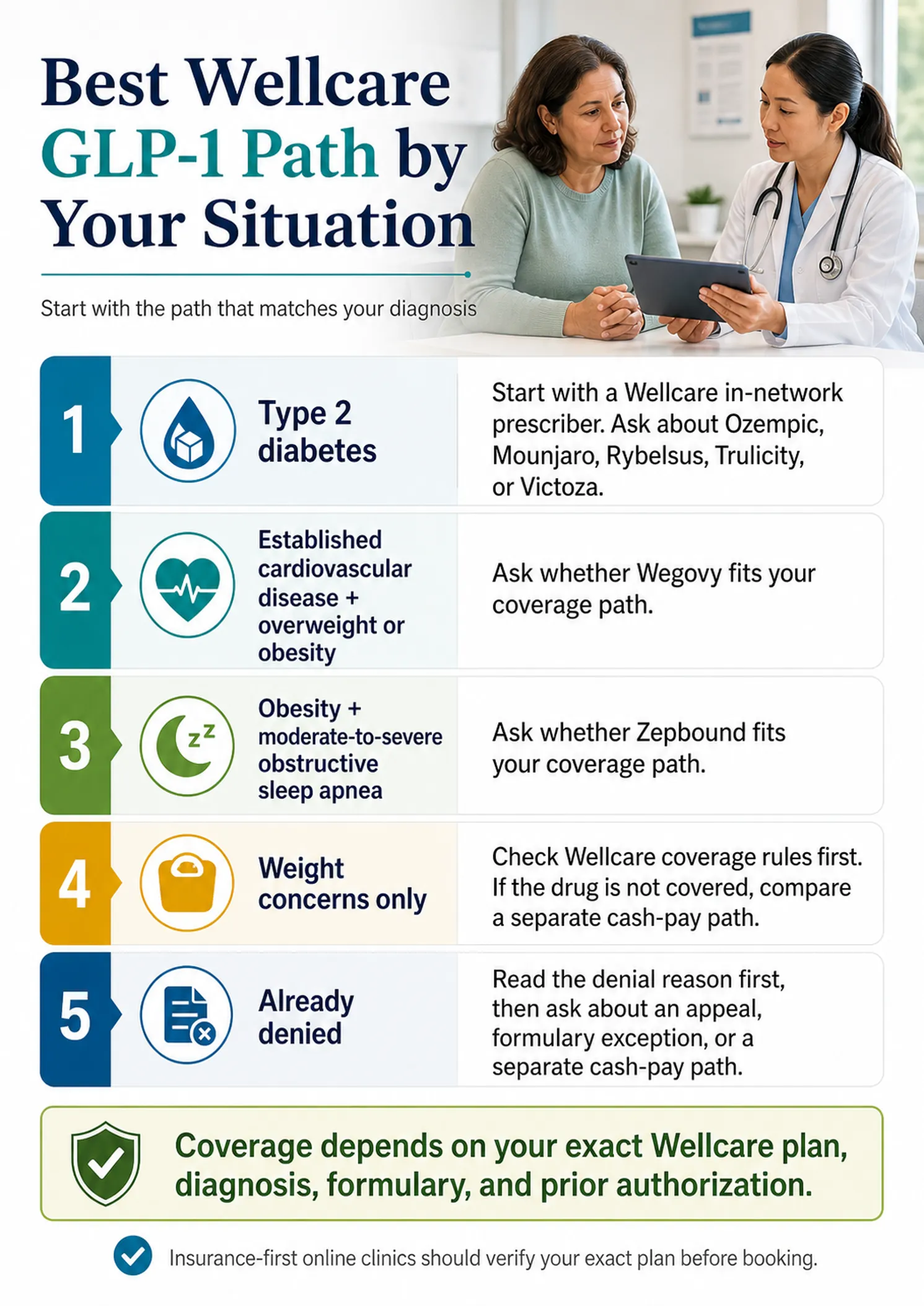
Five diagnostic pathways can unlock GLP-1 coverage on Wellcare Part D in 2026: type 2 diabetes (the broadest pathway); CV risk reduction in adults with established CVD who are overweight or obese (Wegovy); moderate-to-severe obstructive sleep apnea in adults with obesity (Zepbound); noncirrhotic MASH with moderate-to-advanced liver fibrosis (Wegovy); and reducing CV risk in adults with type 2 diabetes (Rybelsus, Ozempic). Coverage also depends on whether your specific plan lists the drug and you meet prior authorization criteria.
| Diagnosis | GLP-1s that may unlock coverage | Documentation Wellcare typically needs |
|---|---|---|
| Type 2 diabetes | Ozempic, Mounjaro, Rybelsus, Trulicity, Victoza | T2D diagnosis with ICD-10 code, recent A1C, current and prior diabetes medications, complications/comorbidities |
| Cardiovascular risk reduction — established CVD + overweight/obesity | Wegovy | Documented established CVD (prior MI, stroke, PAD, or angiographic evidence), BMI documenting overweight/obesity, cardiology notes, prescriber attestation |
| Moderate-to-severe obstructive sleep apnea + obesity | Zepbound | Sleep study with AHI score, BMI documenting obesity, prior CPAP trial or relevant history, prescriber attestation that Rx is for OSA (not weight loss) |
| Noncirrhotic MASH with moderate-to-advanced liver fibrosis | Wegovy injection (FDA indication added 2025) | Liver biopsy or qualifying noninvasive testing documenting MASH with moderate-to-advanced fibrosis, prescriber attestation |
| CV risk reduction in adults with type 2 diabetes | Rybelsus, Ozempic | T2D diagnosis plus documentation of cardiovascular risk reduction goal |
| Weight loss only (no covered comorbidity) | None under normal Part D | Look at the Medicare GLP-1 Bridge starting July 1, 2026 |
This table is coverage-navigation information based on Wellcare's published 2026 guidance. It is not a recommendation that any medication is appropriate for you — that's a conversation with your prescriber.
MASH is new. The FDA approved Wegovy for noncirrhotic MASH with moderate-to-advanced liver fibrosis in 2025, and Wellcare's 2026 coverage page now lists this as a covered indication. If you have liver disease and obesity, ask your hepatologist or GI specialist whether you might qualify — it's a covered indication many readers don't know exists.
Cardiovascular risk reduction has two flavors. Wegovy's CV indication is for adults with established cardiovascular disease — prior heart attack, stroke, peripheral artery disease, or angiographic evidence of CVD — who are also overweight or obese. Just having high blood pressure or high cholesterol isn't enough. Rybelsus and Ozempic have a separate CV-risk indication for adults who also have type 2 diabetes.
The OSA pathway requires a sleep study. If you suspect you have sleep apnea but haven't been formally diagnosed, the OSA pathway isn't open until you have an actual sleep study showing moderate-to-severe OSA with a documented AHI score.
Mounjaro doesn't have a non-T2D pathway. Mounjaro and Zepbound contain the same active ingredient (tirzepatide), but they're separate FDA-approved products with separate indications. Mounjaro is approved for type 2 diabetes only. Zepbound is approved for weight management and OSA. If you want tirzepatide for OSA on Wellcare, the path is Zepbound, not Mounjaro.
Which GLP-1 providers accept Wellcare?
Answer capsule
For Wellcare members with a covered indication, the strongest first step is a Wellcare in-network prescriber — a PCP, endocrinologist, obesity-medicine specialist, cardiologist, sleep specialist, or hepatology specialist. Online insurance-first options: Form Health and knownwell publicly accept Medicare and most major commercial plans. Sesame Care offers broad provider choice with PA help. If Wellcare denies you, Ro publishes manufacturer-matched pricing across the broadest FDA-approved branded formulary.
Tier 1 — Wellcare in-network prescribers (the truest “accepts Wellcare” path)
This is the only meaning of “accepts Wellcare” that matches a normal doctor visit. Use the Wellcare Find a Provider tool, select your exact plan type (Medicare, PDP, D-SNP, Medicaid by state), and search by specialty:
- Primary care — the catch-all starting point if you have any covered indication.
- Endocrinology — for type 2 diabetes pathways.
- Obesity medicine — for help building the strongest possible PA documentation.
- Cardiology — for the Wegovy CV-risk pathway.
- Sleep medicine — for the Zepbound OSA pathway.
- Hepatology or GI — for the Wegovy MASH pathway.
Why this is Tier 1: your visit is billed to Wellcare, your doctor knows local Wellcare PA workflows, and the prescription routes naturally to your in-network pharmacy. No platform fees on top.
Tier 2 — Online insurance-first clinics (verify your specific plan first)
Form Health publicly states it accepts most major private insurance and Medicare for visits, labs, and FDA-approved medications. Form is built around medical weight management and includes both physician and registered dietitian visits — closer to a traditional doctor's office than a cash-pay subscription.
knownwell publicly states it accepts Medicare and most major commercial insurance nationwide, with state-by-state filtering on its site. knownwell's clinical model is weight-inclusive obesity care — built for patients who want a clinic that handles GLP-1s alongside the rest of their primary care.
Call script before you book either clinic:
“I have Wellcare [exact plan name and ID]. Are you in-network for this specific plan, and do you submit prior authorizations to Wellcare for FDA-approved GLP-1 medications when medically appropriate?”
Tier 3 — Cash-pay FDA-approved branded providers (your fallback if Wellcare denies)
These are the platforms where the visit is cash-pay but the medication can still be filled at a pharmacy that bills your insurance — or at a cash-pay manufacturer-matched price if Wellcare won't cover it.
Ro — Broadest FDA-approved formulary, manufacturer-matched cash-pay pricing
Ro has the deepest FDA-approved formulary in cash-pay telehealth: Wegovy pill, Wegovy pen, Zepbound pen, Zepbound KwikPen, Foundayo, and Ozempic. Ro publishes pricing matched to NovoCare, LillyDirect, and TrumpRx — the manufacturer-direct cash-pay floors. Ro Body membership: $39 for the first month, then $149/month on a monthly plan or as low as $74/month with annual prepay. Medication priced separately.
⚠️ Important: Ro's insurance concierge supports commercial plans only — it does not coordinate coverage for government insurance plans, including Wellcare. Ro is best used as a cash-pay FDA-approved backup for Wellcare members.
Ro also publishes a free GLP-1 Insurance Coverage Checker that runs your insurance card and tells you what each branded GLP-1 will cost — useful even if you don't end up using Ro for the prescription.
Sesame Care — Broadest provider choice, PA help as standard care
Sesame Care runs a marketplace model: you browse providers, pick your own, and book. Sesame's Success by Sesame program (ongoing program access listed as low as $59/month with annual subscription — medication not included) includes provider-handled prior authorization paperwork. The formulary is broad — Wegovy, Zepbound (KwikPen, vial, single-dose pen), Foundayo, Ozempic, and other options. Sesame's program fee is always cash; the medication can be billed through your pharmacy to your plan if covered. For a Wellcare member with a covered indication who wants provider choice and PA help, Sesame is a strong fit.
See Sesame Care providers and pricing → (sponsored affiliate link, opens in a new tab)Hims / Hers — FDA-approved GLP-1s via March 2026 Novo Nordisk partnership
Hims and Hers added Novo Nordisk's FDA-approved GLP-1s after their March 2026 partnership — including Wegovy pill, Wegovy injection doses, and Ozempic injection pens. They're a fit if you're comfortable in a mainstream consumer telehealth brand and don't need much hand-holding on coverage. Hims and Hers do not have a PA support team for Wellcare claims — treat these as cash-pay branded paths.
Tier 4 — Verify-only paths (don't default here)
PlushCare announced it stopped accepting Medicare Part B as of January 1, 2026. Some Medicare Advantage plans may still work through their booking system, but you have to verify at booking. We don't recommend it as a default route for Wellcare members.
Tier 5 — Cash-pay compounded (a separate category, never a Wellcare path)
Compounded GLP-1 products are pharmacy-prepared formulations. The FDA has stated that non-FDA-approved compounded GLP-1 products cannot be marketed as generic versions of, the same as, or made with the same active ingredient as FDA-approved drugs, and cannot be claimed to be clinically proven. Compounded GLP-1 medications are not a verified Wellcare Medicare formulary path. Any page telling you a compounded provider “accepts Wellcare” is either confused or selling you something.
| Provider | Writes FDA-approved GLP-1 Rx? | Sends Rx so Wellcare can adjudicate? | Helps with PA? | Visit billed to Wellcare? | Last verified |
|---|---|---|---|---|---|
| In-network Wellcare prescriber | ✅ | ✅ | ✅ | ✅ | May 1, 2026 |
| Form Health | ✅ | ✅ | ✅ | ⚠️ Verify your specific plan | May 1, 2026 |
| knownwell | ✅ | ✅ | ✅ | ⚠️ Verify your specific plan | May 1, 2026 |
| Sesame Care | ✅ (broadest cash-pay branded formulary) | ✅ | ✅ (provider-handled) | ❌ Program fee is always cash | May 1, 2026 |
| Ro | ✅ (Wegovy pill, Wegovy pen, Zepbound pen, KwikPen, Foundayo, Ozempic) | ✅ | ⚠️ Commercial plans only | ❌ Membership is cash | May 1, 2026 |
| Hims | ✅ (Wegovy pill, Wegovy injection, Ozempic — post-March 2026) | ✅ | ⚠️ Limited | ❌ Cash | May 1, 2026 |
| Hers | ✅ (Wegovy pill, Wegovy injection, Ozempic — post-March 2026) | ✅ | ⚠️ Limited | ❌ Cash | May 1, 2026 |
| PlushCare | ✅ | ✅ | ⚠️ Stopped Medicare Part B Jan 1, 2026; verify MA status | ⚠️ Plan-specific | May 1, 2026 |
The honest reading of that matrix: if you want true insurance-first online care, Form Health and knownwell are the strongest options to verify. If you want a cash-pay branded backup with provider choice and PA help, Sesame Care earns it. If your goal is the cheapest FDA-approved cash-pay path when Wellcare denies you, Ro publishes manufacturer-matched pricing across the broadest formulary.
What Wellcare actually covers for GLP-1s in 2026
Answer capsule
On the sampled 2026 Wellcare Value Script PDP formulary, Ozempic, Mounjaro, Rybelsus, and Trulicity all appear on Tier 6 with prior authorization required and quantity limits. Wegovy and Zepbound were not found on the sampled Value Script formulary search. Verify your exact plan's drug list before assuming any specific coverage.
| Medication | Active ingredient | 2026 Value Script PDP formulary status | Indications that may unlock coverage |
|---|---|---|---|
| Ozempic® | semaglutide injection | Tier 6, PA required, quantity limit 3 mL per 28 days | Type 2 diabetes; CV risk reduction in adults with T2D and established CVD; CKD with T2D |
| Mounjaro® | tirzepatide injection | Tier 6, PA required, quantity limit 2 mL per 28 days | Type 2 diabetes |
| Rybelsus® | oral semaglutide | Tier 6, PA required, quantity limit 30 tablets per 30 days | Type 2 diabetes; CV risk reduction in adults with T2D |
| Trulicity® | dulaglutide | Tier 6, PA required, quantity limit 2 mL per 28 days | Type 2 diabetes |
| Victoza® | liraglutide | Not found in sampled Value Script PDP — verify your plan | Type 2 diabetes; CV risk reduction in adults with T2D |
| Wegovy® (pen and pill) | semaglutide | Not found in sampled Value Script PDP — verify your plan | CV risk reduction in adults with established CVD and overweight/obesity; noncirrhotic MASH with moderate-to-advanced liver fibrosis |
| Zepbound® (KwikPen, vial, single-dose pen) | tirzepatide | Not found in sampled Value Script PDP — verify your plan | Moderate-to-severe OSA in adults with obesity |
| Foundayo™ | orforglipron (oral) | Not a standard Part D weight-loss path in 2026 | Available through the Medicare GLP-1 Bridge for eligible Part D members starting July 1, 2026 |
Sampled May 1, 2026 from the Wellcare Value Script PDP 2026 formulary and Wellcare 2026 GLP-1 prior authorization criteria document. Other Wellcare plans can differ. Wellcare formularies update monthly.
“Tier 6” doesn't always mean coinsurance. On the sampled Wellcare Value Script PDP 2026 Summary of Benefits, Tier 6 drugs sit behind a $615 deductible (Tiers 3–6) and then have an $11 cost share for a 30-day supply at retail or mail-order, with a $33 cost share for a 90-day supply. Other Wellcare plans can have different cost-sharing structures, including coinsurance instead of flat copays. Pull your specific plan's Summary of Benefits before assuming any cost number.
“Prior authorization required” is the most common reason people give up. PA isn't unusual — it's standard for GLP-1s on every Medicare plan we looked at. Per the sampled 2026 Wellcare GLP-1 PA criteria document, the coverage duration is 1 year, indications are “All FDA-approved Indications,” and the document lists “Prerequisite Therapy Required: No” for the GLP-1 agonist class — meaning Wellcare's published criteria for this class don't require step therapy as a prerequisite.
“Not found” on the sampled formulary doesn't mean Wegovy or Zepbound are universally excluded across every Wellcare plan. It means we couldn't confirm them on this specific plan's formulary on the day we checked. Always pull your exact plan's drug list before assuming.
The takeaway: what's wrong with your prescription, not which website it came from, is what gets you denied. The same Wellcare formulary and PA criteria apply regardless of where the prescription was written.
How to find a Wellcare GLP-1 doctor — step-by-step
Answer capsule
Start with Wellcare's own provider finder, search the right specialty, and ask the right verification questions before you book. The goal is a doctor who's in-network for your exact plan, comfortable submitting Wellcare prior authorizations, and able to send the prescription to your in-network pharmacy.
Step 1: Identify your exact Wellcare plan name and ID
Open your Wellcare member ID card. Find the exact plan name (for example, “Wellcare Value Script PDP,” “Wellcare Medicare Advantage HMO,” “Wellcare D-SNP,” or “Wellcare Medicaid [State]”). This matters because each plan type has its own network and formulary.
Step 2: Use the Wellcare provider finder for your plan type
Visit the official Wellcare Find a Provider page. Search by specialty — primary care, endocrinology, obesity medicine, cardiology, sleep medicine, or hepatology depending on your indication. For Medicaid plans, search the right state plan, not the generic Wellcare directory.
Step 3: Call the office before you book — here's the script
“Hi — I have Wellcare [exact plan name and member ID]. Three quick questions: First, are you in-network for this specific plan? Second, does your office prescribe FDA-approved GLP-1 medications when medically appropriate — Ozempic, Mounjaro, Wegovy, Zepbound? And third, does your office submit prior authorizations to Wellcare and handle appeals if needed?”Step 4: Confirm the pharmacy side
Wellcare's preferred mail-order service is Express Scripts Pharmacy, and Wellcare lists Evernorth EnGuide Pharmacy as the dedicated mail-order provider for GLP-1 medications. Ask your prescriber to send the prescription to either an in-network retail pharmacy or your plan's mail-order pharmacy. Filling at an out-of-network pharmacy is one of the most common reasons an otherwise-approved claim turns into a surprise bill.
Step 5: If you're using an online clinic, verify before paying
Before paying any membership fee, ask:
- “Do you accept my exact Wellcare plan?”
- “Will my visit be billed to my plan, or do I pay out of pocket?”
- “Do you submit prior authorizations to Wellcare?”
- “What pharmacy will my prescription be sent to, and is it in my Wellcare network?”
- “What happens if Wellcare denies coverage — do you help with the appeal?”
Want the right PA documents, documents checklist, and call script?
Our quiz maps your plan type, diagnosis, and denial status to the right next step.
How prior authorization actually works with Wellcare
Answer capsule
Prior authorization is a paperwork process where Wellcare reviews documentation showing the medication is medically necessary for an FDA-approved indication. CMS rules give Part D plans 72 hours to decide a standard initial coverage determination or exception request, and 24 hours for expedited. If denied, you have 65 calendar days from the denial notice to file a Level 1 redetermination, and Wellcare has 7 calendar days for standard or 72 hours for expedited responses.
Prior authorization sounds scary. It's mostly tedious. The reason it kills most GLP-1 requests is bad documentation, not bad intent. Here's what your prescriber actually has to send:
For type 2 diabetes (Ozempic, Mounjaro, Rybelsus, Trulicity, Victoza):
- Confirmed T2D diagnosis with ICD-10 code.
- Recent A1C lab results.
- Current and past diabetes medications.
- Documented complications or comorbidities if relevant.
- Prescriber attestation of medical necessity.
For Wegovy on the CV-risk indication:
- Documented established cardiovascular disease (prior MI, stroke, peripheral artery disease, or angiographic evidence — not just risk factors).
- BMI documenting overweight or obesity.
- Cardiology notes or hospital records as supporting evidence.
- Prescriber attestation that Wegovy is being prescribed to reduce major adverse cardiovascular events.
For Wegovy on the noncirrhotic MASH indication:
- Liver biopsy or qualifying noninvasive testing documenting MASH with moderate-to-advanced liver fibrosis.
- Hepatology or GI specialist notes.
- Prescriber attestation that Wegovy is being prescribed for MASH, not weight loss.
For Zepbound on the OSA indication:
- Sleep study with AHI score documenting moderate-to-severe OSA.
- BMI documenting obesity.
- Treatment history (prior CPAP trial, weight management attempts).
- Prescriber attestation that Zepbound is being prescribed for OSA, not weight loss.
Wellcare timing — coverage determinations vs. appeals
| What you're filing | Standard timeline | Expedited timeline | Filing deadline |
|---|---|---|---|
| Initial coverage determination | 72 hours for Wellcare to decide | 24 hours | At time of prescription |
| Exception request (formulary or tier exception) | 72 hours after prescriber's supporting statement received | 24 hours | Anytime |
| Redetermination (Level 1 appeal after denial) | 7 calendar days for Wellcare to respond | 72 hours | Within 65 calendar days of the coverage determination notice |
| Reconsideration (Level 2 — Independent Review Entity) | Plan-specific | Expedited available | After Level 1 denial |
Source: CMS Part D Coverage Determinations and Redetermination by Part D Plan Sponsor pages.
Why most Wellcare PAs get denied — and how to fix it
| Denial reason | What it usually means | Your next step |
|---|---|---|
| Missing documentation | Your prescriber didn't include enough clinical evidence | Ask the office to resubmit with the missing labs, notes, or attestations |
| PA criteria not met | Your case didn't satisfy Wellcare's clinical criteria for that drug + indication | Review the criteria in the denial letter; provide what's missing or appeal with additional evidence |
| Non-formulary | The drug isn't on your plan's drug list | Request a formulary exception with prescriber justification, or ask about a covered alternative |
| Weight-loss-only exclusion | Prescription is for weight loss without a covered secondary indication | Check Bridge eligibility for July 2026, or move to a cash-pay path |
The Medicare GLP-1 Bridge — what changes July 1, 2026
Answer capsule
The Medicare GLP-1 Bridge is a CMS demonstration program running July 1, 2026 through December 31, 2027, giving eligible Part D beneficiaries access to Wegovy, Zepbound KwikPen, and Foundayo for weight management at a flat $50/month copay. Eligibility uses three BMI-based clinical tiers. The Bridge is the primary payer for Bridge-covered claims and does not coordinate benefits with other payers. The $50 copay does not count toward Part D TrOOP.
This is the biggest change to Medicare GLP-1 coverage in 22 years. If you're a Wellcare Medicare Part D member and your only barrier has been the weight-loss-only exclusion, the Bridge is the door that's about to open.
Who qualifies — three eligibility tiers
CMS published three distinct clinical tiers in its March 2026 FAQ. You only need to meet one. The BMI is assessed at the time GLP-1 therapy was initiated.
Tier 1 — BMI alone (no other condition required)
- Age 18+
- BMI ≥ 35 at the time of GLP-1 therapy initiation
Tier 2 — BMI ≥ 30 plus one qualifying condition
- Age 18+
- BMI ≥ 30 at the time of GLP-1 therapy initiation, AND at least one of:
- Heart failure with preserved ejection fraction (HFpEF)
- Uncontrolled hypertension (systolic BP above 140 mm Hg or diastolic BP above 90 mm Hg despite treatment with two antihypertensives)
- Chronic kidney disease stage 3a or above
Tier 3 — BMI ≥ 27 plus one qualifying condition
- Age 18+
- BMI ≥ 27 at the time of GLP-1 therapy initiation, AND at least one of:
- Prediabetes (as defined by American Diabetes Association guidelines)
- Previous myocardial infarction
- Previous stroke
- Symptomatic peripheral artery disease
Which drugs are in — and which are out
| Drug | Bridge status |
|---|---|
| Wegovy® injection | ✅ All formulations included |
| Wegovy® pill | ✅ All formulations included |
| Foundayo™ (orforglipron) | ✅ All formulations included (added April 6, 2026 after FDA approval) |
| Zepbound® KwikPen® | ✅ KwikPen formulation only |
| Zepbound® single-dose vial | ❌ Excluded |
| Zepbound® single-dose pen | ❌ Excluded |
| Ozempic® | ❌ Not in the Bridge (regular Part D for T2D only) |
| Mounjaro® | ❌ Not in the Bridge (regular Part D for T2D only) |
| Rybelsus® | ❌ Not in the Bridge |
| Saxenda® | ❌ Not in the Bridge |
How the $50 copay works
Pharmacies collect a flat $50 copay from eligible beneficiaries for Bridge prescriptions. The Bridge operates outside the normal Part D payment flow — Wellcare and other Part D sponsors don't carry risk for Bridge claims. The $50 copay does not count toward your Part D true out-of-pocket (TrOOP) total.
When the Bridge does NOT apply
If your prescriber is using Wegovy for cardiovascular risk reduction, Wegovy for noncirrhotic MASH, or Zepbound for OSA, that is not the Bridge — that's regular Part D coverage through Wellcare's normal utilization management process. CMS has explicitly said it will monitor plans to make sure they don't push covered indications onto the Bridge.
After December 31, 2027
The Bridge transitions to the BALANCE Model (Better Approaches to Lifestyle and Nutrition for Comprehensive hEalth), a longer-term program in which CMS plans to negotiate directly with manufacturers on behalf of Part D plan sponsors and state Medicaid agencies. Final BALANCE eligibility, drug list, and cost-sharing rules haven't been published yet.
Not sure if you'll qualify when the Bridge opens?
We walk through all three CMS eligibility tiers and tell you whether to start a Bridge PA or pursue a different path.
We also have a deeper guide: The Medicare GLP-1 Bridge program — full eligibility and timeline →
What if Wellcare denies your GLP-1?
Answer capsule
Don't restart from scratch — the denial letter tells you why. A missing-documentation denial is fixable; a weight-loss-only denial usually isn't. You have 65 calendar days from the coverage determination notice to file a Level 1 redetermination, and Wellcare has 7 calendar days to respond.
A denial isn't the end. It's information. Your job is to read what the denial says, decide whether the underlying problem is fixable, and pick the right next move.
Step 1: Read the denial letter carefully
Every Wellcare denial includes the specific reason and your appeal rights. Look for the denial code or category, the date the denial was issued (your 65-day clock starts here), the specific clinical criteria that weren't met, and instructions for filing a redetermination.
Step 2: Match the denial to the right next step
Missing documentation denial — the fix is paperwork, not a different drug. Ask the office to resubmit with the missing labs, sleep study, cardiology notes, or A1C. This is the easiest type of denial to overturn.
PA criteria not met — the documentation was complete, but Wellcare's clinical criteria weren't satisfied. Review the specific criteria and either provide additional evidence or appeal with a letter of medical necessity.
Non-formulary — the drug isn't on your plan's drug list. Request a formulary exception with prescriber justification, or ask about switching to a covered alternative.
Weight-loss-only exclusion — this is the one that usually can't be appealed away. Medicare Part D has a federal exclusion for drugs used solely for weight loss. Your real options are the Medicare GLP-1 Bridge (July 1, 2026) or a cash-pay FDA-approved branded path.
Step 3: File the appeal if it's appealable
You have 65 calendar days from the coverage determination notice to file a Level 1 redetermination. Wellcare has 7 calendar days to respond to a standard appeal, 72 hours for an expedited appeal.
If the Level 1 appeal is denied, you can escalate through Level 2 (Independent Review Entity), Level 3 (Administrative Law Judge), Level 4 (Medicare Appeals Council), and Level 5 (Federal District Court). Most cases resolve at Level 1 or 2 if the underlying clinical criteria can actually be met.
Step 4: If the denial is unfixable, pick your real path
Option A: Cash-pay FDA-approved branded — Ro publishes manufacturer-matched pricing
Ro currently offers FDA-approved GLP-1s at pricing matched to NovoCare, LillyDirect, and TrumpRx:
- Wegovy pill — $149 for the first month for new patients on lower doses, then $199–$299/month depending on dose.
- Zepbound KwikPen — $299/month for 2.5 mg, $399/month for 5 mg, $449/month for 7.5–15 mg under the manufacturer offer (requires 45-day refill check-ins to maintain $449 pricing).
- Foundayo at TrumpRx-matched pricing.
- Ozempic through Ro's GLP-1 program.
Ro Body membership: $39 for the first month, then $149/month or as low as $74/month with annual prepay. Membership is paid separately from the medication. Ro's insurance concierge supports commercial plans only — not Wellcare.
Check Ro's current pricing and run the free coverage check → (sponsored affiliate link, opens in a new tab)Option B: Cash-pay FDA-approved branded with provider choice — Sesame Care
Sesame Care lets you browse providers, pick your own, and get PA help as part of standard care. Ongoing program access listed as low as $59/month with annual subscription (medication not included). Cash-pay branded GLP-1 medication starts at $149/month. Verify current Sesame pricing on their site at the time of booking.
See Sesame Care providers and pricing → (sponsored affiliate link, opens in a new tab)Option C: Manufacturer programs and savings cards
Manufacturer programs like the Wegovy savings card and the Zepbound savings card are not available to patients with government-sponsored insurance, including Medicare and Medicaid. If you have Wellcare Medicare or Wellcare Medicaid, these programs won't apply to you. NovoCare and LillyDirect direct-to-consumer cash-pay options are open to everyone — that's the floor Ro and Sesame match.
Option D: Cash-pay compounded GLP-1 (read this carefully)
Compounded GLP-1 products are pharmacy-prepared formulations. The FDA has stated that non-FDA-approved compounded GLP-1 products cannot be marketed as generic versions of, the same as, or made with the same active ingredient as FDA-approved drugs, and cannot be claimed to be clinically proven.
Compounded options are a separate cash-pay decision for readers who've read the FDA guidance, verified the pharmacy, and understand the regulatory landscape. They are not a verified Wellcare Medicare formulary path and should not be presented as Wellcare-covered.
Can I use Ro, Sesame, Hims, Hers, or other online GLP-1 platforms with Wellcare?
Answer capsule
A platform may be able to send a prescription to a pharmacy that adjudicates the claim against Wellcare. For the platforms we verified, the visit/membership fee is separate from Wellcare. Ro's insurance concierge does not coordinate GLP-1 medication coverage for government insurance plans, and Ro Body cannot be joined or paid out of pocket by members with Medicaid or other government-funded plans. Sesame Care providers help with PA paperwork even though Sesame's program fee is cash.
Ro is one of our best-recommended cash-pay GLP-1 partners — it publishes manufacturer-matched pricing across the broadest FDA-approved branded formulary in cash-pay telehealth. It is also publicly transparent about a real limitation: Ro's insurance concierge does not coordinate GLP-1 medication coverage for government insurance plans — including Wellcare Medicare, Wellcare MAPD, Wellcare D-SNP, and Wellcare Medicaid. Ro also says Medicaid and other government-funded plan members cannot join Ro Body or pay out of pocket through Ro.
Here's the honest fit: Ro doesn't help with government-insurance coverage, but in exchange, Ro has built the lowest manufacturer-matched cash-pay branded GLP-1 path in the market. If your priority is the lowest legitimate FDA-approved branded medication price after a Wellcare denial, Ro is built exactly for you. If your priority is a telehealth doctor who'll fight your Wellcare PA, Sesame Care or an in-network Wellcare prescriber is the better fit.
The cleanest honest mapping:
- You want insurance-first care, online: Form Health or knownwell, after verifying your specific Wellcare plan.
- You want maximum provider choice plus PA help: Sesame Care.
- You expect Wellcare to deny you and want the lowest-priced cash-pay FDA-approved branded option: Ro.
- You want a familiar mainstream consumer telehealth brand: Hims (male-coded) or Hers (female-coded).
- You want the most direct insurance-first path: Your in-network Wellcare PCP, endocrinologist, or relevant specialist.
How Wellcare plan types differ — and why that matters for GLP-1s
Answer capsule
Wellcare is the Medicare brand of Centene Corporation and operates several distinct plan types, each with different GLP-1 coverage rules. Wellcare PDP plans cover the medication side only. Wellcare MAPD bundles medical and drug coverage. Wellcare D-SNP serves dual-eligible members with state Medicaid coordination. Wellcare Medicaid plans follow each state's preferred drug list.
Wellcare Medicare Part D (PDP) — Value Script, Classic, and similar
Coverage logic: GLP-1 covered only for non-weight-loss FDA-approved indications. Prior authorization and quantity limits are common. The 2026 Part D out-of-pocket cap is $2,100. Formulary updated monthly.
Strongest pathway: Type 2 diabetes (Ozempic, Mounjaro, Rybelsus, Trulicity, Victoza). CV-risk reduction (Wegovy). OSA (Zepbound). Noncirrhotic MASH (Wegovy). After July 1, 2026, the Bridge for weight management.
Wellcare Medicare Advantage (MAPD)
Coverage logic: Same Part D rules, bundled with medical benefits. Some MAPD plans add supplemental obesity benefits — read your plan's Evidence of Coverage to see what's specific to your plan. HMO plans usually require in-network prescribers and referrals; PPO plans give more flexibility at higher cost.
Wellcare D-SNP (Dual Eligible Special Needs Plan)
Coverage logic: Combines Medicare Part D rules with your state's Medicaid drug coverage. Some state Medicaid programs cover Wegovy or Zepbound for obesity; others don't, and the list has changed.
Strongest pathway: Whatever your state Medicaid covers, plus the Medicare Part D pathways. Dually-eligible beneficiaries enrolled in eligible Part D plan types are also eligible for the Bridge starting July 1, 2026 if they meet PA criteria.
Wellcare Medicaid (state programs — Centene's umbrella)
Coverage logic: Each state's Medicaid program publishes its own preferred drug list. Wellcare manages Medicaid plans in select states (Kentucky, North Carolina, New Jersey, ʻOhana in Hawaii, and others).
State coverage of GLP-1s for obesity has changed materially in 2025–2026. Per KFF's January 2026 Medicaid update, California, New Hampshire, Pennsylvania, and South Carolina eliminated coverage, while North Carolina reinstated coverage in December 2025. Pull your state's current Medicaid preferred drug list on the day you check.
Note on Centene's other brands: Centene also operates Ambetter (ACA marketplace plans), which is a separate brand from Wellcare Medicare/Medicaid. Ambetter is commercial insurance and follows different coverage rules — many Ambetter plans cover Wegovy or Zepbound for obesity with prior authorization. If you have Ambetter, this page isn't built for you.
How much will a GLP-1 cost with Wellcare?
Answer capsule
On the sampled 2026 Wellcare Value Script PDP, Tier 6 GLP-1s sit behind a $615 deductible (Tiers 3–6) and then have an $11 cost share for a 30-day supply. Once you hit the 2026 Part D OOP cap of $2,100, covered drugs are $0 for the rest of the year. The Medicare GLP-1 Bridge uses a flat $50/month copay. Cash-pay FDA-approved branded options through Ro start at $149 for the first month for Wegovy pill on new-patient pricing.
| Path | Typical 2026 cost | Notes |
|---|---|---|
| Wellcare Value Script PDP, Tier 6 covered drug, after $615 deductible | $11 copay for 30-day supply, $33 for 90-day supply | Sampled May 2026 from Value Script Summary of Benefits; other plans differ |
| Wellcare Part D, after $2,100 OOP cap | $0 for rest of year | Cap applies to covered drugs only |
| Wellcare Part D, weight-loss-only use | Full retail (~$1,000–$1,300/month) | Excluded under federal Medicare Part D rules |
| Medicare GLP-1 Bridge (July 1, 2026+) | $50/month flat copay | Wegovy, Foundayo, or Zepbound KwikPen only; doesn't count toward Part D OOP cap |
| Ro cash-pay (Wegovy pill, new patient lower dose) | $149 first month, $199–$299/month thereafter | Plus Ro Body membership: $39 first month, then $149/month or $74/month annual prepay |
| Ro cash-pay (Zepbound KwikPen 7.5–15 mg under refill check-in) | $449/month + Ro Body membership | LillyDirect-matched; requires 45-day refill check-ins |
| Sesame Care cash-pay branded GLP-1 | Starts at $149/month for medication | Sesame's program fee is separate cash subscription; verify current pricing |
| NovoCare/LillyDirect direct cash | $349–$499/month depending on dose and product | Manufacturer cash channels — the floor Ro and Sesame match |
Extra Help and state assistance are real and worth checking. Many Wellcare members qualify for the Medicare Low-Income Subsidy (Extra Help) or state pharmaceutical assistance programs that lower drug costs significantly.
Membership fees on telehealth platforms are not covered by Wellcare. A platform fee like Ro's $39–$149 or Sesame's program fee is paid out of pocket regardless of your insurance status.
Why people get sticker shock anyway. Beyond a non-formulary surprise, the most common reasons a covered drug suddenly costs more: you haven't met your deductible yet, your pharmacy isn't in-network, your plan moved the drug to a higher tier, your PA expired, or your prescription was coded with the wrong indication. Each of those is fixable — but each requires a different fix.
Why Wellcare members get stuck — common friction patterns
Real Wellcare members searching for GLP-1 coverage describe the same friction over and over. These are common patterns from public Medicare and GLP-1 forums — examples of the confusion this page is built to solve, not coverage rules or medical evidence.
Sticker shock at the pharmacy counter
A medication that ran $25 last year suddenly costs $700+ this year. This usually means a tier change, an expired PA, a deductible reset, a pharmacy network change, or a year-end plan change. Each is fixable in a different way — it's almost never as final as it feels at the counter.
“Drug is non-formulary”
Doesn't mean “no, ever.” Means “not on this specific plan's drug list.” Your prescriber can request a formulary exception; if denied, you can appeal; if appealed and still denied for a non-weight-loss indication, the drug really isn't covered on this plan and you'd need to switch plans at the next enrollment period or use a covered alternative.
“Medicare doesn't cover Wegovy because it's marketed for weight loss”
This is half-true. Wegovy isn't covered for weight loss alone under Part D — but it can be covered for cardiovascular risk reduction in adults with established CVD or for noncirrhotic MASH when your plan lists it and you have the documentation. If you have an indication that fits, the prescription has to be coded for that indication, not for weight loss.
If any of those patterns sound like your situation
Our quiz maps your specific situation to the appeal type, formulary exception, Bridge eligibility check, or cash-pay path that fits.
Frequently asked questions about GLP-1 providers and Wellcare
Does Wellcare cover Ozempic?
Wellcare Medicare Part D plans may cover Ozempic when prescribed for type 2 diabetes and listed on your specific plan's formulary. On the sampled 2026 Wellcare Value Script PDP formulary, Ozempic appears on Tier 6 with prior authorization required and a quantity limit of 3 mL per 28 days. Wellcare's 2026 guidance also lists Ozempic as a coverage path for cardiovascular risk reduction in adults with type 2 diabetes and chronic kidney disease in T2D.
Does Wellcare cover Mounjaro?
Yes, for type 2 diabetes only, with prior authorization. On the sampled 2026 Wellcare Value Script PDP formulary, Mounjaro appears on Tier 6 with PA required and a quantity limit of 2 mL per 28 days. Mounjaro is FDA-approved for T2D only and is not FDA-approved for weight loss, OSA, or cardiovascular risk reduction.
Does Wellcare cover Wegovy?
Wellcare may cover Wegovy when prescribed for cardiovascular risk reduction in adults with established cardiovascular disease who are overweight or obese, or for noncirrhotic MASH with moderate-to-advanced liver fibrosis — and only if your specific plan's formulary lists it. Wegovy is not covered for weight loss alone under standard Part D. Starting July 1, 2026, Wegovy will be available through the separate Medicare GLP-1 Bridge for eligible Part D members at a $50/month copay.
Does Wellcare cover Zepbound for weight loss?
Wellcare Medicare Part D does not cover Zepbound for weight loss alone in 2026 outside the Bridge program. Zepbound may be covered when prescribed for moderate-to-severe obstructive sleep apnea in adults with obesity, with prior authorization. The Medicare GLP-1 Bridge will cover the Zepbound KwikPen formulation for weight management starting July 1, 2026 — but the single-dose vial and single-dose pen formulations are excluded from the Bridge.
Does Wellcare cover Foundayo?
Foundayo (orforglipron) was FDA-approved on April 1, 2026, and was added to the Medicare GLP-1 Bridge on April 6, 2026. Eligible Medicare Part D members may access Foundayo through the separate Bridge program starting July 1, 2026 at a $50/month copay. Bridge claims operate outside the normal Part D payment flow.
Does Wellcare cover Rybelsus?
Yes, for type 2 diabetes, with prior authorization. On the sampled 2026 Wellcare Value Script PDP formulary, Rybelsus appears on Tier 6 with PA required and a quantity limit of 30 tablets per 30 days. Wellcare's 2026 guidance also lists Rybelsus as a coverage path for cardiovascular risk reduction in adults with type 2 diabetes.
How long does Wellcare take to approve a GLP-1 prior authorization?
For initial coverage determinations and exception requests, CMS rules give Part D plans 72 hours to decide a standard request and 24 hours for expedited. If denied, you have 65 calendar days from the denial notice to file a Level 1 redetermination — Wellcare must respond within 7 calendar days standard or 72 hours expedited.
Can I use Ro or Sesame Care if I have Wellcare?
A platform may be able to send a prescription to a pharmacy that adjudicates the claim against Wellcare. Neither Ro nor Sesame directly bills Wellcare for the medication, and neither is in-network with Wellcare for the visit. Sesame Care providers help with prior authorization paperwork as part of standard care. Ro's insurance concierge supports commercial insurance only and does not coordinate coverage for government insurance plans.
Will the Medicare GLP-1 Bridge replace my Wellcare Part D coverage?
No. The Bridge operates outside the normal Part D payment flow and is administered by Humana as central processor. The Bridge is the primary payer for Bridge-covered products and does not coordinate benefits with other payers. If you currently have Wellcare Part D coverage for a GLP-1 under a non-weight-loss indication, that coverage continues unchanged.
Can I appeal a Wellcare GLP-1 denial?
Yes. You have 65 calendar days from the coverage determination notice to file a Level 1 redetermination. Your prescriber can file on your behalf. Wellcare has 7 calendar days to respond to a standard appeal, 72 hours for expedited. If denied at Level 1, you can escalate through additional appeal levels (Independent Review Entity, Administrative Law Judge, Medicare Appeals Council, Federal District Court).
Does Wellcare cover compounded GLP-1 medications?
Compounded GLP-1 medications are not a verified Wellcare Medicare formulary path. The FDA has stated that non-FDA-approved compounded GLP-1 products cannot be marketed as generic versions of, the same as, or made with the same active ingredient as FDA-approved drugs, and cannot be claimed to be clinically proven. Compounded options are a separate cash-pay decision for readers who have read the FDA guidance and verified the pharmacy.
Does Wellcare D-SNP cover GLP-1 medications?
Wellcare D-SNP plans serve members enrolled in both Medicare and Medicaid. Drug coverage follows Medicare Part D rules (non-weight-loss FDA-approved indications) plus your state's Medicaid drug list. State Medicaid GLP-1 coverage for obesity has changed during 2025–2026. Dually-eligible members in eligible Part D plan types can also access the Medicare GLP-1 Bridge starting July 1, 2026 if they meet one of the three eligibility tiers.
Does Wellcare Medicaid cover Wegovy?
Wellcare offers Medicaid managed-care plans in select states under Centene's umbrella. Coverage of Wegovy for obesity varies by state and has changed during 2025–2026. KFF reported in January 2026 that California, New Hampshire, Pennsylvania, and South Carolina eliminated Medicaid coverage of GLP-1s for obesity, while North Carolina reinstated coverage in December 2025. Check your state's current Wellcare Medicaid formulary directly.
Can I use Wellcare mail order for GLP-1 medications?
Yes, on most plans. Wellcare's preferred mail-order service is Express Scripts Pharmacy, and Wellcare lists Evernorth EnGuide Pharmacy as the dedicated mail-order provider for GLP-1 medications. If your prescription is for an in-network mail-order pharmacy and the drug is on your formulary with PA approved, you can have the medication shipped.
How we built this guide
We compared Wellcare's official 2026 Medicare GLP-1 coverage guidance with the Wellcare 2026 Value Script PDP formulary and Summary of Benefits, the sampled Wellcare 2026 GLP-1 prior authorization criteria document, CMS's primary documentation on the Medicare GLP-1 Bridge and BALANCE Model, CMS Part D coverage determination and redetermination guidance, the FDA's 2025–2026 guidance on unapproved GLP-1 drugs, KFF's January 2026 Medicaid GLP-1 tracker, and each featured provider's own published policy on insurance handling.
What we did not verify and have flagged as needing reader-side verification: every Wellcare plan in every county; every state Medicaid GLP-1 coverage rule on the day you read this; the exact in-network status of every named provider for every Wellcare plan ID; every provider's response time for prior authorization on a Wellcare account.
We do not fabricate testimonials, authors, or credentials. We do not imply weight-loss results are typical. We update this page on the 1st of each month because Wellcare formularies update monthly and CMS Bridge details are still rolling out through 2026. See our editorial standards and methodology.
Still not sure which GLP-1 program is right for you?
Wellcare coverage rules are denser than they need to be. Our quiz takes 60 seconds and routes you to the right next step — whether that's an in-network Wellcare prescriber, an insurance-first online clinic, a Bridge eligibility check, an appeal, or a cash-pay branded path.
Take our free 60-second matching quiz →We map plan type, diagnosis, BMI, qualifying conditions, and denial status to the right next move.
Related guides
Sources
- Wellcare — "Does Medicare Cover Weight-Loss Drugs? Understanding GLP-1 Coverage in 2026" (wellcare.com)
- Wellcare — 2026 Value Script PDP formulary and Summary of Benefits (Formulary Navigator; wellcare.com)
- Wellcare — 2026 GLP-1 prior authorization criteria document (sampled May 2026)
- Wellcare — Find a Provider directory and Mail Order Service page (wellcare.com)
- CMS — Medicare GLP-1 Bridge FAQ (cms.gov, March 2026 update)
- CMS — Part D Coverage Determinations and Redetermination by Part D Plan Sponsor pages (cms.gov)
- KFF — "What to Know About the BALANCE Model for GLP-1s in Medicare and Medicaid"
- KFF — "Medicaid Coverage of and Spending on GLP-1s" (January 2026 update)
- NCOA — Treat and Reduce Obesity Act reintroduction coverage
- FDA — Press announcement and guidance on non-FDA-approved GLP-1 drugs
- Form Health — Insurance and FAQ pages (formhealth.co)
- knownwell — Insurance page (knownwell.co/insurance)
- PlushCare — Medicare coverage policy (plushcare.com/medicare-coverage)
- Ro — Weight Loss Insurance and Pricing pages (ro.co/weight-loss/insurance, ro.co/weight-loss/pricing)
- Sesame Care — Online Weight Loss Program page (sesamecare.com)
- Hims & Hers — Investor announcements regarding the March 2026 Novo Nordisk partnership
Last verified: May 1, 2026 by The RX Index editorial team. We re-verify this page on the 1st of each month. If you find a detail that's out of date, contact us at [email protected].
Your situation changes the answer
Find My GLP-1 Path
The right GLP-1 provider isn't the same for everyone. It depends on your state, your insurance and formulary, whether you want an FDA-approved or compounded medication, your preferred route (injection or oral), and your budget. Because a general answer can't resolve those for you, use The RX Index's Find My GLP-1 Path tool to get a personalized provider match with source-verified pricing before you choose.
- What it asks: your state, insurance situation, medication preference, budget, and support needs
- What you get: a personalized shortlist of GLP-1 providers matched to your situation, with verified pricing and the right questions to ask
- Cost: free · about 2 minutes · no signup