
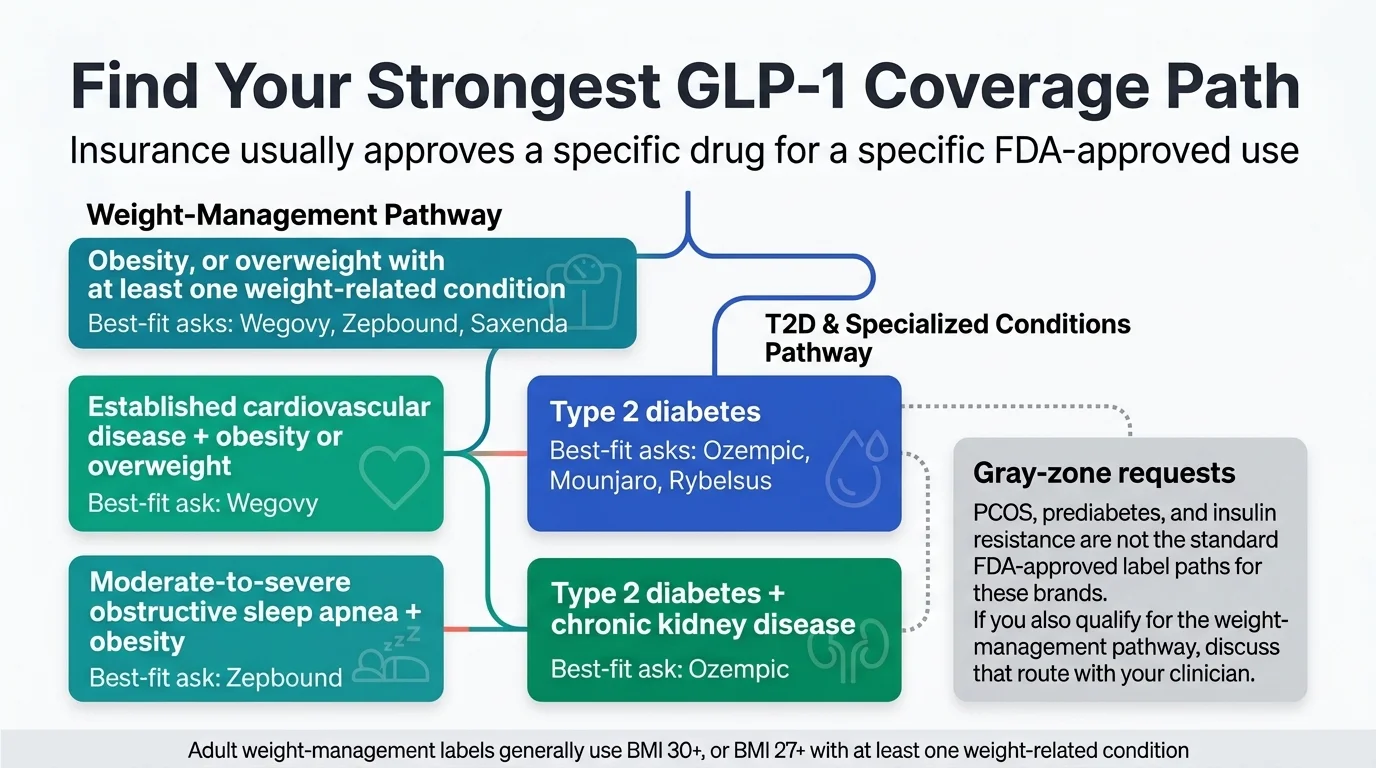
Quick answer: Navitus Zepbound coverage depends on your exact plan, not just the Navitus name. Some plans cover it with strict rules; others exclude weight-loss treatment or require a specific program. Eligible Medicare members have a separate $50 KwikPen path. Check your plan, product, and diagnosis before paying for a new provider.
By The RX Index Editorial Team · Independent guidance for choosing your GLP-1 path. · Last verified: September 2026
Disclosure: Some links on this page are affiliate links, marked "(affiliate link)." If you use them, The RX Index may earn a commission at no extra cost to you. You never need them to check your benefits. Every free checklist on this page works without them. How we make money
Zepbound on Navitus at a glance (2026)
BMI, or body mass index, is a height-and-weight measure used in these coverage rules.
| If your Navitus plan is… | Zepbound for weight loss in 2026 | What’s next |
|---|---|---|
| State of Wisconsin, including UW and participating local employers | Weight-loss drugs are not covered in 2026. | A weight-loss drug benefit starts Jan. 1, 2027, at $200 per covered fill, subject to plan cost-sharing rules. Confirm the exact Zepbound product. 1 |
| UC PPO: UC Care or HealthSavings+ | Prior authorization; the weight-loss BMI rule is 40+. Existing users need their pre-treatment record. | Ask about all start or renewal requirements. 2 |
| PRISMHealth public-agency plans | Digbi Health must prescribe covered weight-loss GLP-1s, and its medication rules apply. | Use Digbi, not a new outside prescriber, for that benefit. 3 |
| SISC school plans | The public list marks Zepbound EXC. | Check your employer’s specific benefit and any required program before treating that as a final answer. 4 |
| Navitus MedicareRx retiree plans | Basic Part D does not cover weight-loss-only use. The separate Bridge offers $50 KwikPen fills to eligible members. | Check medical eligibility and any GLP-1 fills paid by your Part D plan in 2026. 5 |
| Another employer, or not sure | Your plan’s own benefit decides. | Use the call checklist below. |
Get my free Navitus call checklist ↓ Seven questions. A place to write the answers. No signup or paid provider needed.
Here's what trips people up. Two coworkers on different benefit plans can both carry a card with Navitus on it. One gets Zepbound for a copay. The other hears "excluded." Below, you'll see which plan says what, the separate review for sleep apnea, and the one line in Wisconsin's public records that explains why plans land where they do.
The RX Index is the independent GLP-1 decision resource that scores telehealth providers and treatment paths on clinical legitimacy, care quality, transparency, access, and cost, so readers can choose the path that fits their situation.
This page is for you if:
- Your pharmacy card says Navitus, and you want to know if your plan will pay for Zepbound.
- You're starting Zepbound, renewing it, or just got a "no" at the pharmacy.
- You work for the State of Wisconsin, UW, a UC campus, a California county or city, a California school district, or you're a retiree on a Navitus Medicare plan.
This page isn't for you if:
- Your card says Express Scripts, CVS Caremark, or OptumRx. Go to our Express Scripts, CVS Caremark, or OptumRx guides instead.
- You have type 2 diabetes and need Mounjaro. Start with the best tirzepatide for diabetes.
- You want to compare every GLP-1 on Navitus, not just Zepbound. Use our Navitus GLP-1 formulary guide.
What we actually verified (September 22, 2026)
- We compared public documents for five coverage situations: Wisconsin’s Group Health Insurance Program, UC PPO plans, PRISMHealth, the SISC public formulary, and the Medicare rules that apply to eligible Navitus MedicareRx retirees. These are examples, not a survey of all Navitus plans.
- We checked Navitus's prior authorization rules, CMS's Medicare GLP-1 Bridge rules, Lilly's Zepbound prices and savings card terms, and Ro's pricing page. We also checked Ro’s coverage-checker limits and membership terms.
- We did not log in to anyone's account or submit a real request. Your plan’s documents and written coverage decision apply to your benefits. Sources and verification dates are listed below.
How does Navitus Zepbound coverage differ by plan in 2026?
Answer: It depends on your plan. Navitus Health Solutions is a pharmacy benefit manager (PBM), the company that runs the drug list and processes pharmacy claims. Your employer or plan decides whether weight-loss drugs get paid. The examples below include a BMI-based benefit, a required-prescriber program, a 2026 exclusion, a public EXC listing, and a separate Medicare program. Those are not five rules you can apply to every member.
That's why a single "yes" or "no" answer online can steer you wrong. Here's what each plan actually says, with dates.
The Navitus Zepbound plan list
| Navitus plan group | Who’s on it | Zepbound for weight loss in 2026 | Sleep apnea | What to check next | Source, checked Sept. 22, 2026 |
|---|---|---|---|---|---|
| State of Wisconsin Group Health Insurance Program | State employees, UW, and participating local employers; non-Medicare members | Not covered for weight loss in 2026. | Request the rules for the OSA indication; a weight-loss exclusion alone does not answer that question. | 2027 covered weight-loss drugs: $200 copay, no PA. Confirm the exact drug and device. | 6; 1 |
| UC PPO: UC Care, HealthSavings+ | UC faculty, staff, and non-Medicare retirees in those PPO plans | PA and BMI 40+ for weight-loss treatment. Existing users need pre-treatment BMI 40+ plus continued medical need and approval. | UC says coverage for other conditions did not change. Ask for the OSA-specific review. | Do not use current BMI alone to rule out a renewal. | 2; 7 |
| PRISMHealth | Eligible members of participating public-agency plans | Digbi must prescribe, and its medication criteria apply. | Ask Navitus and Digbi which benefit applies. Digbi’s Medicare note directs OSA decisions to Navitus. | Check the required program before paying another clinician. | 3; 8 |
| SISC | Members of participating California school plans | EXC in the public list. That list does not establish every employer’s program rules. | Request your own plan’s OSA criteria. | Ask whether your employer has a separate GLP-1 program. | 4 |
| Navitus MedicareRx retiree plans | Medicare retirees in eligible employer-group drug plans | Basic Part D excludes weight-loss-only use. Eligible members can use the $50 KwikPen Bridge. Some group plans have supplemental benefits. | Standard Part D review, not Bridge. | Check Bridge exclusions and prior Part D-paid GLP-1 fills. | 5; 9 |
Same Navitus name. Five different coverage checks.
State of Wisconsin: a weight-loss drug benefit starts in 2027
Wisconsin's Group Insurance Board chose not to cover weight-loss drugs for 2026. Then, in March 2026, it voted to cover GLP-1 weight-loss drugs starting January 1, 2027, at their own cost level with a $200 copay for members without Medicare. 10
This is a big plan. The state program had 211,303 non-Medicare members in October 2024. It covers state workers, UW employees, and many local governments and school districts. 11
Open enrollment for 2027 runs October 5–30, 2026. That’s your moment to confirm your exact Zepbound product and plan. 12
The newer rule is clear: ETF says covered weight-loss drugs will not require prior authorization or extra benefit eligibility tests in 2027. You still need a prescription. Its notice says some FDA-approved weight-loss drugs, not every Zepbound device. Ask Navitus which one is covered. 1
University of California PPO: BMI 40 or higher
Starting January 1, 2026, UC's PPO plans limited weight-loss drug coverage, including GLP-1s like Zepbound, to members with a BMI of 40 or higher. If you were already on treatment, you could continue only if your BMI was 40 or higher before you started. Prior authorization goes through Navitus. UC also says exceptions may apply; ask for the written rule rather than assuming a BMI number is the whole approval. 2
At UC's October 2025 staff town hall, UC said there would be no comorbidity exceptions to the BMI 40 rule in UC Care. In other words, conditions like prediabetes don't lower the bar. One member's worry says it all: "will that be honored in 2026?" The same town hall separates an OSA indication from a comorbidity used to seek weight-loss coverage. 7
UC's page lists Navitus Customer Care at (833) 837-4308. UC's HMO plans aren't run by Navitus and follow different rules. This section covers the PPO plans only. 2
PRISMHealth (California public agencies): only through Digbi Health
PRISMHealth moved its pharmacy benefit from Express Scripts to Navitus in 2026. It also made Digbi Health the only prescriber for covered weight-loss GLP-1s. 13 3
Digbi's PRISM FAQ lists these rules for weight-loss GLP-1s, effective January 1, 2026:
- You're 18 or older and on an Anthem or Blue Shield plan through your employer.
- Your BMI is 40 or higher, or 35 to 39 with at least one related health condition.
- For people already taking a GLP-1 for weight management, the FAQ requires 5% weight loss since starting. It gives new starters 90 days to make progress. Ask Digbi how it will measure your response. 3
A Zepbound prescription for weight loss from any other doctor won't be paid. Mendocino County and the City of Chico publish Navitus benefit information using the carrier ID NVPSM. 14 15 A carrier ID of NVPSM on your card is a strong clue you're on PRISM. Digbi's PRISM line is (866) 344-2189, or visit Digbi’s PRISM page. 3
Sleep apnea note: Digbi's FAQ tells Medicare (group retiree) members with sleep apnea, MASH, or heart-event risk to contact Navitus for a coverage decision. If you're not on Medicare and you have sleep apnea, ask both Navitus and Digbi which review applies to you. The FAQ also describes separate group-retiree benefits, so Medicare members should not assume all of Digbi’s non-Medicare rules apply. 3
SISC schools: listed as excluded
When we rechecked the public SISC Navitus formulary on September 22, 2026, Zepbound was listed as EXC, meaning excluded from the standard listed benefit. 4 Pull your current list before you decide anything. Formularies change. Ask about an employer-specific GLP-1 program, too: the CSUSM Corporation Q&A shows that Zepbound can appear not covered in a lookup yet be paid when an eligible member uses Digbi. That example does not prove every SISC member has Digbi. 8
Navitus Medicare retiree plans: check the Bridge and any group-plan benefit
Basic Part D does not cover drugs used only for weight loss. But Medicare's GLP-1 Bridge can cover eligible members, and some employer-group plans offer separate supplemental benefits. A GLP-1 fill paid by your Part D plan in 2026 blocks Bridge eligibility for 2026. 5 We cover it in the Medicare section below.
Not on this list?
Navitus runs pharmacy benefits for many employers, public agencies, and health plans. Each one has its own list. The only answer that counts is yours, and the call checklist helps you get the status, the reason, and the next action in writing.
Why does my coworker's Navitus plan cover Zepbound when mine doesn't?
Answer: Because Navitus isn't one plan. Your employer, union, school district, public agency, or health plan picks the benefit, and covering weight-loss drugs can cost a large employer millions of dollars a year. Wisconsin’s public records show how BMI limits and copays affected rebates under the Navitus agreements used for that program’s cost estimates. They do not reveal every employer’s contract.
Think of it like this. Navitus is the restaurant kitchen. Your employer writes the menu and pays the bill.
So why do employers pick such specific rules? Wisconsin's Board memos give a rare look behind the curtain.
The $200 clue
| Plan design in Wisconsin’s cost analysis | Rebate treatment described in the memos |
|---|---|
| FDA-label eligibility, without an extra restrictive BMI rule | Full rebates in the modeled option |
| Separate $200-copay level, without an extra BMI restriction | Full rebates in the 2026 memo’s model |
| BMI threshold of 35, with a $50 copay | Partial rebates in Table 2 of the 2026 memo |
| BMI threshold above 35 | No rebates under the agreements described in the 2026 memo |
| Copay above $200 | No rebates under the agreements described in the 2026 memo |
| Lifetime limits | No rebates under the older agreements described in the 2024 memo |
Sources: 11 and 16. These describe dated agreements and estimates, not universal Navitus rules.
Now look at Wisconsin's 2027 copay: exactly $200. That was the highest copay that kept full rebates in the memo’s model.
The money is real. Wisconsin's model for the $200 option expected about 9,401 members to use these drugs in 2027, at about $16.6 million in first-year drug costs. Those are forecasts, not measured 2027 spending. 16
Your employer's deal may be different. But now you know why two Navitus cards can give opposite answers, and why checking your own benefit beats a hundred general searches.
Your situation changes the answer. The right GLP-1 provider isn't the same for everyone — it depends on your state, your insurance and formulary, whether you want an FDA-approved or compounded medication, your preferred form (injection or oral), and your budget. Because a general answer can't resolve those for you, use The RX Index's Find My GLP-1 Path tool to explore a provider match before you choose. The tool does not confirm your Navitus benefits.
Find my provider options with Find My GLP-1 Path →
How do I check my own Navitus plan for Zepbound?
Answer: Search "Zepbound" in the Navitus member portal or app, and note the code next to it. Then call the number on your pharmacy card with a short list of questions. Ask about the exact Zepbound device and the reason it's prescribed, and get a reference number. Wait times vary; keep the reference number so you do not have to start over.
Step 1: Look it up
- Log in at the Navitus member portal or use the Navitus app if your plan supports it. These tools show plan-specific medication costs and coverage. 17
- No login yet? Use your employer’s benefits page to reach its public Navitus preview. Examples include UC’s preview and PRISM’s NVPSM preview. These do not replace your member-specific benefit check.
- Search "Zepbound," then match the device, strength, and quantity on your prescription. Tirzepatide is also the ingredient in Mounjaro, a different brand with different approved uses. 18 19
Step 2: Write down exactly what you see
Look for letters like PA, QL, RDX, EXC, or 100%/EXC. Screenshot the screen with the date. We decode those codes below.
Step 3: Make the call
Call the number on your pharmacy card, or Navitus Customer Care at 844-268-9789. Then read this script. 20
Your Navitus call script (copy it) "Hi, I'm checking coverage for Zepbound under my current plan. 1. Is Zepbound covered for weight management on my plan? Which exact product and strength are you checking: single-dose pen, KwikPen, or a vial? 2. Is there a separate rule if it's prescribed for obstructive sleep apnea? 3. Is prior authorization, a quantity limit, or a specific program or prescriber required? 4. Where can my prescriber find the current criteria? 5. What would I pay at my pharmacy? Does that include my deductible? 6. Does drugmaker copay help count toward my deductible or out-of-pocket max? 7. Can I get a reference number, and where can I see this answer in writing?"
Your call checklist
| Write this down | Your answer |
|---|---|
| Plan name, date, and rep’s name | |
| Reference number | |
| Device and dose they checked | |
| Covered for weight management? | Yes / No / Review required / Not yet confirmed |
| Covered for sleep apnea? | Yes / No / Review required / Not yet confirmed |
| Required program or prescriber? | |
| Price at my pharmacy, including any deductible | |
| Does copay help count toward my deductible? | Yes / No / Ask for plan terms |
| Where are the written criteria or denial reason? | |
| Who I contact next |
You won't be the first to make this call. One Navitus member, in a comment Navitus published on its website, described the moment perfectly: "When my copay was higher than expected and no one could figure out why…" That member called customer support. Do the same, with this list in hand. Navitus published the comment anonymously; it does not identify a Zepbound case. 21
Keep the checklist: Copy it into your notes, or use your browser’s Print command to save this page as a PDF. No signup needed.
Rather have someone else check for you?
Ro offers a free coverage check for the Zepbound single-dose pen. Ro says it sends a report with your coverage details, a cost estimate, and whether prior authorization is needed. If you continue with Ro and your plan permits that prescriber, its team can help with the paperwork. 22 and 23.
Know the limits before you click:
- It does not check KwikPen coverage.
- It's a coverage report, not an approval or a prescription.
- On PRISM? Use Digbi for the required covered weight-loss program. A Ro coverage report does not make a Ro prescription meet that rule. 8
Let Ro check my Zepbound pen coverage — free → (affiliate link)
What do "PA," "EXC," and "not covered" mean for Zepbound?
Answer: They're different problems with different fixes. "PA" (prior authorization) means a review is required—not that approval is promised. "EXC" means the standard benefit excludes the drug. Ask whether an exception or required program applies before treating that code as your final answer. Always get the exact reason before you choose a next step.
Most people treat every "no" the same way. That's how they waste weeks. Use this table to name your problem first.
The Navitus Zepbound coverage decoder
| What you see or hear | What it means | Who can act | Your next step |
|---|---|---|---|
| PA | A coverage review is required; approval is not guaranteed. | Your prescriber | Get the current criteria and submit the matching records. |
| QL | Your plan limits the quantity. | Prescriber or pharmacy | Check the requested quantity and whether an exception is needed. |
| RDX | Coverage is limited to specified diagnoses. | Prescriber | Make sure the diagnosis on file is accurate. |
| EXC or 100%/EXC | Excluded from the standard listed benefit. | Plan, and any required program | Ask about exceptions and program-specific coverage before comparing cash prices. |
| “Missing information” denial | Requested records were not received in time. | Prescriber’s office | Identify the missing item and the correct resubmission or appeal process. |
| “Criteria not met” denial | A coverage requirement was not met. | Prescriber and you | Read which rule; decide whether the evidence supports an appeal. |
| Pharmacy rejection at the counter | The claim did not pay; the reason still needs checking. | Pharmacy and plan | Ask for the exact rejection reason. |
| “Authorization expired” at renewal | Your old approval ended. | Prescriber | Ask for the renewal requirements and authorization dates. |
This is our next-step framework, built from 24, 20, and the 8. It is not a complete list of pharmacy claim codes.
Does "100%/EXC" mean 100% covered?
No, and this one fools a lot of people. Navitus defines an excluded product as one that isn't available at a reduced copay or coinsurance under normal conditions. On Wisconsin’s public list, 100%/EXC means the member pays the full cost under that listed benefit—not that insurance pays 100%. That does not tell you the lowest manufacturer self-pay price. Annoying? Yes. But now you know. 24 and 25.
A true benefit exclusion is not the same as missing paperwork. But a program restriction can also show as not covered: CSUSM’s Q&A says eligible members get Wegovy or Zepbound covered through Digbi even when the lookup says otherwise. Ask that question before you pay cash. 8 Our plan exclusion vs. prior authorization guide and our pharmacy rejection code guide go deeper. For more Navitus formulary terms, see our Navitus GLP-1 formulary guide.
Which Zepbound should I ask for on Navitus: pen, KwikPen, or vial?
Answer: Ask about the exact product your plan covers. Lilly’s commercial savings offer for a covered single-dose pen is one option; the KwikPen is the only Zepbound product in Medicare’s $50 Bridge. LillyDirect sells single-dose vials through its self-pay program. Those purchasing channels do not prove what every plan covers.
Same medicine. Different packaging. Different ways to pay. A prescription for the wrong device can get rejected even when you qualify.
The Zepbound device map
| Product | What it is | Payment option verified for this guide | Medicare Bridge |
|---|---|---|---|
| Single-dose pen | Four pens per 28-day supply; needle built in | Covered commercial insurance: as little as $25 with the eligible card and savings caps. Commercial insurance without coverage: as low as $499 with the separate offer. | No |
| KwikPen | One pen holds four weekly doses; separate pen needles needed | Self-pay offers start at $299 / $399 / $449 by dose. Check your plan before assuming it is cash-only. | Yes: $50 if eligible, plus separately purchased pen needles |
| Single-dose vial | Four vials per 28-day supply; syringe and needle needed | LillyDirect’s self-pay channel: $299 / $399 / $449 by dose and offer terms. | No |
| Multi-dose vial | A separate four-dose presentation in the current label | Do not apply single-dose-vial prices or availability claims to it. Ask the pharmacy about the exact product. | Not included in CMS’s Zepbound product list |
The simple rule: Using insurance? Match the prescription to the covered product. On Medicare’s Bridge? Ask about the KwikPen. Paying cash? Compare the KwikPen and LillyDirect single-dose vial at your prescribed dose.
Sources: 18, 26, 27, and 28. The $449 price has refill conditions; see the cost table below.
For doses and how each device works, see our Zepbound dose chart for the pen, vial, and KwikPen.
Can Navitus cover Zepbound for sleep apnea?
Answer: Sometimes, through a separate review. The FDA approved Zepbound in December 2024 to treat moderate-to-severe obstructive sleep apnea (OSA) in adults with obesity, so some plans review it for that use apart from weight loss. Your clinician needs to document the diagnosis and severity. The diagnosis has to be real. 29
Obstructive sleep apnea means your airway keeps closing while you sleep, so your breathing stops and starts. A sleep study counts those events per hour. Moderate OSA means an apnea-hypopnea index, or AHI, of 15 to under 30 events an hour. Severe means 30 or more. 18
The FDA based its approval on two year-long trials called SURMOUNT-OSA. One enrolled people who used a breathing machine at night (called PAP, like a CPAP). The other enrolled people who couldn't or wouldn't use one. The FDA indication does not require every patient to fail CPAP first. Your plan can still have its own review requirements. 29
What to have your prescriber check
Every plan writes its own rules. Have your prescriber check which of these your plan requires:
- A sleep study report showing moderate-to-severe OSA, with the date
- Your current BMI
- Sometimes, your history with a PAP machine, or a sleep specialist's involvement
Use the requirements for your exact plan. Navitus directs prescribers to its prescriber portal for forms. 20
How the Navitus plans we checked handle it
The PRISM and UC distinctions below come from 3 and 2.
- PRISM: Digbi's FAQ tells Medicare members with sleep apnea to contact Navitus for a coverage decision. Non-Medicare members should ask Navitus and Digbi which review applies.
- UC PPO: UC says coverage for "other conditions" didn't change. Ask Navitus whether sleep apnea is reviewed outside the BMI 40 rule.
- Navitus Medicare retiree plans: Sleep apnea is reviewed under your Part D plan. It does not go through the Bridge. A formulary exclusion does not move that indication into the Bridge. 5
Straight talk: Sleep apnea is not a loophole. If you don't have diagnosed OSA, this review isn't for you. Never ask a clinician to list a condition you don't have.
Want the full picture? Read does insurance cover Zepbound for sleep apnea and the best GLP-1 for sleep apnea.
What does my prescriber need for a Navitus prior authorization?
Answer: Your prescriber needs your plan's current Zepbound criteria and the records that prove you meet them. Navitus says it reviews most complete prior authorizations within two business days, and urgent requests within 24 hours. If the office doesn't answer a request for missing information in time, the request can be denied.
That last part matters most. A "no" can be about a missing page, not whether treatment is right for you. 20 and 30.
Where the form lives, and how fast it moves
- Your prescriber downloads the form from the Navitus prescriber portal, prescribers.navitus.com.
- They can send it by mail or fax, or call to speak with a prior authorization specialist.
- Navitus reviews most complete requests within two business days. Urgent requests get a decision within 24 hours.
Starting vs. staying on it
| Plan | To start Zepbound | To keep getting it |
|---|---|---|
| UC PPO | Weight-loss BMI rule of 40+ and PA; check the full criteria | Pre-treatment BMI 40+, continued medical need, and renewal approval |
| PRISMHealth | Digbi prescription; BMI 40+, or 35–39 with a related condition | Digbi’s 5% weight-loss requirement; new starters get 90 days to make progress |
| Wisconsin’s 2027 weight-loss benefit | Confirm a covered product and obtain a prescription; ETF says no PA | Use the 2027 formulary and plan’s refill rules |
| Medicare Bridge | Eligible plan, adult age, CMS’s full clinical criteria and exclusions, and Bridge PA | Continued program eligibility and an approval for the requested medicine |
Sources: 2, 7, 3, 1, and 28. These rules are not interchangeable.
Your prescriber checklist
Bring this to your appointment:
- [ ] The exact product, dose, and quantity; include the product code if your pharmacy provides it
- [ ] The reason it's prescribed (weight management, or sleep apnea)
- [ ] Your BMI with the date it was taken
- [ ] Your starting BMI if you're already on a GLP-1 (UC and renewals look back)
- [ ] Related health conditions (only ones you actually have)
- [ ] For sleep apnea: your sleep study report and its date
- [ ] Past weight treatments, if your plan asks
- [ ] The correct form: Navitus for a plan PA, or the separate Bridge form for Medicare Bridge treatment
Bring the checklist: Copy these items into your appointment notes, or print this page. Your prescriber should use only the items your benefit requires.
Want a provider who handles this paperwork for you? Compare options in our guide to Zepbound providers that help with prior authorization.
What should I do if Navitus denies Zepbound?
Answer: Start with the written reason. A "missing information" denial needs the missing record and the correct resubmission or appeal process. A "criteria not met" denial may be worth appealing with better proof. A plan exclusion is a benefit choice, so ask whether your plan allows any exception at all. Follow the deadline printed on your notice. 20
If information was missing
Call your prescriber's office. Ask which item Navitus requested and whether it was sent. Then ask whether the office should complete the existing request, submit a new one, or appeal.
If a rule wasn't met
Find out which rule. BMI? Program? Records? Your prescriber should answer that exact rule, not send a general letter about why Zepbound is helpful.
If your plan excludes it
Ask Navitus for the exclusion language and whether any exception process exists. An appeal letter argues medical need; it does not itself add an excluded benefit. Also ask whether a required program can provide coverage. Switching to a different telehealth company won't change your benefit either. 20 and 8.
If it stopped at renewal
Ask for your authorization end date and your plan's renewal rules. Bring your starting records: UC’s continuation rule looks at pre-treatment BMI, while Digbi asks about weight loss since starting. 2 and 3. If your plan year just changed, ask what changed with it.
Deadlines: Use the deadline on your denial notice. Commercial and Medicare plans follow different rules.
Get the free appeal letter template →
If your notice allows further review, see how external review works for GLP-1 denials. Bridge requests are different: CMS has no Bridge appeal process, but a prescriber can resubmit corrected or additional information. 28
How much will Zepbound cost on a Navitus plan?
Answer: If your plan covers the single-dose pen, Lilly's savings card can bring it to as little as $25 a fill on commercial plans, with up to $100 off a 28-day fill and $1,300 in savings for 2026. If your plan won't pay, Lilly’s published self-pay offers are $299 to $449 per 28-day supply for the KwikPen or single-dose vial, depending on dose and terms. Eligible Navitus Medicare retirees can pay $50 a month through Medicare's Bridge. 26 and 9.
Cost is the part that keeps people up at night. At UC's 2025 town hall, one member put it bluntly: "The out-of-pocket costs are unrealistic." Navitus's own 2026 survey found that 68% of GLP-1 users said cost affected whether they started or stayed on treatment, and 24% reported paying more than $250 a fill. The survey covered 2,000 U.S. adults with GLP-1 use in the prior two years, not just Navitus members or Zepbound users. 7 and 31.
So here are the verified payment options, side by side.
Zepbound cost ladder (verified September 22, 2026)
| Your situation | Price or cost rule | What changes the total |
|---|---|---|
| Commercial plan covers the single-dose pen; eligible Lilly card | As little as $25 per 28-day fill | Maximum savings of $100 per 28-day fill, $1,300 for 2026, up to 13 fills; other card rules apply. |
| Wisconsin’s new covered weight-loss benefit, Jan. 1, 2027 | $200 copay | Exact product must be covered. HDHP deductible and plan out-of-pocket limits matter. |
| Commercial plan does not cover the single-dose pen; eligible Lilly card | As low as $499 per 28-day fill | Separate non-covered offer and eligibility rules. |
| KwikPen or LillyDirect single-dose vial, self-pay | $299 at 2.5 mg; $399 at 5 mg; $449 at 7.5–15 mg with the purchase offer | Higher-dose continuation requires refill purchase within 45 days of the preceding delivery or receipt, under the applicable offer. |
| Higher doses without the purchase offer | $499 at 7.5 mg; $699 at 10–15 mg | Regular self-pay prices, not the discounted continuing-offer price. |
| KwikPen through Ro | Ro publishes the same $299 / $399 / $449 dose prices | Membership is extra. This is a comparison of published prices, not a tested checkout. |
| LillyDirect self-pay pharmacy | The published medication prices above | No LillyDirect pharmacy membership fee; your prescriber’s care and injection supplies can still cost extra. |
| Eligible Medicare Bridge member | $50 per monthly KwikPen fill | Separate pen needles; no credit toward the Part D out-of-pocket limit. |
| Ro’s displayed list-price reference | About $1,087 | Ro shows this beside its KwikPen cash price. It is not your pharmacy quote or a price for every Zepbound presentation. |
Price sources, checked September 22, 2026: 26, 27, 23, 1, and 28.
The $25 catch, in dollars: If your eligible covered-pen copay is $200 and the card saves the maximum $100 for that fill, you pay $100—not $25. “As little as” is not a promise about your copay.
Lilly’s commercial savings cards and KwikPen discount offers have separate limits. Current card terms end December 31, 2026; the KwikPen card terms cap use at 11 fills per calendar year. Do not turn a 2026 offer into a guaranteed 2027 budget. 26
What a year really costs (our math)
We added up 13 four-week fills: 364 days of medicine. These are examples at today’s published prices, not a promise that an offer will last a year. One example stays at 5 mg; the other reaches a higher maintenance dose. Your prescriber sets your dose. Never pick a dose to save money.
| Example | Our calculation | What the number does—and does not—include |
|---|---|---|
| Self-pay, 5 mg maintenance after one starter fill | $299 + (12 × $399) = $5,087 | 13 medication fills at today’s prices; no care or supplies |
| Self-pay, higher-dose offer after the first two fills | $299 + $399 + (11 × $449) = $5,637 | Assumes prescribed dose changes, continuing offer eligibility, and timely refills; no care or supplies |
| Ro, first 12 calendar months on monthly membership | $39 + (11 × $149) = $1,678 | Membership only; add medication |
| Ro, intro month followed by annual prepayment at the published $74 monthly equivalent | $39 + (12 × $74) = $927 paid | Buys the intro month plus 12 prepaid months—13 membership months, not 12; medication extra |
| Wisconsin non-HDHP, 2027 | $1,325 individual / $2,650 family pharmacy out-of-pocket limit | Covers all qualifying pharmacy spending together, not just this drug; confirm a covered Zepbound product |
| Medicare Bridge, 13 eligible monthly fills | 13 × $50 = $650 | An arithmetic example, not a claim that all retirees qualify; pen needles extra |
Keep the clocks straight: A four-week drug fill is not a calendar-month membership. The 13-fill medicine examples cannot be described as 13 monthly membership charges. The $299 dose is a starter dose, not a maintenance dose. 18
The copay-help catch: two Navitus plans, opposite rules
Some Navitus plans enroll members in Access Guidance Services, a program that helps you use drugmaker copay help. But plans set different rules for it.
| Plan | Does manufacturer help count toward your costs? |
|---|---|
| UC PPO | No. UC says manufacturer or third-party payments do not count toward its deductible or out-of-pocket maximum. 2 |
| Wisconsin, non-Medicare AGS benefit from July 1, 2026 | Yes, for eligible assistance under that program. ETF says it can count toward cost sharing and out-of-pocket limits. This did not create Zepbound weight-loss coverage in 2026. 10 |
Why does this matter? Lilly's card terms say Lilly can cut your savings if your plan doesn't count card payments toward your costs. And if your plan uses an "alternate funding program," you can't use the card at all. So ask Navitus: "Is my plan in Access Guidance Services, and does copay help count toward my deductible?"
Two more rules to keep straight:
- Lilly’s commercial copay savings cards exclude Medicare, Medicaid, TRICARE, and other government coverage. Separate self-pay offers have different eligibility terms; do not confuse a cash discount with insurance assistance.
- When you use Lilly’s self-pay offer, you agree not to submit that purchase for insurance reimbursement or apply it to your insurance deductible or out-of-pocket spending. 26
More detail: our Zepbound savings card guide and cheapest Zepbound without insurance.
My Navitus plan won't pay for Zepbound. What's my best next step?
Answer: Match your next step to your plan's rule. You can ask about an exception, use the sleep apnea review if you truly have OSA, go through your plan's required program, wait for a coverage change like Wisconsin's on January 1, 2027, or compare self-pay care if your clinician recommends treatment. The next-step table is our framework based on the plan rules above.
Here's how that plays out, plan by plan.
| If you’re on… | And… | Your best next step |
|---|---|---|
| Wisconsin state plan | You want treatment before 2027 | Compare self-pay now with your clinician. Before changing to the 2027 benefit, verify the covered product and claim date. |
| Wisconsin state plan | You can wait | Confirm the 2027 product and cost-sharing rules during Oct. 5–30 open enrollment. ETF says no PA for covered weight-loss drugs. |
| UC PPO | Starting BMI is 40+, or you already use treatment and pre-treatment BMI was 40+ | Have your prescriber check all PA or renewal requirements. |
| UC PPO | Below the weight-loss BMI rule before treatment | Ask whether any stated exception applies. A real OSA diagnosis needs its own coverage check; otherwise compare self-pay. |
| PRISMHealth | You meet Digbi’s rules | Enroll with Digbi for the covered weight-loss benefit. |
| PRISMHealth | You do not meet the rules, or prefer another doctor | Confirm the decision with Digbi, then compare self-pay care. |
| Any plan | You have diagnosed moderate-to-severe OSA and obesity | Ask your clinician for the plan’s OSA-specific review. |
| SISC or another EXC listing | You have not checked for a program or exception | Ask Navitus and HR before paying cash. If no covered path applies, compare self-pay. |
| Navitus Medicare retiree | Seeking weight management | Check the full Bridge rules and prior Part D-paid fills before counting on $50 KwikPen. |
Want to start now instead of waiting on your plan?
If your plan says "no," or "not until January," and you'd rather not wait, Ro is our pick for readers who want online prescribing and ongoing support with FDA-approved Zepbound. Here's why it fits:
- FDA-approved Zepbound KwikPen at LillyDirect's prices: $299 (2.5 mg), $399 (5 mg), and $449 (7.5–15 mg with Lilly's refill offer). Ro says its cash prices match LillyDirect, NovoCare, and TrumpRx.
- A licensed provider reviews your health history, prescribes if it's right for you, and stays on hand for dose changes and side effects.
- Low-risk start: Ro says it refunds your $39 if you are medically ineligible for GLP-1 treatment. An insurance exclusion is not the same as medical ineligibility.
- Insurance help, too: if your plan covers the Zepbound pen and allows Ro’s prescriber, Ro’s team can check and help with the paperwork. 23
One honest catch: Ro does not change what your Navitus plan covers. If getting your plan to pay is your top priority, your plan's own path is better: your own doctor's prior authorization, or Digbi Health if you're on PRISM. But with Ro’s cash-pay path, treatment does not depend on insurance approval. You can request a provider review and, if prescribed, access FDA-approved KwikPen at Ro’s published LillyDirect-matched medication prices, with a provider in your corner along the way. The care membership is extra.
Does that sound like your situation? Get started for $39, then as low as $74/month with annual plan paid upfront ($149 month to month). Medicine is billed separately.
Staying only until your benefits change? Compare monthly billing before prepaying a year. Ro’s terms say membership renews automatically, paid fees are generally nonrefundable, and cancellation is due at least 48 hours before renewal. 32
What the providers state—and what we verified
| Provider-stated offer | What we checked on September 22, 2026 | What we did not test |
|---|---|---|
| Ro offers a free Zepbound coverage report | Its checker lists Zepbound single-dose pen and excludes KwikPen. 22 | A live Navitus benefit check or approval |
| Ro matches LillyDirect medication prices | Both publish $299 / $399 / $449 for the cited KwikPen offers; Ro charges a separate care membership. 23 26 | Checkout, delivery speed, or a personal prescription |
| Ro refunds the intro fee for medical ineligibility | Its pricing page states that condition. 23 | A refund request |
| Sesame offers provider choice and Zepbound care | Its Zepbound page describes clinician evaluation and treatment if appropriate. 33 | A visit, prescription, or Navitus claim |
Check your eligibility on Ro → (affiliate link)
Prefer to pick your own doctor? Sesame lets you compare provider options for Zepbound care. Check the care fee and medicine cost before booking. 33 See Sesame's weight-care providers → (affiliate link)
Not the right fit?
- On PRISM? Start with Digbi for the required covered weight-loss program.
- On Medicare? Jump to the Bridge section. Eligible members have a $50 option without a telehealth membership.
- Already have a doctor and just want the lowest cash price? Read LillyDirect vs. Ro for Zepbound.
Is paying cash for Zepbound a mistake when I have insurance?
Answer: No. If your plan won’t pay and treatment fits your health needs and budget, self-pay is a valid option. Just know that Zepbound bought with Lilly's self-pay offer doesn't count toward your deductible, you can't bill insurance for it, and you should re-check your plan at every open enrollment.
Lots of people feel guilty paying cash when they "have insurance." Don't. Your plan made a choice. You're allowed to make yours.
A few things to keep it clean:
- Keep your receipts. You may want them for an HSA or FSA. Check with your account administrator first, and see how to submit a GLP-1 for HSA reimbursement.
- Track the offer window. Missing Lilly’s 45-day refill-purchase window can raise higher-dose prices from $449 to $499 or $699. Follow your clinician’s dosing instructions; do not take medicine early to meet an offer deadline. 26
- Switching to coverage takes a product check. Confirm the covered device, pharmacy, and effective date before the next fill. PA depends on the plan; Wisconsin says its covered 2027 weight-loss drugs will not require it. 1
What about compounded tirzepatide? Compounded tirzepatide is not Zepbound, and it is not FDA-approved. 34 This page covers FDA-approved Zepbound only. If you're weighing the two, read compounded vs. name-brand GLP-1s first.
Not sure which way fits you? Get my free Navitus call checklist and make one call before you decide.
I’m a Navitus Medicare retiree. How do I get Zepbound?
Answer: For weight loss, check Medicare’s GLP-1 Bridge. Eligible Part D members, including qualifying employer-group retirees, can get Zepbound KwikPen for $50 a month through December 31, 2027. Group-plan membership alone is not enough. For moderate-to-severe sleep apnea, use your Navitus MedicareRx plan’s review, not the Bridge. 5
This is the best news on the page for retirees who qualify.
Many retirees from employers like UC and the State of Wisconsin get Part D through Navitus MedicareRx. Wisconsin's own fact sheet calls its plan an employer group waiver plan (EGWP). CMS says EGWP membership is an eligible plan type for the Bridge. Lots of people assume their group plan shuts them out. It doesn't. But your health criteria and prior paid claims still matter. 35 and 28.
Who qualifies for the $50 Bridge?
You must be 18 or older, enrolled in an eligible Part D plan, and prescribed treatment for weight management with ongoing nutrition and activity support. Your clinician must document one of these paths at the time you first started GLP-1 therapy:
| Starting BMI | Additional condition needed for this clinical path |
|---|---|
| 35 or higher | None of the conditions listed in the next two rows is required. Other Bridge rules still apply. |
| 30 or higher | Heart failure with preserved ejection fraction; or uncontrolled blood pressure above 140 systolic or 90 diastolic despite two blood-pressure medicines; or chronic kidney disease stage 3a or worse |
| 27 or higher | Prediabetes under ADA criteria; or prior heart attack; or prior stroke; or symptomatic peripheral artery disease |
These paths overlap. A person with BMI 32 and qualifying prediabetes can meet the third path. Starting BMI matters: treatment-related weight loss does not mean you must regain weight to qualify. 28 and 9.
What can block Bridge eligibility?
Do not skip these checks. CMS excludes people whose applicable diagnoses include type 2 diabetes, moderate-to-severe OSA, or noncirrhotic MASH with moderate-to-advanced fibrosis. Those need the Part D path. A drug missing from your Part D formulary does not make that indication eligible for the Bridge. 5
Also, a GLP-1 prescription filled through your Part D plan in 2026 makes you ineligible for the Bridge in 2026. This includes fills paid through an employer-group plan’s supplemental weight-loss benefit. Ask the plan to check your paid claims before you count on $50. 5
How do I start—and what does the $50 include?
- Your prescriber sends the prescription to the pharmacy.
- The pharmacy submits the Bridge claim first. That creates the record for the program’s PA process.
- Your prescriber completes the Bridge PA, not an ordinary Navitus PA for weight loss. Sending it before the pharmacy claim can produce a “patient not found” problem. 28
The Bridge uses KwikPen only for Zepbound. The $50 does not include pen needles and does not count toward your Part D out-of-pocket limit. Coupons cannot be added to a Bridge claim. 28 and 5.
Need help? Patients can call 1-800-MEDICARE. Prescribers can call the Bridge team at 855-273-0102, Monday–Friday, 8 a.m.–7 p.m. Eastern. 28
You don't need a telehealth membership for this. Your own doctor and pharmacy can handle it.
See if you qualify for the $50 Medicare Bridge →
For device details, see Zepbound KwikPen and the $50 Medicare Bridge. On Medicaid with a Navitus card? Rules vary by state. Start with does Medicaid cover Zepbound.
What's changing for Navitus members in 2027?
Answer: Three things to check. Wisconsin adds a covered weight-loss drug benefit on January 1, 2027. Navitus launched new GLP-1 programs that employers can add. And Lilly’s current 2026 card terms expire December 31. Open enrollment is your moment to check your next year—not assume this year’s offer continues. 1 36 26
Wisconsin: the $200 copay starts January 1
Do not multiply $200 by 13 and call that your annual bill. ETF’s 2027 rules include deductibles and out-of-pocket limits. HDHP means high-deductible health plan.
| 2027 Wisconsin plan design | What applies to covered weight-loss drugs |
|---|---|
| Non-HDHP | No pharmacy deductible; $200 copay until the combined pharmacy limit applies. The limit is $1,325 individual / $2,650 family across pharmacy levels 1–5. |
| State HDHP and local PO7/17 | Pay 100% until the $2,000 individual / $4,000 family combined deductible is met, then the copay. Combined in-network medical and pharmacy limit: $3,500 / $7,000. |
These are plan-year limits, not guaranteed Zepbound costs. Confirm your product is covered. 1
Do not subtract today’s Lilly card from a 2027 copay. The verified commercial card terms end December 31, 2026; this guide does not assume they will carry over. 26
ETF’s newer member guidance says no PA or extra benefit eligibility requirement for covered weight-loss drugs. Open enrollment runs October 5–30, 2026. 1 and 12.
Navitus's new GLP-1 programs for employers
On September 15, 2026, Navitus announced GLP-1 Pathways, options that plan sponsors can add. The programs help plan sponsors manage access, treatment, and costs. Navitus also offers DirectAccess, which gives members direct-to-consumer pricing on GLP-1s for weight management outside the normal pharmacy benefit.
These only help you if your employer adds them. That makes open enrollment the time to ask. DirectAccess is not the same as adding insurance coverage. 36
Your fall checklist
- Pull your plan's 2027 drug list when it's posted.
- Ask HR: "Are we adding GLP-1 Pathways, DirectAccess, or any weight-loss drug coverage for 2027?"
- Check whether your plan's BMI rule changed.
- Paying cash? Track the 45-day refill-purchase window without changing your prescribed dosing schedule.
- Using a Lilly card? Watch for its December 31, 2026 end date.
Is Zepbound safe for me?
Answer: Zepbound is FDA-approved, but it isn't right for everyone. Its label has a boxed warning about thyroid C-cell tumors, it shouldn't be combined with other GLP-1 or tirzepatide medicines, and stomach side effects are common. A licensed prescriber should review your health history before you start. 18
Coverage is one question. Safety is another. From Zepbound's prescribing information:
- Boxed warning: Tirzepatide caused thyroid C-cell tumors in rats. It's unknown whether it does in people. Don't use Zepbound if you or a family member has had medullary thyroid carcinoma, or if you have Multiple Endocrine Neoplasia syndrome type 2 (MEN 2).
- Don't combine: Don't use it with other tirzepatide products or other GLP-1 medicines.
- Serious allergic reactions have been reported. Don't use it if you've had a serious reaction to tirzepatide or any Zepbound ingredient.
- Common side effects include nausea, diarrhea, vomiting, constipation, and stomach pain.
- Birth control pills: Switch to a non-oral method or add a barrier method for 4 weeks after starting and 4 weeks after every dose increase, as the label directs.
- Pregnancy: Stop Zepbound when pregnancy is recognized and contact your prescriber.
- Get medical help for severe symptoms: Severe or lasting stomach pain, especially with vomiting, needs prompt review for pancreatitis. Trouble breathing or swelling of the face or throat can signal a serious allergic reaction and needs emergency help. 18
Read more: is Zepbound safe?
How did we verify this page?
The RX Index offers independent guidance for choosing your GLP-1 path. This page compares public benefit documents, manufacturer terms, and provider-stated offers; it does not report a personal insurance test or a medical consultation. It is general coverage information, not personal medical advice.
What we did: On September 22, 2026, we checked Wisconsin ETF’s benefit decisions, newer 2027 rules, and Board memos; UC’s PPO changes and town hall; Digbi’s PRISM FAQ and employer guidance; the public SISC formulary; Navitus’s PA instructions; CMS’s Bridge rules; Lilly’s prices and savings terms; and Ro’s checker, pricing, and terms. We checked Sesame’s Zepbound page for its current care offering.
What we didn't do: We didn't log in to anyone's Navitus account, submit a prior authorization, or test approval through any provider. We didn't survey every Navitus plan. Navitus serves many employers and health plans, and yours may differ.
What is original here: The cross-plan tables, coverage decoder, call script, and cost calculations are our work. They bring the linked sources together so you can compare the rules and act.
Why we built it: Most answers online say "it depends" and stop there. We wanted Navitus members to see the real rules for real plans, and to know exactly what to ask about their own.
Dates matter: Prices, offer deadlines, Bridge rules, and plan-year benefits can change. The date above records when we checked the sources. Confirm your own benefit before paying.
Read our methodology, editorial standards, and corrections policy.
Frequently asked questions
Does Navitus cover Zepbound?
It depends on your plan. Navitus runs the drug list, but your employer or plan decides whether Zepbound is paid. In 2026, UC's PPO plans cover it with prior authorization at BMI 40+, PRISMHealth covers it only through Digbi Health, and Wisconsin does not cover weight-loss drugs in 2026. Its new weight-loss drug benefit starts January 1, 2027; confirm the exact Zepbound product. 2 3 1
Does Navitus cover Zepbound for sleep apnea?
Some Navitus plans review Zepbound for obstructive sleep apnea separately from weight loss. The FDA approved it for moderate-to-severe OSA in adults with obesity in December 2024. Expect to need a sleep study. On Navitus Medicare retiree plans, sleep apnea is reviewed under Part D, not the Bridge. 29 5
Is Zepbound on the Navitus formulary?
It appears in the public lists we checked, but listed isn't the same as paid for. PA means a review is required; EXC indicates exclusion from the listed benefit. Neither replaces a check of your employer’s program rules. 24 8 Search "Zepbound" in the Navitus portal or app to see yours.
What does 100%/EXC mean on a Navitus plan?
It means the drug is excluded from normal coverage. Navitus defines an excluded product as one that isn't available at a reduced copay or coinsurance under normal conditions. On Wisconsin’s list, the member pays 100% under that listed benefit. That is not a quote for the lowest self-pay price. 24 25
How long does a Navitus prior authorization take?
Navitus says it reviews most complete prior authorizations within two business days, and urgent requests within 24 hours. If the prescriber's office doesn't answer a request for missing information in time, the request can be denied. These are Navitus review times, not Medicare Bridge turnaround times or approval promises. 20 30
Does Navitus cover the Zepbound KwikPen or vials?
LillyDirect sells single-dose vials through its self-pay channel. That does not establish a universal rule for every plan or the separate multi-dose vial in the label. Ask about the exact product. Medicare Bridge covers KwikPen only. 27 18 28
Can I use the Zepbound savings card with Navitus?
Yes, if you meet the commercial covered-pen card rules. It offers as little as $25 per 28-day fill, with maximum savings of $100 per 28-day fill and $1,300 for 2026. Government coverage is excluded from this commercial offer. Other self-pay and non-covered offers have different terms. 26
Will Wisconsin state employees get Zepbound covered in 2027?
Wisconsin has approved a 2027 benefit for some FDA-approved weight-loss drugs, with a $200 copay and no PA. Its general notice does not identify every covered Zepbound presentation. Confirm your exact product and the applicable deductible or out-of-pocket limit with Navitus. Open enrollment is October 5–30, 2026. 1 12
Does the University of California cover Zepbound in 2026?
In UC's PPO plans (UC Care and HealthSavings+), weight-loss drugs like Zepbound need prior authorization and a BMI of 40 or higher. Existing users need pre-treatment BMI 40+ plus continued medical need and approval; UC also notes that exceptions may apply. A current BMI below 40 does not alone settle renewal. UC's HMO plans aren't run by Navitus and have different rules. 2 7
Why does my Navitus plan say I need Digbi Health?
You're likely on PRISMHealth, a California public agency program. Starting in 2026, PRISMHealth made Digbi Health the only prescriber for weight-loss GLP-1s. Digbi’s published medication rules use BMI 40+, or 35–39 with a related condition, and a 5% response rule for existing users. New starters get 90 days to make progress. Its Medicare note describes different reviews. 3
Can Ro check my Navitus coverage for Zepbound?
Ro's free coverage check covers the Zepbound single-dose pen. It doesn't check KwikPen coverage, and it's a coverage report, not an approval. A report from Ro does not replace PRISM’s requirement to use Digbi for covered weight-loss prescribing. 22 8
Can my doctor prescribe Mounjaro instead?
Mounjaro contains the same medicine as Zepbound but is FDA-approved for type 2 diabetes, not weight management. Some Navitus plans limit diabetes GLP-1s to a diabetes diagnosis. Clinicians can prescribe approved drugs off-label when appropriate, but that does not override a plan’s diabetes requirement. Do not treat Mounjaro as an insurance workaround. 19 37
Does Navitus MedicareRx cover Zepbound?
Basic Part D does not cover weight-loss-only use. Eligible Navitus MedicareRx members can use the separate $50 KwikPen Bridge through December 31, 2027. Group-plan membership alone does not qualify you, and any GLP-1 fill paid through Part D in 2026 blocks Bridge eligibility for 2026. Sleep apnea goes through Part D. 5
Still not sure which GLP-1 program is right for you? Use our free Find My GLP-1 Path tool.
Find my GLP-1 provider options →
Sources below were checked September 22, 2026. Publication dates are shown where relevant. A retrieved public document is not a personal coverage determination. Linked formularies can change at the same address.
Sources
- Wisconsin ETF — 2027 Non-Medicare Plan Design and Cost-Sharing Changes
- University of California — 2026 PPO benefit changes
- Digbi Health — PRISM Member Journey FAQ, version 5; 2026 rules
- SISC public Navitus prescription formulary hosted by BSSP; changing document
- CMS — Medicare GLP-1 Bridge: Information for Part D Plans
- Wisconsin ETF — GIB Approves Benefit Changes for 2026
- CUCSA — October 2025 Town Hall: 2026 Open Enrollment; October 29, 2025
- CSUSM Corporation — Navitus Employee Q&A; 2026
- Medicare.gov — Weight-loss drug coverage
- Wisconsin ETF — GIB Approves Cost Sharing, GLP-1s for Weight Loss for 2027; March 16, updated April 15, 2026
- Wisconsin ETF — Weight-Loss Drugs: Current Events, Options, and Cost Analysis; October 15, 2024
- Wisconsin ETF — 2027 open-enrollment dates
- Lake County — 2026 health-benefit transition information
- Mendocino County — What’s New in Health Benefits
- City of Chico — Employee Benefits
- Wisconsin ETF — 2027 Final Benefit and Contract Changes Update; revised March 12, 2026
- Eli Lilly — Zepbound prescribing information
- Eli Lilly — Mounjaro prescribing information
- Ro — GLP-1 Insurance Coverage Checker
- Ro — Weight Loss Program Pricing
- Wisconsin public Navitus formulary; changing document
- Eli Lilly — Zepbound savings and self-pay offer terms
- Eli Lilly — LillyDirect Zepbound
- CMS — Medicare GLP-1 Bridge: Information for Providers
- FDA — First medication approved for obstructive sleep apnea; December 20, 2024
- Ro — Terms of Use; April 2, 2026 version
- Sesame — Zepbound care and prescribing information
- FDA — Concerns with Unapproved GLP-1 Drugs Used for Weight Loss
- Wisconsin ETF — State of Wisconsin Pharmacy Benefits Program Fact Sheet, ET-8933
- FDA — Understanding Unapproved Use of Approved Drugs, Off Label