
Ozempic cost with insurance depends on your plan's charge. Eligible commercially insured patients can pay as little as $25, but the savings card takes off no more than $100 per one-month fill. A deductible can leave a much higher bill. Medicare has a $2,100 limit for covered Part D drugs in 2026. (Novo's offer terms, Medicare costs)
Disclosure: Some links on this page are affiliate links, marked "(affiliate)." If you use them, we may earn a commission. That never changes the prices or the math we show you. How we make money
That's the quick answer. The costly surprises hide in the details: a $25 card your plan rules won't let you use, a January bill that looks like a typo, and months when paying cash actually beats your insurance. We checked the coverage rules and did the math pen by pen, so you can find your number fast.
This page is for you if you have insurance — job-based, marketplace, federal employee, Medicare, Medicaid, TRICARE, or VA — and an Ozempic prescription for type 2 diabetes, or you're about to get one.
Start somewhere else if:
- You want Ozempic only for weight loss. Ozempic isn't FDA-approved for that. Novo's published Ozempic offer terms require an FDA-approved use, including for its self-pay offer. Go to the weight-loss section to check a different treatment path. (Ozempic labeling, offer eligibility)
- You don't have insurance. See how to buy brand-name Ozempic at Novo's cash price.
- You want to know if your plan will approve it. See Does insurance cover Ozempic?.
Find your row
| If you have… | What to budget or check | $25 card? | Read next |
|---|---|---|---|
| Job-based, marketplace, or federal employee coverage for Ozempic | $25 when your eligible one-month patient charge is $25–$125; a charge below $25 stays lower | Yes, if all offer rules are met | The $25 card |
| The same coverage, with a deductible or coinsurance | Your processed claim price, less any eligible savings — not a national average | Yes, if eligible | Why it's so high |
| A plan that won't cover your prescription | $199–$499 per pen through Novo's self-pay offer, depending on dose and eligibility; not an insurance copay | No commercial-card benefit | Cash vs. insurance |
| Medicare drug coverage | Your plan's cost-sharing, within the $2,100 2026 limit for covered Part D drugs | No | Medicare |
| Medicaid | Your state's or managed-care plan's charge for an approved prescription | No | Other plans |
| TRICARE | Check the drug's status and medical-necessity approval: $48 retail / $44 home delivery are formulary-brand rates; non-formulary rates are $85 | No | Other plans |
| VA health care | $8 per 30-day supply at the listed Tier 2 rate, or $0 if exempt | No | Other plans |
Sources: NovoCare, Medicare, Medicaid, TRICARE pharmacy costs, TRICARE's Ozempic medical-necessity guidance, VA Ozempic listing, and VA copay rates. TRICARE retail rates cover up to 30 days; home-delivery rates cover up to 90 days. Special beneficiary groups have different rates.
You can check the bill before buying another care subscription. Use the two-price worksheet below. List price is not your insurer's negotiated price, and neither one is automatically your copay.
The RX Index is the independent GLP-1 decision resource that scores telehealth providers and treatment paths on clinical legitimacy, care quality, transparency, access, and cost, so readers can choose the path that fits their situation.
Jump to: Cost worksheet · The $25 card · Yearly examples · Cash vs. insurance · Medicare · 2027 changes · Pill vs. pen · Weight loss · Telehealth fees · FAQ
How Much Is Ozempic With Insurance?
With commercial insurance that covers Ozempic, your bill may be a flat copay, a percentage of the plan's price, or a deductible-stage charge. Novo's savings card can lower an eligible one-month charge by up to $100. That makes a $50 charge $25 — but a $300 charge still leaves $200. (Offer terms, copay and coinsurance basics)
Below is every kind of coverage we checked. Find yours, then look at the last column. That's the next price check to make.
The Ozempic Insured-Cost Ledger (checked September 22, 2026)
| Your coverage | What sets your price | What you pay or check | Card / deductible detail | Next money move |
|---|---|---|---|---|
| Job-based, marketplace, FEHB, or state-employee plan; covered one-month charge of $125 or less | Your copay or other patient charge | $25, or your existing lower charge | Card eligibility applies; ask how assistance is counted | Ask whether a covered three-month fill costs less |
| Same plan, patient charge over $125 | Your charge minus up to $100 | Example: $150 → $50 | Not every bill becomes $25 | Ask about a lower tier or mail order |
| Same plan, deductible not met | The plan's allowed price and remaining deductible | Get the pharmacy's processed claim price | A list-price example is not your quote | Ask if diabetes drugs skip your deductible; compare cash |
| Same plan, 25% coinsurance | 25% of the plan's allowed price | At an assumed $1,027.51 price: $156.88 after eligible savings | Illustrative math, not an insurer quote | Get the actual allowed price |
| Plan with an accumulator, maximizer, or alternate-funding arrangement | The plan's assistance rules and Novo's exclusions | Do not build a budget around an ineligible card | The relevant arrangements can exclude offer use | Get your plan's rules in writing |
| Commercial plan that doesn't cover Ozempic | A separate cash offer, if eligible | Pen: $199 introductory, then $349 at doses through 1 mg; $499 at 2 mg. Tablets: $149–$299 | Novo's self-pay purchases do not count toward insurance limits | Check offer eligibility and which drug your plan covers |
| Job-based coverage plus a government prescription plan | Coordination-of-benefits rules | Ask both plans how the claim is processed | Government prescription coverage excludes the commercial card | Confirm which plan pays first; don't guess |
| Medicare Part D or Medicare Advantage drug coverage, 2026 | Plan cost-sharing; deductible up to $615 | $2,100 annual covered-Part-D-drug limit | No commercial card | Check Extra Help and the payment-plan option |
| Medicare, 2027 | The plan's rules and applicable negotiated drug price | Deductible up to $700; covered-drug limit $2,400 | A negotiated drug price is not your copay | Compare the actual 2027 plan benefit |
| Medicare with Extra Help, 2026 | Extra Help rules | $12.65 or less for a covered brand-name fill | No deductible for covered drugs under Extra Help | Apply through Social Security |
| Medicaid | Your state and managed-care benefit | Check the exact covered prescription | No commercial card | Check the drug list and approval requirements |
| TRICARE | Formulary status, medical-necessity approval, beneficiary group, and pharmacy | Standard formulary-brand rates: $48 retail / $44 home delivery; non-formulary: $85 | No commercial card; lower rates aren't automatic for Ozempic | Ask about the medical-necessity form and home delivery |
| VA health care, approved Ozempic injection | Listed Copay Tier 2 and your exemption status | $8 for 30 days, $24 for 90 days, or $0 if exempt | Eligible medication copays share a $700 annual cap | Use the VA prescribing and pharmacy process |
| No insurance and low income | Novo's Patient Assistance Program rules | $0 if approved; Ozempic pen income limit is 200% of the federal poverty level | Income is only one requirement | Check the full eligibility rules before applying |
Sources: Novo's offer terms, list price, PAP eligibility, Medicare 2026 costs, CMS 2027 benefit figures, Table V-2, TRICARE rates, VA drug tier, and VA copays. These are program rules and labeled examples, not personal coverage decisions.
How common is coverage?
Coverage is common. A low bill isn't guaranteed.
- The drug list and your approval are different things. In GoodRx's analysis of MMIT data dated August 8, 2025, 97.6% of commercial enrollees outside ACA marketplace plans had Ozempic 1 mg listed as covered. That is a share of enrollees, not a count of plans or a current approval rate.
- Approval steps were common. In that same non-ACA commercial group, 68.9% faced prior authorization and 27.8% faced step therapy. Marketplace plans were measured separately: 84.2% faced prior authorization. (GoodRx's data and methodology)
- Ro's results describe Ro's users, not everyone with insurance. In its August 2024–April 2025 checker data, nearly all users had coverage for a type 2 diabetes GLP-1, and about half of covered users had a copay of $50 a month or less. Those figures are not Ozempic-only results. Ro is one of our affiliate partners. (Ro's report)
Not sure what your plan covers? Ro will call your insurance company and find out for you, free. Its checker covers the Ozempic, Wegovy, and Zepbound pens and reports whether prior authorization is needed. You don't have to buy a membership. You do need to give Ro your insurance details, and its advertised $50 credit is for new Ro accounts. The free check doesn't write a prescription or file prior authorization. It just gets you answers. (Ro's free checker)
Check my Ozempic coverage for free →
This is a direct link to Ro's free checker, not paid enrollment. Ro's paid insurance support works with eligible commercial plans, including FEHB, not Medicare, Medicaid, TRICARE, or VA coverage. Government-plan readers should use their plan's own benefit check. (Ro's insurance limits)
Rather do it yourself? Call the number on your insurance card, or use NovoCare's coverage lookup. We earn nothing either way.
What Will You Pay With Your Plan? Work It Out Here
Start with four things: whether your plan covers this prescription, how much deductible is left, whether you pay a flat copay or a percentage, and whether you can use Novo's savings card. To compare the rest of the year, you also need refill dates, the plan's price, and any other bills that will use the same deductible. (Insurance terms, offer rules)
Four words, in plain English:
- Deductible: an amount you may need to pay before your plan starts sharing certain costs. Some benefits apply before you meet it.
- Copay: a flat amount per fill, like $50.
- Coinsurance: a percentage of the plan's allowed price, not automatically a percentage of list price.
- Drug list (formulary): the drugs your plan covers, often sorted into price levels called tiers.
Ozempic Insurance vs. Cash Worksheet
Copy this table into your notes or print it. Fill it in during your insurance and pharmacy calls. You do not need to pay for a visit just to ask your insurer about benefits.
| Write down… | Your answer |
|---|---|
| Quote date, plan name, and pharmacy | ____________________ |
| Exact prescription: pen or tablet, strength, quantity, and days supplied | ____________________ |
| Covered and approved, approval still needed, or excluded? | ____________________ |
| Patient charge for this fill before the savings card | $___________________ |
| Eligible savings confirmed by the pharmacy | $___________________ |
| This fill: charge minus confirmed savings | $___________________ |
| Estimated patient charge after the relevant deductible is met | $___________________ |
| Remaining deductible; reset date; remaining out-of-pocket limit | ____________________ |
| Does the plan count card assistance toward those limits? | ____________________ |
| Novo self-pay price for this exact fill, if eligible | $___________________ |
| Separate visit, membership, lab, or other care charge | $___________________ |
| Number and dates of fills before the plan year ends | ____________________ |
| Other expected bills that use the same deductible or limit | ____________________ |
| Still unknown: what must the plan, pharmacy, or clinician confirm? | ____________________ |
You'll have four answers: this fill, later fills, cash versus insurance for the fills you still need, and what is still unknown. We never fill in a blank with $0.
For a qualifying one-month commercial-card example, a $300 patient charge minus the full $100 savings leaves $200. Add a separate $149 care fee and that billing period costs $349, not $200. That is example math, not a claim that your prescription or care plan will cost those amounts.
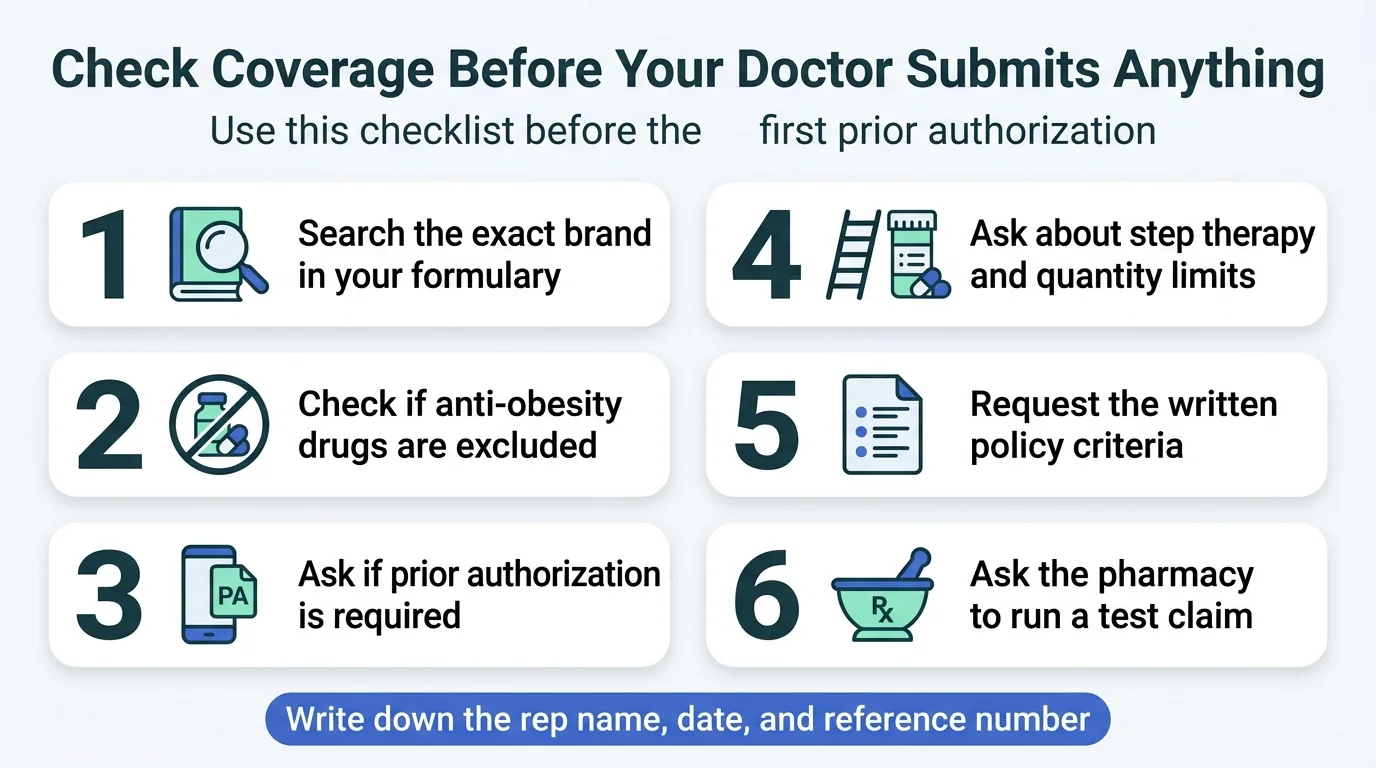
Don't know your numbers? Ask your plan these 6 questions
Call the member services number on your insurance card. Ask for two prices: what you'd pay today, and what you'd pay after your deductible is met. Then ask them to email it to you or put it in writing.
- Is my exact Ozempic prescription on my plan's drug list, and what tier is it?
- Do I need prior authorization or step therapy first?
- What would I pay for the prescribed supply today, and after my deductible is met? Is that a flat copay or a percentage?
- Do diabetes drugs skip my deductible? Does my plan have a preventive drug list that includes this prescription?
- Can I fill three months at a time? What quantity and days supplied will the plan cover, and is mail order cheaper?
- Does my plan use a copay accumulator or maximizer? Will the Ozempic savings card count toward my deductible?
Write down the date and the name of the person you spoke with. If the price changes later, you'll have a record.
Plan-specific rules: UnitedHealthcare · Blue Cross · CVS Caremark · Kaiser
Not sure which treatment path fits you? The right GLP-1 provider isn't the same for everyone — it depends on your state, your insurance and formulary, your preferred treatment form, and your budget. Because a general answer can't resolve those for you, use The RX Index's Find My GLP-1 Path tool to compare provider options before you choose. For Ozempic, stay with the FDA-approved brand-name path. A provider match is not an insurance quote or a prescription. Find My GLP-1 Path →
Why Is Ozempic So Expensive Even With Insurance?
A deductible, coinsurance, a high drug tier, or a savings-card restriction can keep your cost high. Novo lists Ozempic at $1,027.51, but your plan's allowed price may differ. The card takes off at most $100 per qualifying one-month fill, so it can't erase a large deductible bill. (List price, card terms)
Here's where that $1,027.51 goes in three worked examples. We assume the plan's allowed price equals list price, the full deductible applies in the first column, and the card is eligible. These are not pharmacy quotes.
| Cost item | Deductible not met | After the deductible, 25% coinsurance | Flat $50 copay |
|---|---|---|---|
| Assumed plan price for one pen | $1,027.51 | $1,027.51 | $1,027.51 |
| Your share before the card | $1,027.51 | $256.88 | $50.00 |
| Savings card pays | −$100.00 | −$100.00 | −$25.00 |
| You pay | $927.51 | $156.88 | $25.00 |
That first column is the one that makes people call their plan in a panic. It can be a correct deductible-stage bill, but the price alone doesn't prove that. Ask the pharmacy whether insurance processed the claim and which rule produced the charge.
Covered but expensive, or not approved yet? Read the pharmacy's message
These sound alike at the counter. They're different problems with different fixes.
| What the pharmacy tells you | What to check | Your next step |
|---|---|---|
| "It's covered. You owe about $900." | Is a deductible being applied, or is another benefit rule responsible? | Ask for the claim breakdown; check the cash crossover |
| "It's covered. You owe $150 to $300." | Is this coinsurance, a high copay, or a different pharmacy price? | Check card eligibility; ask about a tier exception and a larger fill |
| "Prior authorization required." | Approval is still needed | Your prescriber sends your plan the paperwork |
| "Not covered." | Is the drug excluded, the use excluded, the pharmacy out of network, or the claim entered incorrectly? | Get the exact reason in writing before paying another service |
| "Your savings card was rejected." | Eligibility, activation, claim details, and offer restrictions | See how to fix a rejected Ozempic savings card |
One rule worth checking before you count on the card: a copay accumulator can keep the card's contribution from counting toward your deductible. A maximizer is a different arrangement that changes how assistance is used. Novo's commercial-card terms exclude plans or arrangements with accumulator or maximizer features. Certain alternate-funding arrangements are also excluded. A rejected card is not proof of which rule caused it. (Novo's restrictions)
Stuck on an approval or a denial? That's a coverage problem, not a price problem. Our coverage guide walks through approvals and appeals, and our appeal letter template helps you push back.
How Does the $25 Ozempic Savings Card Work With Insurance?
Novo Nordisk's Ozempic savings card pays up to $100 of your cost for each one-month fill, $200 for two months, or $300 for three months, so you can pay as little as $25. Eligible commercial coverage includes job-based, marketplace, FEHB, and state-employee plans. The commercial card can't be used with government prescription coverage such as Medicare, Medicaid, TRICARE, or VA. (Full terms)
What you'll pay with the card
These examples assume a covered one-month prescription, full eligibility, and no other offer restriction.
| Your patient charge before the card | The card pays | You pay |
|---|---|---|
| $20 copay | $0 — you're already under $25 | $20 |
| $50 copay | $25 | $25 |
| $125 copay | $100 | $25 |
| $150 copay | $100 | $50 |
| $256.88 — the 25% example above | $100 | $156.88 |
| $1,027.51 — the deductible example above | $100 | $927.51 |
Novo's current terms say up to $100 for a one-month fill. Do not use an older $150 limit to work out today's bill.
The three-month move: $25 for three months
If your prescription is written and dispensed for three months, your plan covers that fill, and your eligible patient charge is $25–$325, the card can bring the whole fill down to $25. That's about $8.33 a pen when three maintenance pens are dispensed. A charge already below $25 stays lower. (Three-month offer rule)
For pens, Novo defines an offer month as 28 days. Three maintenance pens supply 84 days, not 90. Ask your plan and pharmacy how they handle that quantity under their three-month benefit.
Here is the same 13-pen supply bought two ways: 13 separate $25 fills cost $325. Four qualifying three-pen fills at $25, plus one qualifying one-pen fill at $25, cost $125. Both supply 52 weeks at a steady maintenance dose. This comparison assumes each fill meets its card limit and your plan covers the larger fills.
Ask your prescriber whether a three-month prescription fits your treatment plan, and ask your insurer whether mail order handles that quantity.
The fine print that changes your price
We read Novo's full savings-offer terms so you don't have to. These are the rules that change what you pay:
| Rule in Novo's terms | What it means for you |
|---|---|
| Government prescription coverage excludes the commercial card | Medicare, Medicaid, VA, DoD, and TRICARE members need a different path |
| Commercial coverage plus government prescription coverage is still excluded | A second, job-based plan does not restore card eligibility; two commercial plans are not automatically the same situation |
| FEHB, marketplace, and state-employee plans count as commercial for this offer | These members may qualify if the other rules are met |
| Ozempic must be prescribed for an FDA-approved use | An off-label weight-loss prescription does not qualify for the published Ozempic offers |
| Accumulator, maximizer, and specified alternate-funding arrangements are excluded | Ask about these rules before counting on a discount |
| Novo intends eligible card payments to count toward your deductible | Your plan's actual treatment of that assistance still needs checking |
| Activation lasts up to 48 months; Novo can change or end the offer | Recheck the terms after a rejection or a plan change — not just after four years |
| Eligible reimbursement requests must arrive within 180 days | Keep receipts and use the required form; Novo says to allow 6–8 weeks |
| Age, residency, pharmacy, and other eligibility rules apply | The offer page requires adults 18 or older and U.S. eligibility; use a participating pharmacy |
Sources: NovoCare savings-offer terms and offer eligibility, checked September 22, 2026.
How to turn it on
- Activate the card on NovoCare, or text BEGIN to 21848. Message and data rates may apply.
- Give the card details to your pharmacy along with your insurance card.
- Using mail order that cannot process the offer? Keep your receipts and follow Novo's reimbursement instructions. Requests must arrive within 180 days; reimbursement depends on eligibility.
Turn on my Ozempic savings card →
Free from Novo Nordisk. Questions? Call 1-877-304-6855. We earn nothing on this link.
Card rejected at the counter? Here's how to fix it.
What Does Ozempic Cost With Insurance Over a Year? 10 Worked Examples
For the same 13 maintenance pens, our commercial-plan examples range from $125 to about $4,012 under the stated assumptions. Those are calculations, not patient records or a national price range. Your plan's price, refill dates, other claims, and savings eligibility decide your actual spending.
Same pen. Same dose. Very different bills. Your plan's design can do that, not your prescription.
Read these assumptions before using the totals
Thirteen maintenance pens cover 52 weeks — 364 days. That is our comparison unit, not a promise of exactly 13 purchases in a calendar year. Starting on January 1 and refilling every 28 days can put a 14th purchase on December 31. A starter pen can also last longer than 28 days when used for the labeled starting schedule. (Ozempic prescribing information)
For the commercial examples, we assume a plan price of $1,027.51 per pen in 2026 and $675 in the 2027 scenario. Those are published list prices, not verified insurer prices. We hold the copay, coinsurance, and eligible card terms unchanged, count the card's contribution toward the deductible, and assume no other claims, no additional spending-cap benefit, and no plan-year reset within the comparison.
For Medicare, we use the standard benefit design and assume Ozempic is the only covered drug. The 2027 example uses CMS's published $276.78 price for the 1 mg-dose, 4 mg/3 mL Ozempic pen, NDC 00169-4130-13, without an added dispensing fee. Other products and plan designs need their own calculation. Amounts are rounded to cents per claim, then to whole dollars in the table.
| Plan type or payment path | First 3 pens, using 2026 assumptions | 13-pen total using 2026 rules and prices | 13-pen total using the stated 2027 scenario |
|---|---|---|---|
| A. $50 copay + card, one pen per fill | $75 | $325 | $325 |
| B. Covered three-pen fills + card, each fill reduced to $25 | $25 | $125 | $125 |
| C. $150 copay + card | $150 | $650 | $650 |
| D. 25% coinsurance, deductible already met, + card | $471 | $2,039 | $894 |
| E. $3,300 remaining deductible, then 20%, + card | $2,783 | $4,012 | $3,095 |
| F. Diabetes drugs skip the deductible, 20% + card | $317 | $1,372 | $455 |
| G. Eligible Novo self-pay, maintenance dose through 1 mg, no introductory offer | $1,047 | $4,537 if today's price is held constant | Future self-pay price not established |
| H. Standard Medicare example, Ozempic only | $1,232 | $2,100 | $1,425 |
| I. Medicare + Extra Help, maximum covered brand-name copay | $37.95 or less | $164.45 or less | $187.20 or less |
| J. TRICARE, standard formulary-brand rates after applicable medical-necessity approval | $144 retail or $44 in one home-delivery fill | $624 retail or $220 for five home-delivery fills | Same published 2026–2027 rates |
Sources for the inputs: Novo list price, card and self-pay terms, Novo's 2027 list-price announcement, Medicare 2026, CMS 2027 benefit figures, CMS's product-specific negotiated-price example, and TRICARE rates. Totals are our calculations.
Row B assumes four covered three-pen fills and one covered single-pen fill, each reaching $25. Row J assumes four three-pen home-delivery fills plus one single-pen home-delivery fill, each charged the published up-to-90-day rate. These are purchase totals; your pharmacy must confirm how it will dispense and bill your supply.
10 ways to lower your number — or make the bill easier to handle
These are options to check, not a ranking of guaranteed savings.
| # | Move | Who it helps | What the worked examples show |
|---|---|---|---|
| 1 | Turn on the savings card | Eligible commercial coverage | Up to $100 per one-month fill; up to $1,300 over 13 qualifying fills |
| 2 | Ask about a three-month prescription | Plans that cover larger fills | $325 → $125 for the same 13 pens under row B's assumptions |
| 3 | Ask whether diabetes drugs skip your deductible | Plans with a relevant preventive-drug benefit | Rows E and F differ by $2,640 |
| 4 | Compare cash for the fills left before reset | A high remaining deductible | At six fills, our $3,300 example favors standard self-pay by $1,179.01 |
| 5 | Ask whether a tier exception is available | A high-tier covered prescription | Reducing a $150 copay to $50 changes the 13-fill example from $650 to $325, if approved |
| 6 | Check card restrictions before counting on savings | Commercial plans | Avoid budgeting for assistance your plan or the offer excludes |
| 7 | Medicare: consider the Prescription Payment Plan | High bills early in the year | Same total, spread into monthly bills — not a discount |
| 8 | Medicare: check Extra Help | People who meet income and resource rules | Up to $164.45 for 13 covered brand-name fills at the 2026 maximum copay |
| 9 | Medicare: compare plans October 15–December 7 | Medicare members reviewing next year's coverage | Compare the drug, pharmacy, premiums, and all other medicines together |
| 10 | TRICARE: ask about home delivery | Covered prescriptions eligible for that pharmacy path | Compare the same quantity at your approved copayment rate |
Savings calculations use the assumptions above. Medicare payment-plan rules, Extra Help, and open enrollment have separate eligibility and timing rules.
Want to see your own year? Start with the two-price worksheet, then compare only the fills before your next deductible reset. Do not carry an unused deductible across a reset in your math.
Is It Cheaper to Pay Cash for Ozempic Than to Use Insurance?
Sometimes. Novo's self-pay price can be below a covered deductible-stage bill, but those purchases do not count toward your insurance deductible or out-of-pocket limit. The right comparison is the total for the fills you still need, including any separate care fees — not just today's cheapest receipt. (Novo's self-pay terms)
Novo's cash prices (checked September 22, 2026)
These offers require an eligible prescription for an FDA-approved Ozempic use. They are not a promised discount for weight-loss-only prescribing.
| Ozempic form and dose | Self-pay offer price | What changes the comparison |
|---|---|---|
| Pen, 0.25 mg or 0.5 mg — first two eligible fills | $199 each | New-to-offer rules apply; each discounted fill must be completed by December 31, 2026 |
| Pen, 0.25 mg, 0.5 mg, or 1 mg — standard offer | $349 per pen | Standard price after the introductory offer or when that offer does not apply |
| Pen, 2 mg | $499 per pen | Not part of the $199 introductory offer |
| Pill, 1.5 mg | $149 per 30-tablet bottle | Starting dose, not an effective maintenance dose for blood sugar control |
| Pill, 4 mg | $199 per 30-tablet bottle | Your prescriber chooses the maintenance dose |
| Pill, 9 mg | $299 per 30-tablet bottle | A different prescribed strength, not an optional price upgrade |
Sources: Novo's current price table and eligibility and FDA-approved tablet labeling.
"New" means new to the Ozempic Savings Offer, with no participation in another Ozempic savings offer in the past 365 days. It does not simply mean you have never taken the medicine. The $199 fills must be filled by December 31, 2026.
You can access eligible offer prices through NovoCare Pharmacy or participating pharmacies, with a valid qualifying prescription. Novo says it will update self-pay pricing after December 31, 2026. Do not assume today's offer price is a year-long price lock. (NovoCare)
The catch: Novo's self-pay terms say these purchases happen outside your insurance. They don't count toward your deductible or out-of-pocket maximum, and you can't use the commercial $25 card benefit on the same fill. Every cash dollar under this offer is a dollar your plan never sees.
That rule belongs to Novo's self-pay offer. It is not a blanket rule that every cash purchase at every pharmacy can never be submitted to an insurer.
The crossover: when cash beats insurance for the rest of the year
Our example: you have a remaining deductible, pay 20% after it, use the eligible savings card, and Ozempic is your only cost using that deductible. "Pens left" means maintenance pens you will fill before that deductible resets.
For this comparison, the assumed covered price is $1,027.51 per pen, the standard self-pay price is $349, and both prices stay fixed across the fills shown. We count the card's contribution toward the deductible and assume no separate out-of-pocket cap is reached.
| Remaining deductible | At $349 cash per pen, cash is cheaper with this many pens left or fewer | If the first two fills instead qualify for $199 each |
|---|---|---|
| $1,700 | 5 | 6 |
| $3,300 | 10 | 12 |
| $5,000 | All 13 in this comparison | All 13 in this comparison |
The introductory column applies only when the exact lower-dose fills qualify and occur before the deadline. It is not a dose recommendation or a promise of 13 fills at 2026 prices after December 31.
In plain words: the bigger your remaining deductible, and the fewer fills before it resets, the more room there is for cash to win.
Here is the $3,300 example without any introductory discount:
| Maintenance pens left before reset | Insurance total in our model | Cash at $349 per pen | Lower total |
|---|---|---|---|
| 3 | $2,782.53 | $1,047.00 | Cash by $1,735.53 |
| 6 | $3,273.01 | $2,094.00 | Cash by $1,179.01 |
| 10 | $3,695.01 | $3,490.00 | Cash by $205.01 |
| 11 | $3,800.51 | $3,839.00 | Insurance by $38.49 |
| 13 | $4,011.51 | $4,537.00 | Insurance by $525.49 |
These are our calculations from the published prices and card limits, with an assumed insurance price. Other claims using the same deductible, a lower allowed price, a different card-credit rule, or reaching your out-of-pocket limit changes the result.
Don't switch payment paths without redoing the remaining-year math
A cheap first fill can be an expensive plan for the year. In the same 13-pen, $3,300-deductible model, paying $199 cash for each of two eligible fills and then using insurance for 11 costs $4,198.51. Insurance for all 13 costs $4,011.51. The mixed path costs $187 more because those cash fills did nothing for the deductible.
That does not mean you must choose one payment path forever. Switching can make sense when your benefits, price, eligibility, or expected medical bills change. Compare the costs still ahead of you; money already spent is not a reason to keep choosing a more expensive next step.
When insurance deserves a closer look
A low flat copay, a deductible already met, other bills that will meet the same deductible, or being near your out-of-pocket limit can all favor insurance. On Medicare, Novo self-pay purchases do not count toward the covered Part D limit. (Medicare costs, Novo terms)
Paying cash? Buy where Novo's prices apply.
See Novo's cash prices and pharmacies →
We earn nothing on this link.
No prescriber for the cash path? Sesame lets you choose a clinician and says an appropriate prescription can go to your pharmacy of choice. Its Success program is weight-management care, not a promise of a complete diabetes-care service. Before paying, confirm that the clinician handles your condition, your records, and the pharmacy you need. Sesame's program fee is separate from the medicine. (Sesame's program details)
Compare Sesame's clinicians and care plans → (affiliate)
How Much Is Ozempic With Medicare in 2026?
A covered Ozempic prescription costs what your Medicare drug plan charges. The 2026 deductible can be up to $615, and the annual out-of-pocket limit is $2,100 for covered Part D drugs together. Medicare members can't use Novo's commercial $25 card, and Ozempic isn't part of Medicare's $50 GLP-1 Bridge. (Medicare, Novo, CMS Bridge list)
Here is the math if the plan uses the standard 2026 design, its allowed price is $1,027.51 per pen, Ozempic is your only covered drug, and you begin with no spending toward the deductible. That assumed price is not a Medicare-wide quote.
| Pen | You pay in this example | Total so far |
|---|---|---|
| 1 | $718.13 | $718.13 |
| 2 to 6 | $256.88 each | $2,002.53 after pen 6 |
| 7 | $97.47 | $2,100.00 — limit reached |
| 8 onward, for covered Part D drugs that year | $0 | $2,100.00 |
Pen 1 costs the most because you pay the first $615, then 25% of the remaining assumed charge. With the first maintenance fill on January 1 and another every 28 days, this example reaches the limit on June 18. A different plan price, copay, start date, or other covered drugs changes that schedule.
Know what the cap covers. The $2,100 counts eligible out-of-pocket spending for all your covered Part D drugs together. It doesn't include your monthly premium or drugs your plan doesn't cover. Plans can use different copays and deductibles, so check the actual benefit. (Medicare.gov)
Why the $25 card and the $50 Bridge don't help
Novo's commercial savings card can't be used with government prescription coverage, even when you also have a job-based plan. Medicare's GLP-1 Bridge charges eligible members $50 for a monthly supply of its covered weight-management products from July 1, 2026, through December 31, 2027. Its list includes Wegovy injection and tablets, Zepbound KwikPen, and Foundayo — not Ozempic. (Novo's terms, CMS)
People with type 2 diabetes must seek GLP-1 coverage through regular Part D rather than treating the Bridge as a backup for a denied diabetes prescription. Bridge eligibility has separate clinical and coverage requirements.
Spread it out with the Medicare Prescription Payment Plan
This free Medicare option lets you pay your covered drug costs in monthly bills instead of all at the pharmacy counter. It spreads your costs out. It doesn't lower them. You sign up through your drug plan. (How it works)
In our example, with a pen every 28 days from January 1, you'd otherwise pay about $975 in January because two fills fall in that month. Joining the payment option before the first fill changes the billing schedule:
| Month | Illustrative payment-plan bill |
|---|---|
| January | About $175 |
| February | About $96 |
| March | About $122 |
| April | About $150 |
| May | About $182 |
| June through December | About $196 each month |
Same $2,100 total, with cent-level adjustments in the actual calculation. We applied Medicare's first-month limit and remaining-balance formula to our sample fill dates. This is not a promise of fixed $175 monthly payments. (Medicare's calculation examples)
Extra Help: $12.65 or less a fill in 2026
Extra Help is a federal program for people who meet its income and resource rules. In 2026, the covered brand-name copay is $12.65 or less, with no deductible. Thirteen such fills total $164.45 or less. Some members pay less or nothing. (CMS benefit table, 2026 column)
It's free to apply through Social Security. Use its eligibility check rather than ruling yourself out based only on a rough income estimate. (Apply for Extra Help)
Can you pay cash on Medicare?
Yes. Novo's self-pay terms allow eligible government-insured patients to buy outside their plan. But that money won't count toward the Part D limit. Compare the remaining covered cost before choosing cash, especially when your plan covers Ozempic. (Novo's self-pay rules)
What about Novo's free-drug program?
Novo's Patient Assistance Program no longer accepts Medicare beneficiaries with prescription-drug coverage for Ozempic. Check Extra Help instead. Do not use the program's broader insulin eligibility rules as Ozempic eligibility. (NovoCare)
What's coming in 2027
The maximum deductible rises to $700 and the covered Part D limit to $2,400. CMS's negotiated semaglutide price takes effect, but the exact product matters. For the specific 1 mg-dose pen and standard benefit used in our model, 13 fills total $1,424.59. That is a worked example, not a promised Medicare copay. See all the 2027 changes.
Medicare open enrollment runs October 15 to December 7. Information about next year's plans becomes available in October. Check how each 2027 plan covers Ozempic before you pick one. (CMS enrollment guidance)
Compare Medicare drug plans → · Apply for Extra Help at Social Security →
Neither link pays us anything. More: Which GLP-1s does Medicare cover for diabetes?
What Changes for Ozempic Prices on January 1, 2027?
Novo announced a $675 list price for Ozempic pens starting January 1, 2027. Medicare's negotiated semaglutide pricing starts the same day, while its maximum Part D deductible rises to $700 and its covered-drug limit to $2,400. None of those figures guarantees a lower January pharmacy bill for every patient. (Novo's announcement, CMS benefit figures, negotiated-price fact sheet)
| What | 2026 | Starting January 1, 2027 |
|---|---|---|
| Ozempic pen list price | $1,027.51 | $675 announced; not a patient copay |
| 25% coinsurance example, with eligible card savings | $156.88 per pen; $2,039.44 for 13 | $68.75 per pen; $893.75 for 13, only under our unchanged-benefit assumptions |
| $3,300-deductible, then 20% example | $4,011.51 for 13 pens | $3,095 under the stated scenario |
| Medicare negotiated price | Use the plan's actual 2026 price | $274 per 30-day equivalent for the selected semaglutide group; the CMS example for one specific Ozempic pen is $276.78 |
| Medicare maximum deductible / covered-drug limit | $615 / $2,100 | $700 / $2,400 |
| Standard Medicare example, Ozempic only | $2,100 for 13 pens | $1,424.59 for the specific pen in our model |
| Flat copay plans | Your copay | A list-price cut does not automatically change a fixed copay; the new benefit may change it |
| Novo's $199 introductory pen offer | First two eligible lower-dose fills | Each discounted fill must occur by December 31, 2026 under the current terms |
| Ozempic 25 mg tablet | Not an approved strength in the current label | No future approval or launch is assumed in our price math |
| Commercial savings offer | Up to $100 per one-month fill | Future scenarios assume today's terms continue; that is not a future-price guarantee |
The $274 Medicare figure is not a flat copay or a universal per-pen price. CMS calculates that headline on a 30-day-equivalent basis across the selected drug group. Its separate package example identifies the 1 mg-dose Ozempic pen at $276.78. Do not apply that pen's price to every formulation. (CMS's calculation and package examples)
The big shift in our example: a lower allowed price makes insurance win sooner. If the plan price becomes $675, the standard cash price stays $349, and every other assumption stays the same, cash beats insurance with 4 or fewer fills at a $1,700 remaining deductible, 8 or fewer at $3,300, and 12 or fewer at $5,000. That is a scenario to test against your 2027 quotes, not a prediction that Novo will keep its cash price.
Your to-do list before December 31, 2026
- On Medicare: compare 2027 drug plans between October 15 and December 7.
- On a job-based plan: during your open enrollment, ask how the 2027 plan covers Ozempic — the tier, deductible, allowed price, and three-month fills.
- New to the Ozempic offer and paying cash: the $199 price only applies to eligible fills made by December 31, 2026.
- On a deductible or coinsurance plan: get a January estimate. A deductible reset or benefit change can offset a lower drug price.
What Do Medicaid, TRICARE, and the VA Charge for Ozempic?
These programs have their own coverage and cost-sharing rules, and their prescription coverage excludes Novo's commercial $25 card. Medicaid needs a state-specific answer. TRICARE needs a pharmacy and medical-necessity check. The VA lists Ozempic injection at Tier 2, which is $8 per 30 days for veterans who owe that copay. (Medicaid, TRICARE, VA tier, VA rates)
| Coverage | What you pay or confirm | Money tip |
|---|---|---|
| Medicaid | Your state or managed-care plan's charge for the approved prescription; some patients owe $0 | Ask which approval rules apply before the prescription is sent |
| TRICARE, standard formulary-brand rate after applicable approval | $48 at a network retail pharmacy for up to 30 days; $44 by home delivery for up to 90 days | Ask whether Ozempic needs a medical-necessity form for that lower rate |
| TRICARE, covered non-formulary claim without a lower-rate exception | $85 for up to 30 days retail or up to 90 days by home delivery | A rejected or unapproved claim is not a promise of an $85 price |
| TRICARE, military pharmacy or active-duty member | $0 for covered, approved medication under the applicable rules | Confirm the pharmacy can fill it and the required approval is in place |
| VA health care, approved Ozempic injection | Tier 2: $8 / $16 / $24 for 30 / 60 / 90 days, or $0 if exempt | Priority Group 1 owes no medication copay; eligible medication copays share a $700 annual cap |
| FEHB, marketplace, or state-employee plan | Your plan's patient charge | These count as commercial for Novo's card; see the card rules |
| Job-based coverage plus government prescription coverage | The coordinated benefits for your actual plans | Do not assume the government plan always pays first; commercial-card exclusions still apply |
TRICARE says Ozempic can be covered for medically necessary diabetes treatment when prior-authorization requirements are met. Its published pharmacy guidance also says Ozempic needs a medical-necessity form for a formulary copayment and military-pharmacy coverage. That is why "$44 by mail" alone is not a complete Ozempic quote. (Current diabetes coverage, drug-specific guidance)
Compare the same amount of medicine. At standard formulary-brand rates, 12 maintenance pens cost $576 through 12 retail fills or $176 through four three-pen home-delivery fills. Both supply 336 days. At the standard $85 non-formulary rate, those same purchase patterns cost $1,020 and $340. Those are our calculations; approval, dispensing, and beneficiary rules still control the bill. (TRICARE cost schedule)
Survivors of active-duty service members and medically retired service members and their families can have different protected copays. Use your own beneficiary category in the TRICARE Formulary Search Tool, or call Express Scripts at 1-877-363-1303. (DHA's 2026–2027 cost notice)
For the VA, the Ozempic injection listing requires local prior authorization. Its published listing shows Tier 2 and a June 17, 2026 formulary-data refresh. Your VA pharmacy confirms approval, supply, and any copay exemption. (VA Formulary Advisor)
On CHAMPVA? See GLP-1 providers that accept CHAMPVA. CHAMPVA is not the same benefit as a veteran receiving medicine through VA health care. More detail: Does TRICARE cover GLP-1s?
You won't see a telehealth button in this section, on purpose. Ro can't coordinate these government insurance benefits. Start with the clinician and pharmacy that can actually use your coverage. (Ro's insurance limits)
Is the Ozempic Pill Cheaper Than the Pen With Insurance?
Not automatically. Your plan may cover the pill and pen differently, and Novo lists both at $1,027.51 per package before discounts. The eligible commercial offer can take up to $100 off a one-month fill of either. A tablet bottle supplies 30 days; a maintenance pen supplies 28. (List prices, offer terms)
| Comparison | Pen — weekly injection | Pill — daily tablet |
|---|---|---|
| Published list price | $1,027.51 per pen | $1,027.51 per 30-tablet bottle |
| Maintenance supply in the comparison | 28 days | 30 days |
| Eligible one-month commercial savings | Up to $100 | Up to $100 |
| Example: $50 patient charge before the card | $25 per 28-day fill | $25 per 30-day fill |
| What $300 buys at that example copay | 12 pens: 336 days | 12 bottles: 360 days |
| What $325 buys at that example copay | 13 pens: 364 days | 13 bottles: 390 days |
| Standard self-pay offer | $349 through 1 mg; $499 at 2 mg | $149 at the 1.5 mg starting dose; $199 at 4 mg; $299 at 9 mg |
The supply comparison is our math, not proof that the pill saves every patient $25 per year. Twelve 30-day bottles do not cover 365 days. Starting with no medicine on hand, you need a 13th bottle to cover days 361–365, even though medicine remains for later.
It's new. The Ozempic pill launched May 4, 2026, in 1.5 mg, 4 mg, and 9 mg strengths. Ask whether your plan's drug list includes your prescribed tablet yet. Novo said it expected an FDA decision on a 25 mg tablet by late 2026; the current approved tablet label does not include that strength. (Novo's launch announcement, tablet label)
Switching from Rybelsus? A May 20, 2026 Blue Cross and Blue Shield of Oklahoma notice describes a transition for its self-funded groups and says a new prescription is needed. That is not a rule for every insurer. Rybelsus and Ozempic tablet strengths are not interchangeable milligram for milligram. (BCBS Oklahoma notice, FDA tablet label)
High deductible? If your prescriber chooses 4 mg maintenance tablets, one $149 starting bottle plus eleven $199 bottles totals $2,338 for 360 days at today's self-pay prices. A thirteenth bottle adds $199. This is a fixed-price illustration, not a future price lock. The $149 starting dose is not a low-cost maintenance plan.
Only your prescriber can choose between the pen and the pill. Both are approved for blood-sugar control in adults with type 2 diabetes, but their additional heart and kidney indications differ. Review the injection prescribing information or tablet prescribing information for the form actually prescribed. More: Ozempic pill reviews · How to get the Ozempic pill online
Will Insurance Pay for Ozempic If It's for Weight Loss?
Do not count on it for weight loss alone. Ozempic is FDA-approved for uses involving adults with type 2 diabetes, not weight management. Your plan decides coverage, and Novo's published Ozempic offers require an FDA-approved use. Paying outside insurance does not remove that offer requirement. (Ozempic label, Novo's terms)
A doctor can still prescribe Ozempic off-label when medically appropriate. But an off-label prescription does not create insurance coverage or savings-offer eligibility. Get the pharmacy's actual non-offer cash quote rather than building a weight-loss budget around Novo's $199 or $349 prices. (FDA on off-label use)
There's a better question to ask your plan: "Do you cover Wegovy or Zepbound for weight management?" Both are FDA-approved for weight management and have their own criteria. In Ro's August 2024–April 2025 checker data, 43% of users had coverage for a weight-loss GLP-1. That describes people who used Ro's checker, not all insured Americans. (Wegovy label, Zepbound label, Ro's report)
| What your plan says | The useful next question |
|---|---|
| "Ozempic is covered only for type 2 diabetes." | Which FDA-approved weight-management medicines are in my benefit? |
| "We cover weight-management drugs, with approval." | Which product, form, and clinical requirements apply to me? |
| "Weight-management drugs are excluded." | What separate FDA-approved self-pay option fits my clinician's recommendation and my budget? |
One more thing: your prescription and your plan's paperwork have to match your real diagnosis. Don't ask anyone to change it to get coverage.
On Medicare? Medicare's $50 GLP-1 Bridge covers its listed Wegovy products, Zepbound KwikPen, and Foundayo for weight management if you meet its separate rules. Ozempic is not on the list, and people with type 2 diabetes use the regular Part D path instead. Here's how the Bridge application works. (CMS)
If your plan says no to weight-management drugs, FDA-approved cash options still exist. Ro lists the Wegovy pill and Foundayo starting at $149 for specified starting strengths, an eligible $199 first-two-fill offer for lower-dose Wegovy pens, and Zepbound KwikPen starting at $299 for 2.5 mg. Those are dose- and offer-specific medication prices, not a promise of the same maintenance cost. Ro's membership is extra. (Ro's current price table)
Want to know which weight-loss GLP-1 your plan covers? Ro's free check looks at the Wegovy and Zepbound pens too, not just Ozempic. You don't have to buy a membership.
See if my plan covers Wegovy or Zepbound →
Direct link to the free checker. It does not write a prescription or submit prior authorization.
Do You Need a Telehealth Company to Use Insurance for Ozempic?
No. A clinician who can prescribe for you can send an appropriate prescription to your pharmacy. If your own doctor handles the approval paperwork, you do not need to add a telehealth membership. Ro and Sesame charge for care separately from the medicine; usual doctor visits can also have costs. (Ro pricing, Sesame program details)
The right choice comes down to one question: who's going to handle the prescription and the paperwork?
| Your situation | Where to start | Extra cost, besides the medicine |
|---|---|---|
| Your doctor prescribes Ozempic and handles prior authorization | Your doctor + your pharmacy + an eligible Novo offer | Your usual visit and care costs |
| You want online weight-management care and commercial-insurance support | Ro, if its clinician and program fit your needs | $39 first month; $149 month-to-month or as low as $74/month with annual prepayment |
| You want to choose your clinician and pharmacy | Sesame, after checking that clinician's services | Advertised $99 month-to-month or from $59/month with annual billing; see the billing issue below |
| You need ongoing type 2 diabetes care | Your existing primary-care clinician or diabetes specialist, or a service that confirms that scope | The relevant visit and treatment charges |
| Medicare, Medicaid, TRICARE, or VA | A clinician and pharmacy that can use your benefit | Varies — Ro can't coordinate those government benefits |
| Weight loss only | Check Wegovy or Zepbound coverage first | See weight loss |
Ro Body and Success by Sesame are advertised as weight-management programs. A website listing Ozempic does not by itself establish that the service will take over your full diabetes care. Confirm clinical fit before buying a membership. (Ro's Ozempic service, Sesame's service)
What telehealth really costs in a year
| Program | What you'll see advertised | What the billing math means | Medicine included? |
|---|---|---|---|
| Ro, month-to-month | $39 first month, then $149/month | $39 + 11 × $149 = $1,678 for the first 12 months | No |
| Ro, annual prepayment | As low as $74/month | $888 for a 12-month prepaid term at that rate; if taken after the $39 first month, that's $927 paid for 13 months of service | No |
| Sesame, month-to-month | $99/month; its billing FAQ also says every 28 days | At 28-day billing, 13 cycles cost $1,287 and cover 364 days; see the first-year timing below | No |
| Sesame, annual | From $59/month, billed annually | From $708 for 12 months at the stated starting rate; providers can set higher prices | No |
| Your own doctor | Your office's charges and insurance benefit | Your usual visit costs; no added Ro or Sesame subscription | No |
Our calculations from Ro's pricing and Sesame's pricing and billing FAQ, checked September 22, 2026. These are public offers, not a completed checkout.
Watch the billing clock. Sesame's page says both "$99 per month" and "billed every 28 days." Those are not the same schedule. Confirm the amount, renewal interval, and next charge date in your selected subscription before paying.
At 28-day billing, a first charge on day 0 followed by renewal every 28 days puts another charge on day 364. That is 14 charges, or $1,386, within the first 365 days, buying 392 days of service. It is not a $1,287 first-calendar-year cash budget. At calendar-month billing, 12 charges would be $1,188. The subscription you actually accept decides which schedule applies.
And "$74 a month" on Ro's annual plan gets paid upfront for the annual term. It is not a $74 month-to-month bill.
The honest part about Ro
Ro does not set or lower your plan's Ozempic copay. Its membership is an extra bill. Ro says insurance does not cover that membership, and you cannot count it toward your insurance deductible. If avoiding another subscription is your priority, start with your own doctor. Sesame's advertised annual care fee is lower than Ro's, but compare the chosen clinician's fee and service before deciding it is the cheaper total path. (Ro's insurance information, Ro's terms, Sesame pricing)
What Ro adds is help with the part where a lot of insured people get stuck: the paperwork. Its insurance team checks coverage and submits prior authorization for appropriate prescribed treatment. Sesame also advertises prior-authorization help, so paperwork support is not exclusive to Ro.
What Ro's membership adds — provider-stated features checked September 22, 2026:
- A dedicated insurance team that checks coverage and submits prior-authorization paperwork for eligible insurance.
- Licensed providers who can prescribe appropriate treatment, plus ongoing messages with the care team and help with side effects and dose changes.
- A stated eligibility response in about two days and an insurance process of about two to three weeks on its Ozempic page. These are Ro's estimates, not response times we measured.
- An initial-fee refund when the provider does not prescribe treatment under the program's eligibility terms. An insurance denial alone is not a promise of a refund.
Sources: Ro's Ozempic page, pricing, and Body Membership Terms.
Skip Ro if:
- You need it to coordinate Medicare, Medicaid, TRICARE, or VA coverage. It does not. Ro also says Medicaid members and members of some other government programs are not eligible for its treatment program. Go to Medicare or other plans.
- Your doctor already prescribes Ozempic and handles the paperwork. Keep that. Just check the savings-card rules.
- You only need a cash prescription and do not want ongoing subscription care. Compare a suitable existing clinician or one-time visit. Ro's membership is still an added charge; confirm your exact Ozempic pharmacy price rather than assuming enrollment includes Novo's discount.
What happens if you cancel or insurance says no?
Ro: its terms say paid membership fees are nonrefundable, and the membership continues until canceled even when you do not request or receive medicine. Cancel at least 48 hours before the next renewal to avoid that charge. The initial no-prescription refund is not a general money-back promise for an annual plan or an insurance denial. (Ro's terms)
Sesame: its program FAQ says you can receive a full refund by canceling at least three hours before your initial visit. After that visit, the first month is nonrefundable. Cancel before the next billing cycle to avoid future charges; previous-month fees are nonrefundable. Check the chosen prepaid plan's terms rather than assuming unused months are refundable. (Sesame's refund policy)
Before prepaying, get three answers: the medicine's price, the care fee, and what happens to that fee if you cannot get the medicine. That is the complete bill.
One member's story
Alyssa, a Ro member featured in Ro's 2025 coverage report, put off starting treatment for a couple of months because she assumed her medicine would cost about $1,000. Then, in her words, "Ro ran my prior authorization and guided me to a savings card." She says her prescription came to $25 at CVS.
Ro lists Alyssa as a paid partner. Her story doesn't name her medicine, and her price isn't a promise of yours — your plan sets that. We earn a commission if you join Ro through an affiliate link.
Have private insurance or FEHB, and want someone else to handle the paperwork?
See if I qualify for Ro's insurance help → (affiliate)
Get started for $39, then as low as $74/month with annual plan paid upfront. The medicine and your copay are separate. The initial refund applies when treatment is not prescribed under Ro's eligibility terms, not simply when insurance says no.
Would you rather choose your own clinician and pharmacy?
Compare Sesame's plans and prices → (affiliate)
From $59/month with an annual subscription. The medicine is separate. For the $99 month-to-month option, confirm the billing interval and your selected provider's price.
More on providers: Ozempic providers that accept insurance · Our Ro review · Our Sesame review
How We Checked These Numbers
We read Novo Nordisk's savings-offer terms, list price, and cash prices; Medicare, CMS, TRICARE, and VA rules; and each provider's posted prices on September 22, 2026. Then we did the math ourselves for 10 worked examples, with the assumptions shown. We didn't file an insurance claim or test a pharmacy price, so your plan's exact number may differ.
This page separates what a source publishes, what we calculated, and what only your plan or provider can confirm. The goal is to help you understand the bill before you commit.
Provider-stated vs. verified: what we actually checked
| Claim or offer | What the source states | What we verified | What we did not verify |
|---|---|---|---|
| Novo's commercial savings card | Up to $100/$200/$300 in savings for qualifying one-/two-/three-month fills; as little as $25 | Published limits, eligible uses, coverage exclusions, larger-fill rules, and reimbursement deadline | Your eligibility or the result of a pharmacy claim |
| Novo's list and self-pay prices | A $1,027.51 list price; separate dose-based self-pay offers | Public prices, eligible doses, introductory-offer cutoff, and no-insurance-credit terms | A personal pharmacy quote or a future price guarantee |
| Medicare's benefit and negotiated prices | 2026 and 2027 limits; a 2027 negotiated semaglutide price | CMS benefit tables and the product-specific pen example, not just the normalized headline price | Your plan's copay or your other covered-drug spending |
| TRICARE and VA | Coverage conditions and pharmacy copays | TRICARE's medical-necessity guidance and rate tables; VA's listed Ozempic injection tier and copay table | A beneficiary-specific approval, pharmacy stock, or an exemption decision |
| Ro | Free coverage checking; separate paid care and insurance support | Public service scope, prices, refund boundary, and cancellation terms | Checkout, response times, an approval, or treatment results |
| Sesame | Clinician choice, separate care fees, and prior-authorization help | Public prices and refund terms; the conflicting monthly/28-day billing descriptions | Which schedule a particular checkout uses or a specific clinician's final charge |
| Our cost tables | Per-fill and supply-length comparisons | Arithmetic using the stated inputs, with charges rounded to cents before totals | Any patient's actual experience or guaranteed savings |
Sources checked: Novo offer terms, Novo list price, CMS 2027 benefit tables, CMS negotiated-price fact sheet, TRICARE, VA drug listing, VA copays, Ro pricing, Ro terms, and Sesame program terms.
What we didn't do
We didn't file an insurance claim, test a pharmacy's price, or sign up for Ro or Sesame for this page. We can't see your plan's negotiated price. The tables are worked examples, not patient records. This page covers prices and plan rules, not a treatment or dosing recommendation.
How we make money
Ro and Sesame are affiliate partners, and paid links are marked. NovoCare, Medicare, Social Security, TRICARE, and VA links pay us nothing. Your own doctor plus an eligible Novo savings card can avoid another care subscription. That earns us nothing, and we tell you anyway.
How we score providers
When we compare telehealth providers on other pages, the RX Index Score uses five pillars, in this order: clinical legitimacy, care quality, transparency, access, and cost.
Read our editorial standards and full affiliate disclosure.
Spot a price that changed?
Use our corrections page and include the source, date, and price or rule that changed. Do not send your insurance member number or private medical records. The verification date above records this source check; it is not a promise that a price will stay the same.
Ozempic Cost With Insurance: FAQ
The $25 offer, the price at your pharmacy, and any care subscription are three different things. Use the answer that matches your coverage, then confirm the exact prescription and supply with your pharmacy.
How much is Ozempic with insurance per month?
There is no single insured price. Eligible commercially insured patients may pay as little as $25 for a one-month fill, with savings capped at $100. A $150 patient charge becomes $50 in that example; a charge already below $25 stays lower. Your deductible and plan rules can change the amount. (Novo's offer terms)
Why is my Ozempic almost $1,000 with insurance?
A deductible is one possible reason, but the price alone doesn't prove it. Ask whether the claim was covered, rejected, or processed outside insurance. At an assumed plan price of $1,027.51, a fully deductible-stage fill with the maximum eligible $100 savings leaves $927.51. Your actual plan price may be different. (Cost-sharing definitions, Novo list price)
How do I get Ozempic for $25?
You need eligible commercial coverage for Ozempic, a prescription for an FDA-approved use, and compliance with the other offer rules. For a one-month fill, an eligible patient charge from $25 through $125 can become $25. Activate the offer and give the details to your pharmacy. If your charge is already below $25, you pay that lower amount. (Eligibility and activation)
Can I get three months of Ozempic for $25?
Yes, if the prescription is written and dispensed for three months, your plan covers that fill, and you meet the offer rules. The maximum savings is $300, so an eligible $25–$325 patient charge can become $25. For maintenance pens, three offer months mean three pens, or 84 days; tablets use a 90-day supply. (Three-month terms)
Does the Ozempic savings card count toward my deductible?
Novo says it intends the card's payments to count toward your deductible and out-of-pocket maximum. Get your plan's rule in writing. Novo's commercial-card terms exclude accumulator and maximizer arrangements; this is not simply permission to use the card while accepting no deductible credit. (Novo's restrictions)
How long does the Ozempic savings card last?
Up to 48 months from activation. Novo can change or end the offer, and you must still meet the eligibility rules each time. A card's activation period is not a four-year price guarantee. (Program terms)
Can I use the Ozempic savings card with Medicare?
No. Medicare prescription coverage excludes the commercial card, even if you also have a job-based plan. Medicare's covered-Part-D-drug limit and Extra Help can limit costs; the Medicare Prescription Payment Plan spreads payments without lowering the total. Novo's separate self-pay offer has different rules. (Novo terms, Medicare costs)
Is it cheaper to pay cash for Ozempic?
Sometimes. Compare the eligible cash price with your processed insurance charge, then compare the fills left before your plan resets. Novo's self-pay offer does not count toward your insurance deductible or out-of-pocket limit. A cheaper first fill is not proof that cash will cost less for the rest of the year. (Self-pay rules)
Will Ozempic cost less in 2027?
Novo announced a $675 list price for Ozempic injection starting January 1, 2027. Medicare's negotiated price also starts in 2027. Neither change guarantees a lower personal copay: your plan's price, tier, deductible, and coverage still matter. Medicare's standard maximum deductible rises to $700 and its covered-drug out-of-pocket limit to $2,400. (Novo announcement, CMS benefit figures)
Will I pay the same amount every refill?
Not always. Your price can change when you meet your deductible, when your plan year resets, when coverage changes, or when your prescribed dose or supply changes. Under Novo's current standard self-pay offer, the 2 mg pen costs more than the lower-dose pens. Get a new quote when one of those details changes. (Deductible basics, dose-based offer prices)
Does a free coverage check include a prescription?
No. Ro's free check asks about coverage; it does not write a prescription or file prior authorization. Those are separate steps in paid care when treatment is appropriate. You do not need to join the paid program just to request the free check. (Ro checker FAQ)
Can I use my HSA or FSA for Ozempic?
Your qualifying prescription costs that insurance or another source has not paid can generally be eligible HSA or FSA expenses. Do not claim the part paid by insurance or a savings card. (IRS Publication 969)
Novo's discounted self-pay offer has an extra restriction: its terms prohibit reimbursement from a healthcare reimbursement account or other payer. Do not assume a general HSA/FSA rule overrides that offer. Confirm the proposed payment or reimbursement with NovoCare and your account administrator before using those funds at the offer price. (Novo self-pay terms)
Can I use GoodRx and my insurance together?
Not on the same claim. A GoodRx discount is used instead of insurance. It does not automatically count toward your deductible, though some plans may accept a receipt for credit. That is different from Novo's self-pay offer, which specifically bars applying those purchases toward insurance limits. (GoodRx restrictions, GoodRx deductible guidance, Novo terms)
Can I get Ozempic for free?
Novo's Patient Assistance Program may provide Ozempic pens at no cost if you meet all its rules. The published income limit is 200% of the federal poverty level, but income alone is not enough: the program also has insurance, residency, and other requirements. Medicare Part D members cannot get Ozempic through that program. (Novo PAP eligibility)
For Medicare, check Extra Help instead. In 2026, the maximum Extra Help brand-name copay is $12.65 for a covered fill, and some people pay less or nothing. (CMS benefit table, apply through Social Security)
Is compounded semaglutide the same as Ozempic?
No. Compounded semaglutide is not FDA-approved, and it isn't Ozempic. This page covers brand-name Ozempic only. The FDA does not review compounded drugs for safety, effectiveness, and quality before they are marketed. (FDA's GLP-1 guidance)
Still not sure which GLP-1 program is right for you? Take our free matching quiz.
Find my GLP-1 treatment path →
Related guides: Mounjaro cost with insurance · Ozempic savings card · Does insurance cover Ozempic? · Ozempic providers that accept insurance
Safety: Ozempic can cause serious side effects. It caused thyroid tumors in rodents; whether it causes these tumors in people is unknown. Do not use it if you or a family member has had medullary thyroid carcinoma (MTC), if you have Multiple Endocrine Neoplasia syndrome type 2 (MEN 2), or if you have had a serious allergic reaction to semaglutide or the product's ingredients. Read the injection prescribing information and Medication Guide or the tablet prescribing information and Medication Guide, as appropriate, and talk with your prescriber. These are not all warnings or side effects.
This page is general information, not medical, insurance, or financial advice. Confirm your prescription's price with your plan and pharmacy before paying. Affiliate links are marked. See our editorial standards and full affiliate disclosure.