
Disclosure: Some links on this page are affiliate links, marked "sponsored." We may earn a commission at no cost to you. You do not need a paid telehealth membership to check your plan, your pharmacy, or Lilly's savings-card options. How we make money
Zepbound cost with insurance can be as little as $25 per 28-day fill for eligible people with commercial coverage for single-dose pens. Lilly's card saves up to $100 per fill, so a $200 covered copay can become $100. Your deductible, remaining card benefit, and separate care fees can leave you paying more. [1]
By The RX Index Editorial Team · Last verified: September 2026 (sources checked September 22, 2026) · How we verify
That high first bill is scary. It's also not the whole story. Below, we show when a full year on a high-deductible plan can cost less than paying cash, the exact point where cash does win for one fill, and a refill move that can turn three $75 copays into one $25 payment for 84 days.
Your Zepbound price at a glance
| If your insurance… | What you pay per 28-day fill |
|---|---|
| Covers single-dose pens and charges less than $25 | That lower charge. The card does not raise it to $25. |
| Covers single-dose pens and charges $25–$125 | As little as $25 with enough eligible card savings left. |
| Covers single-dose pens and charges more than $125 | Your charge minus up to $100, subject to card rules. |
| Uses coinsurance or an unmet deductible | Get the pharmacy's after-insurance quote first. List price will not tell you your bill. |
| Does not cover Zepbound | Qualifying cash offers: $299–$449 for KwikPen or vials, depending on dose; single-dose pens as low as $499 under the noncovered-commercial offer. |
| Medicare, for weight loss, and you qualify for the GLP-1 Bridge | $50 for a 28-day Zepbound KwikPen supply. |
| Medicare, Medicaid, TRICARE, or VA in other cases | Your coverage rules set the price. The commercial-insurance savings card cannot be used. Separate self-pay options have different rules. |
Manufacturer offers checked September 22, 2026. The $449 higher-dose offer has a 45-day refill-purchase condition. Card eligibility, savings limits, and expiration dates apply; care, supplies, taxes, and fees can be separate. These are payment paths, not personal quotes. [1] [2] [3]
This page is for you if you have insurance — through work, the Marketplace, COBRA, Medicare, Medicaid, or TRICARE — and you want your real Zepbound price.
A different page will help you more if:
- You have no insurance at all → Zepbound self-pay prices
- You're picking a new health plan → Best insurance for Zepbound
- Lilly's card got rejected at the pharmacy → Zepbound savings card fixes
- You want compounded tirzepatide → that's a different product, not Zepbound, and it is not FDA-approved. Start with The RX Index's Find My GLP-1 Path tool to compare separate treatment paths. [20]
Jump to your situation: I have a pharmacy quote · My plan has a copay · My plan uses coinsurance or a deductible · My plan won't cover it · I have Medicare, Medicaid, or TRICARE · I don't know my coverage yet
The RX Index is the independent GLP-1 decision resource that scores telehealth providers and treatment paths on clinical legitimacy, care quality, transparency, access, and cost, so readers can choose the path that fits their situation.
How much does Zepbound cost with insurance?
With eligible commercial coverage for Zepbound single-dose pens, Lilly's savings card can lower your share by up to $100 per 28-day fill. A covered charge of $25–$125 can become $25. If your plan already charges less than $25, you keep that lower price. [1]
The $100 rule
Here's the one line that explains the covered-commercial single-dose pen offer:
Start with your charge after insurance. Subtract up to $100 in eligible savings, stopping at $25. (If your plan already charges less than $25, you just pay that. The card has nothing to lower.)
| What your plan charges (before the card) | What you pay with the full available benefit |
|---|---|
| $20 | $20 |
| $75 | $25 |
| $125 | $25 |
| $150 | $50 |
| $200 | $100 |
| $350 | $250 |
These are examples of the math, not real bills. They assume an eligible 28-day single-dose pen fill, an active card, and enough unused savings. [1]
Here are the rules this comes from, straight from Lilly's current terms for people whose commercial plan covers the Zepbound single-dose pen:
- Up to $100 off a 28-day fill, $200 off a 56-day fill, or $300 off an 84-day fill
- $1,300 max savings per calendar year
- 13 fills max per calendar year
- Ends December 31, 2026
- Not for government-plan enrollees — Medicare, Medicaid, TRICARE, VA, and other state or federal programs are excluded from this commercial card. [1]
One detail we like: $1,300 is exactly 13 fills × $100. With 13 eligible 28-day fills and the full benefit available, those limits line up. Prior savings use, longer fills, or reduced card benefits can change what remains. [1]
You can get the card free from Lilly at zepbound.lilly.com/savings (not an affiliate link).
Why does your friend pay $25 while you pay more?
Same card. Different plan. Plans charge very different amounts before the card kicks in. With the full eligible benefit, a friend with a $50 copay pays $25. If your covered charge is $300, you pay $200. If it is $1,000 during your deductible, you pay $900. Those last two numbers are examples, not typical prices. [1]
That's why Reddit threads about Zepbound cost with insurance look so random. In one r/Zepbound price thread, u/Gold-Leading3602 asked another member: "did your insurance give a negotiated rate before hitting deductible?" That's exactly the right question. (Shared on Reddit; not advice or a current price.) [18]
Is your bill "covered but high" — or not covered at all?
Having insurance isn't the same as having Zepbound coverage. Figure out which problem you have before you do any math:
- The pharmacy confirms the claim was processed under your covered benefit, but the price is high. Check the copay, coinsurance, deductible, and savings-card application. Keep reading.
- The pharmacy said "not covered," "prior authorization required," or "plan exclusion." That's a coverage problem, not a price problem. Jump to prior authorization or not covered.
- You got a cash price from a pharmacy or coupon site. That's not your insured price. Ask the pharmacy to run your insurance.
Write down the actual claim status: covered, waiting for approval, or excluded. Those three answers lead to different next steps; an insurance-company name alone does not settle which one applies. [4] [5]
The right GLP-1 provider isn't the same for everyone — it depends on your state, your insurance and formulary, whether you want an FDA-approved or compounded medication, your preferred form (injection or oral), and your budget. Because a general answer can't resolve those for you, use The RX Index's Find My GLP-1 Path tool to compare providers and published pricing before you choose. Your plan and pharmacy still set your exact Zepbound price — the next two sections show you how to find it.
What will I pay with a copay, coinsurance, or deductible?
It depends on how your plan charges for Zepbound. An eligible $25–$125 copay can drop to $25 with Lilly's savings card. Coinsurance uses your plan's allowed price—the amount its rules recognize for the prescription—not automatically Lilly's list price. [1] [4]
Four words that decide your price:
- Copay: a flat amount, like $50 per fill.
- Coinsurance: a percent of your plan's allowed price, like 20%.
- Deductible: what you pay for benefits subject to it before your plan starts sharing those costs. Some plans have a separate drug deductible. [32]
- Out-of-pocket max: the limit on qualifying spending for covered, in-network care in a plan year. Premiums, noncovered purchases, and charges outside the benefit do not all count toward it. [4] [6]
If your plan charges a copay
| Your copay per 28-day fill | You pay with Lilly's card | Cost for 13 identical fills |
|---|---|---|
| $10 | $10 | $130 |
| $25 to $125 | $25 | $325 |
| $150 | $50 | $650 |
| $200 | $100 | $1,300 |
| $250 | $150 | $1,950 |
| $300 | $200 | $2,600 |
This table assumes the same eligible copay and full card benefit for each fill, with no lower bill after an out-of-pocket limit is reached. Thirteen 28-day fills cover 364 days. It is a cost comparison under the current rules—not a promise about 2027 savings.
For context, KFF's 2025 employer survey reported average copays of $71 for third-tier drugs and $123 for fourth-tier drugs among workers in plans with three or more tiers. Both fit the $25 row in this example. They are not Zepbound-specific averages, so they do not show what most Zepbound users pay. [7]
A $200 employer-plan example. Evernorth offers an optional employer benefit that caps eligible patients' costs for Wegovy or Zepbound at $200 a month and says those payments count toward their annual deductible. That is a specific benefit, not every Express Scripts plan. Do not assume Lilly's card can be added to that program; ask which assistance is already built into the quote. An ordinary $200 covered copay becomes $100 only when the separate Lilly card rules are met. [8] [1]
If your plan charges coinsurance
Example only: assume your plan's allowed price is $1,000 for a 28-day fill, your deductible is met, and the full card benefit applies. We use a round number so you can see the math—not because $1,000 is a verified Zepbound price.
| Your coinsurance | Plan charges in this $1,000 example | You pay with Lilly's card | Cost for 13 identical fills |
|---|---|---|---|
| 10% | $100 | $25 | $325 |
| 20% | $200 | $100 | $1,300 |
| 25% | $250 | $150 | $1,950 |
| 30% | $300 | $200 | $2,600 |
| 35% | $350 | $250 | $3,250 |
| 40% | $400 | $300 | $3,900 |
| 50% | $500 | $400 | $5,200 |
These are our calculations using an example price and Lilly's current card limits. A covered out-of-pocket limit can reduce later bills; this table does not model that limit. [1] [4] [6]
Two things to know:
- Use your plan's price, not list price. Ask the pharmacy for your allowed price and your actual charge after insurance.
- Ask if there's a cap per fill. For example, “20%, up to $125” could leave you at $25 after the full eligible card benefit. A $150 cap would leave you at $50, not $25.
If you haven't met your deductible yet
When the deductible applies, you may owe the plan's allowed price until you meet it. In a made-up example with a $1,000 allowed price and at least $1,000 of deductible left, the full $100 card benefit leaves a $900 bill. If less deductible remains, the plan may split that fill between deductible and coinsurance. [1] [4]
That's the January shock. But look at a whole year before you panic. Here's an example plan (made up to show the math): $3,000 deductible, then 20% coinsurance, and a $5,000 out-of-pocket max. Zepbound is covered, you have no other medical bills, and your plan counts the card's payments.
Additional assumptions: the allowed price stays at $1,000, all 13 fills are eligible under the same calendar year's card rules, no card savings were used before fill 1, and your plan counts your full patient share before the card—including the part Lilly pays—toward its deductible and out-of-pocket limit. We are comparing 364 days of medication, not forecasting the next 12 months.
| Fill | Plan charges before the card | You pay after the card |
|---|---|---|
| 1 | $1,000 | $900 |
| 2 | $1,000 | $900 |
| 3 | $1,000; deductible is now met | $900 |
| 4 through 12 | $200 each | $100 each |
| 13 | $200; out-of-pocket limit is now reached | $100 |
| Total for 13 fills | $5,000 | $3,700 |
For a cash comparison, suppose a prescriber chooses one 28-day fill at 2.5 mg, one at 5 mg, and 11 at higher strengths. At today's qualifying vial prices, with every required refill purchase on time, the medication total is $299 + $399 + ($449 × 11) = $5,637. This is a cost example, not a recommended dose schedule or a promise that the offers will stay unchanged. [2]
January hurts. The first bill still isn't the whole year. In this example, insurance costs $1,937 less. The result can change with your allowed price, other covered bills, deductible credits, and remaining card savings. Care fees and supplies are separate on both sides.
The hidden catch: copay accumulators and "alternate funding" plans
Some plans have rules that change the math. Ask about both.
- Copay accumulator: your plan does not count the card's dollars toward your deductible or out-of-pocket max. That means the example above no longer applies. The extra cost depends on when you meet those limits and how much card savings remain; it is not a fixed $1,200–$1,300 increase.
- Alternate funding program: Lilly excludes plans that require you to seek its manufacturer assistance through an alternate-funding arrangement as a condition of Zepbound coverage. Having a third-party plan administrator alone does not establish that exclusion.
Lilly also says it may cut card savings if your plan doesn't count card payments toward your copay, deductible, or coinsurance. So ask your plan this, word for word: "Does my plan use a copay accumulator, copay maximizer, or alternate funding program?" Then ask how that changes your Zepbound card benefit and deductible credit. [1]
How do I find my exact Zepbound price before I pay?
Ask the pharmacy for two numbers for your exact prescription: what you owe after insurance but before the savings card, and what you owe after the card is processed. The second number is the quote to use. The calculation below helps you check it; it does not replace the pharmacy's claim result. [1] [4]
Do the math in 3 steps
- Get your "before the card" price. Ask the pharmacy: "What's my cost after insurance, but before the manufacturer savings card?"
- Check the savings available for this fill. The maximum is $100 for 28 days, $200 for 56 days, or $300 for 84 days. Ask how much annual benefit and how many eligible fills remain. [1]
- Subtract the eligible savings, stopping at $25. If step 1 was already under $25, pay that. If only $30 of savings remains on a $200 charge, the result is $170—not $100.
That's it. That's the calculation.
Zepbound Quote Decoder: fill in your own numbers
| What to write down | Your answer |
|---|---|
| Prescription device, strength, and days supplied | __________ |
| Pharmacy charge after insurance, before the card | $__________ |
| Card savings the pharmacy can apply to this fill | $__________ |
| Final medication charge after the card | $__________ |
| Separate care or supply charges due now | $__________ |
| Date, pharmacy, and person who confirmed the quote | __________ |
Your next step: compare the final pharmacy charge—not list price—with the cash price for the form and dose your prescriber approved. Keep insurance-card numbers and other private details out of this worksheet.
The math only works when you qualify for this offer: you are 18 or older, live in the U.S. or Puerto Rico, and have a single-dose pen prescription for an FDA-approved use. You also need eligible commercial coverage, an active card, and unused benefits. Government-program enrollment and the alternate-funding arrangements described in Lilly's terms can exclude you. The current card expires December 31, 2026, and Lilly can change its benefits. The KwikPen and vials follow different price rules — see below. [1]
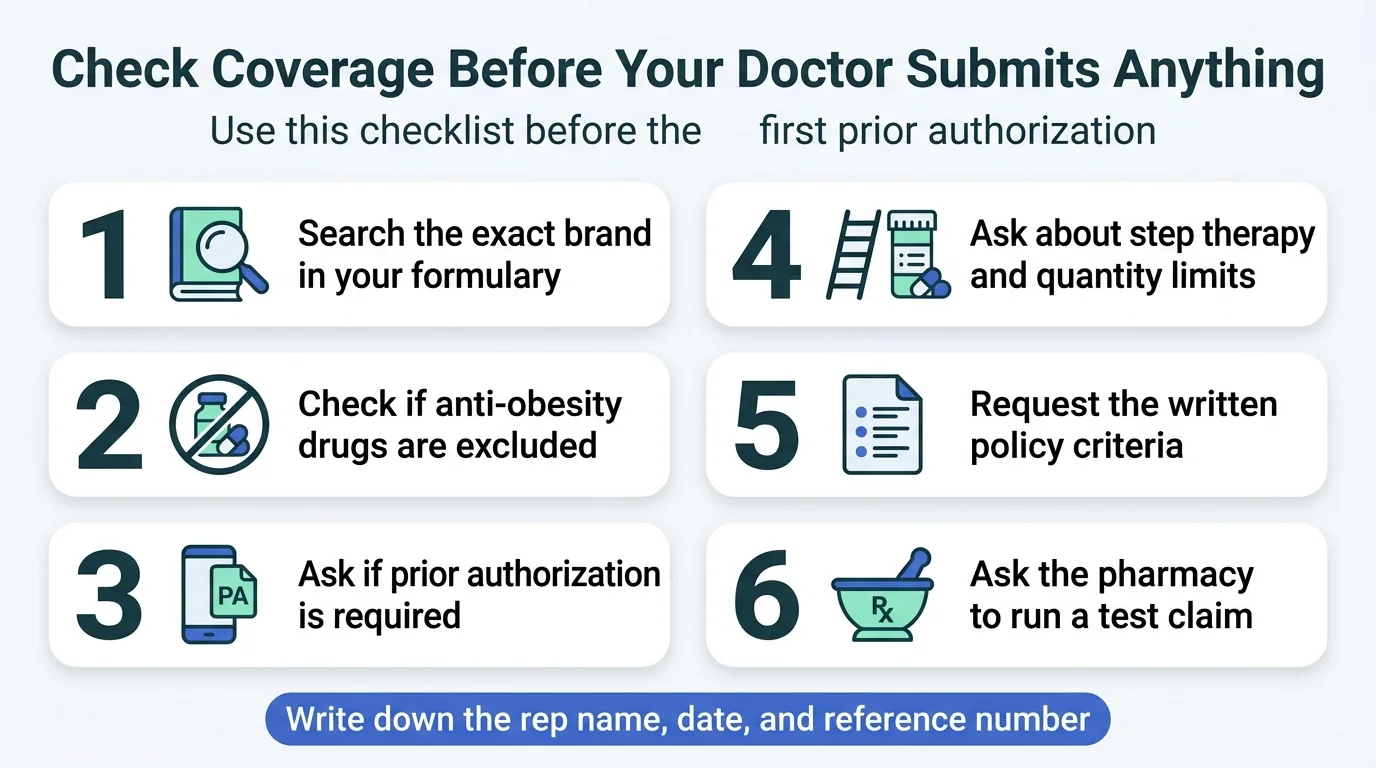
The 7 questions to ask your plan or pharmacy
Copy these. Read them out loud. Write the answers down with the date and the person's name.
- Is the Zepbound single-dose pen covered on my plan — for weight management, sleep apnea, or both?
- Do I need prior authorization or step therapy first?
- For my exact strength and a 28-day supply, what's my cost after insurance but before the manufacturer savings card—and after any eligible card savings?
- Is that a flat copay or a percent? Is there a max per fill?
- Does my deductible apply to this fill? How much of it is left?
- Will the savings card's payments count toward my deductible and out-of-pocket max?
- Once my dose is steady, can I get an 84-day supply by mail? What would it cost?
Question 7 matters more than you'd think. As u/Even_Novel132 wrote on r/Zepbound: "My copay varies if I do mail order home delivery or if I go to a retail pharmacy." (Shared on Reddit; not advice or a current price.) [18]
Three free ways to check your coverage
| Way to check | What you get | The catch |
|---|---|---|
| Call the number on your insurance card | Your plan's coverage and cost-sharing rules | You make the call and ask the right questions. The pharmacy must confirm the actual claim. |
| Lilly's online coverage check | A coverage estimate | It is not a guarantee of coverage or your final cost. |
| Ro's free insurance check | Ro's team contacts your plan and emails a report for the Zepbound single-dose pen | It does not check KwikPen coverage. You create a free Ro account and share insurance details. |
Public checker descriptions verified September 22, 2026. [10] [26]
Rather have someone else make the call? Ro's insurance team will contact your plan for you and email a free coverage report for the Zepbound pen — whether it's covered, whether you need prior authorization, and your estimated cost. The report is free. You need a free Ro account, but you do not need a paid membership. [10]
Check my Zepbound coverage for free → (sponsored) Checks the Zepbound pen, not the KwikPen. A coverage report is not a prescription or an approval.
Is it cheaper to pay cash for Zepbound than to use my insurance?
Sometimes. Qualifying self-pay offers for Zepbound KwikPen or vials run from $299 to $449 per 28 days, depending on dose and refill timing. With a full $100 covered-pen card benefit, cash is cheaper for that fill when your after-insurance, before-card charge exceeds the cash price by more than $100. Compare the full year before switching. [1] [2]
The crossover point, by dose
| Your prescribed dose | Qualifying cash price per 28 days | Insurance and cash tie when your before-card charge is… |
|---|---|---|
| 2.5 mg | $299 | $399 |
| 5 mg | $399 | $499 |
| 7.5 mg | $449; regular price $499 outside the higher-dose offer | $549; $599 at the regular cash price |
| 10, 12.5, or 15 mg | $449; regular price $699 outside the higher-dose offer | $549; $799 at the regular cash price |
Our calculation: cash price + $100. It assumes the full covered-pen card benefit is available and compares medication only. Below the tie point, insurance costs less for that fill; above it, cash costs less. It does not compare deductible credit or care and supply fees. [1] [2]
Example: if your before-card charge is $600 and your prescribed dose qualifies for the $449 cash offer, insurance leaves $500 after a full $100 discount. Cash saves $51 for that fill. That is a calculation, not a quote.
The $299 price is for the 2.5 mg starting strength, which is not a maintenance dose. Do not use it as your long-term budget. The first qualifying higher-dose purchase receives the $449 offer; later purchases must meet the 45-day rule. [1] [21]
Why one month can fool you
In a deductible month, cash looks like a slam dunk. But purchases under Lilly's self-pay offers cannot be billed to insurance or counted toward your deductible or out-of-pocket max. The cash purchase itself does not move you closer to either limit. This restriction is about these offers—not every prescription someone ever pays for in cash. [1] [2]
Go back to the high-deductible example above. Insurance: $3,700 for 13 fills. Cash vials: $5,637. Insurance costs $1,937 less in that example — even though the first three fills hurt more.
Compare the full-year insurance cost first if: you'll meet your deductible this year anyway (surgery, a baby, other medicines), you're close to your out-of-pocket max, or your plan's price drops soon.
Cash can win if: the covered price stays above the crossover point and the deductible credit you give up will not make insurance cheaper later. Include the number of fills you actually expect before your plan year resets.
What changes if you switch to cash
- It may be a different device. The KwikPen, single-dose pens, and vials are different forms of FDA-approved Zepbound. Ask your prescriber to send the right prescription for the form you will use. LillyDirect offers the vial path. [2] [21]
- Watch the 45-day rule. After the first qualifying 7.5 mg-or-higher purchase, buy the next qualifying fill within 45 days of delivery or receipt of the previous fill to keep the $449 offer. Outside that offer, regular prices are $499 at 7.5 mg and $699 at 10, 12.5, or 15 mg. This is a purchase rule, not a dosing schedule. [1] [2]
- The KwikPen card has a fill limit. Lilly's current KwikPen cards allow up to 11 fills per calendar year. Do not multiply a card price by 13 and call it a covered full-year offer; ask for the price after the benefit ends. [1]
- No mixing. You can't combine Lilly's insurance card with its cash offers or with other coupons. [1]
One thing never to do: stretch, split, or skip doses to save money. Talk to your prescriber before changing anything about how you take Zepbound.
More on cash prices: Zepbound self-pay prices · TrumpRx Zepbound · GoodRx and Zepbound
How can I lower my Zepbound cost with insurance?
Ask about an 84-day fill, a coinsurance cap, and your cost after the deductible. With enough eligible card benefit, a covered single-dose pen charge of $25–$325 for an 84-day supply can become $25 for the whole fill. Your plan must allow that supply and your prescriber must approve it. [1]
Ask for a 3-month supply once your dose is steady
This is easy to miss. Lilly's advertised $25 price applies per qualifying fill, not per month. And a 3-month (84-day) fill can get up to $300 off. [1]
To be clear: "$25 for a 3-month supply" does not mean $25 each month. It means $25 for the whole 84-day fill.
| Your copay per 28-day fill, before the card | Thirteen 28-day fills | Four 84-day fills + one 28-day fill | You save |
|---|---|---|---|
| $50 | $325 | $125 | $200 |
| $75 | $325 | $125 | $200 |
| $100 | $325 | $125 | $200 |
| $125 | $325 | $325 | $0 |
| $200 | $1,300 | $1,300 | $0 |
Our comparison covers the same 364 days on both sides. It assumes each 84-day pre-card charge is three times the 28-day copay, a steady prescribed dose, permission to fill both supply lengths, and enough card benefit under unchanged rules. It does not count fractional fills as purchases. [1]
The $75 example: three separate $75 copays become three $25 payments. One $225 charge for an approved 84-day fill becomes one $25 payment. That saves $50 over the same 84 days.
The catch: use the actual 84-day quote, not three times your monthly quote unless your plan confirms that pricing. Ask whether longer fills are allowed and whether your dose is expected to stay the same. A longer supply is not a reason to change treatment.
More ways to pay less
- Ask about a coinsurance cap. A per-fill limit can pull you under the $125 line.
- Check HSA or FSA rules for the exact offer. Your own qualifying prescription expense may be eligible; you cannot claim the part Lilly's card paid. But the KwikPen Self-Pay Savings Card expressly bars reimbursement of your out-of-pocket cost from a healthcare reimbursement account. General HSA/FSA eligibility does not override that offer restriction. [1] [22]
- If you really have sleep apnea, say so. Zepbound is FDA-approved for moderate-to-severe obstructive sleep apnea in adults with obesity, as well as for weight management. Some plans cover the sleep apnea use when they don't cover weight loss. Never seek a diagnosis you don't have. [21] [30]
5 ways people overpay for Zepbound with insurance 1. Missing Lilly's free savings card when you qualify for it. 2. Filling every 28 days when an 84-day fill would cost $25 per 84 days. 3. Choosing cash from one expensive bill without checking the full-year insurance cost. 4. Missing a required cash-offer refill window: the regular price is $50 higher at 7.5 mg or $250 higher at 10–15 mg. [1] [2] 5. Assuming "covered" means $25.
Do I need a new provider — and what does that add to my cost?
Not always. If your current doctor will prescribe Zepbound and file any prior authorization, your cost may be just your copay plus normal visit costs. Online programs charge a separate care fee on top of your medication: Ro starts at $39, then $149 monthly or an advertised $74/month equivalent with annual prepayment. Sesame lists $99 every 28 days or an advertised equivalent from $59/month prepaid yearly. [9] [11]
What prior authorization means
Prior authorization (often called "PA") means your prescriber must send your plan proof that you meet its rules before the plan will pay. The plan's form may ask for your BMI, weight history, lifestyle-program records, or a sleep study for the sleep-apnea use. Use the requirements for your own plan and indication. How long it takes depends on your plan. [26] [30]
Start with the relevant plan guide here: CVS Caremark · Express Scripts · OptumRx · UnitedHealthcare · Blue Cross · Kaiser
Start with your own doctor
Ask one question before you pay any new membership: "Will you prescribe Zepbound and file the prior authorization with my plan?" If the answer is yes, you may not need anyone else. Check your pharmacy price and use Lilly's card if you qualify.
Care fees, side by side
| Cost or service | Your own doctor | Ro | Sesame |
|---|---|---|---|
| Care fee without annual prepayment | Your normal visit costs | $39 first month, then $149 monthly | Listed $99 every 28 days; some clinicians charge more |
| Advertised annual-plan price | Ask your practice | As low as $74/month equivalent, paid upfront | From $59/month equivalent, paid upfront |
| Zepbound medication | Separate | Separate | Separate |
| Checks your coverage for you | Ask the practice; you can also call your plan | Free single-dose pen check; not KwikPen | Ask the clinician you select |
| Handles prior authorization | Confirm with your doctor | Insurance support for eligible plans and prescribed treatment | Program offers PA help; confirm with your chosen provider |
| One care charge plus one $25 medication fill | $25 + visit costs | $174 on the ongoing monthly plan; $64 with the $39 intro charge | $124 at the listed $99 care fee |
| Our fit judgment | People whose doctor already handles PAs | No prescriber, or need help with insurance paperwork | Want to pick a clinician at a lower listed ongoing fee |
Care fees are what each company lists publicly, checked September 22, 2026. They are not checkout quotes. Some Sesame providers may charge more. The totals pair one care charge with one hypothetical $25 medication fill; Ro's monthly billing and a 28-day prescription do not follow the same calendar. Annual-plan prices are prepaid monthly equivalents, not monthly checkout charges. [9] [10] [11]
Our take: when Ro is worth it
Ro does not have the lowest ongoing care fee in this comparison. If the lowest ongoing fee is your top priority, Sesame's listed plans cost less, and your own doctor may cost less still. The reason to compare Ro is the help with the insurance fight. Its team contacts your plan and runs a free coverage check before you commit to paid care; its paid program includes prior-authorization support for eligible prescriptions and plans. Ro cannot make your insurer cover an excluded drug. [9] [10] [25]
So here's our honest filter. If your doctor already handles the paperwork, skip Ro and use Lilly's card if eligible. If you have no prescriber, or your plan's paperwork has you stuck, that's exactly what Ro is for. Ro also lists KwikPen cash prices matching LillyDirect's qualifying $299–$449 offers if your plan says no. The membership is still extra. [9] [2]
A few more facts so there are no surprises: your Zepbound medication is billed separately from the membership. You can cancel the membership. Ro treats prescription purchases as generally final. Canceling future membership renewals does not mean an already-paid prescription or prepaid care plan is automatically refunded. Contact Ro about any dispensing error. [23] [24]
Does this sound like you — covered (or maybe covered), but no doctor lined up to handle the paperwork?
See if you qualify with Ro — $39 to start → (sponsored) Get started for $39, then as low as $74/month with annual plan paid upfront ($149/month if you pay monthly). Ro refunds the $39 if you're not eligible for GLP-1 treatment. That is not a refund promise for an insurance denial. Your Zepbound cost is separate. [9]
When Sesame fits better
Sesame is a marketplace of clinicians, so you choose who you see. Its listed ongoing plans cost less than Ro's, and it says its program can help with prior authorization. The trade-off: the experience depends more on the provider you pick. To choose your own clinician, compare your options there. [11]
Check the cancellation terms before paying: Sesame describes a full first-charge refund when you cancel at least three hours before the first appointment. After that appointment, the first month is not refundable. Cancel before the next billing cycle to stop the next charge. [11]
Compare Sesame clinicians and plan fees → (sponsored)
We only compare FDA-approved Zepbound products on this page. Compounded tirzepatide is not Zepbound and is not FDA-approved. A Zepbound coverage approval and Lilly's card do not apply to a compounded product. To compare that separate treatment path, use Find My GLP-1 Path or read compounded vs. name-brand GLP-1s. [1] [20]
What if my insurance won't cover Zepbound?
First find out why. A missing approval, a denied request, and a benefit exclusion need different fixes. Read the denial notice for the reason, deadline, and review rights; medical need alone does not add an excluded benefit. While you sort it out, compare the qualifying self-pay offers below. [5]
Exclusion or denial? They need different fixes
| What your plan said | What it means | What to check | Your next step |
|---|---|---|---|
| Excluded or “not a covered benefit” | The plan says this drug, drug category, or use is outside your benefits | Whether it applied the correct benefit and diagnosis; the notice's review rights | Request the written exclusion. For employer coverage, ask about a benefit change; compare self-pay separately. |
| Not on formulary | Zepbound is not on the applicable drug list | Whether a formulary exception is available; this does not prove other weight-loss drugs are covered | Ask your prescriber about the exception process and covered alternatives. |
| Prior authorization denied | The submitted request did not meet the plan's requirements | The exact reason, missing records, clinical criteria, and deadline | Get the denial letter, correct errors or missing evidence, and resubmit or appeal when appropriate. |
An appeal can challenge an incorrect decision. It does not guarantee payment or create coverage the contract excludes. [5] [31]
Not sure which one you got? Use our denial decoder, then our free appeal letter template. No page or provider can promise an appeal will win.
Your cash options when Zepbound isn't covered
| Option | Advertised medication price per 28 days | Where | Good to know |
|---|---|---|---|
| Single-dose pen + noncovered-commercial savings card | As low as $499 | Participating pharmacy | Eligible commercial insurance required; up to 13 fills per calendar year. |
| KwikPen + applicable savings card | As low as $299 at 2.5 mg; $399 at 5 mg; $449 at 7.5–15 mg | Participating retail pharmacies or LillyDirect's self-pay path | Current KwikPen cards have an 11-fill calendar-year limit. The higher-dose offer has a 45-day purchase rule. |
| Single-dose vials, self-pay | $299 at 2.5 mg; $399 at 5 mg; $449 at 7.5–15 mg under the offer | LillyDirect | Four vials per 28-day fill; correct vial prescription required. The higher-dose offer has a 45-day purchase rule. |
These are manufacturer offers, not confirmed pharmacy quotes. Use the right eligibility terms for the card or self-pay program. A government-program enrollee cannot use the commercial card, but that does not automatically bar Lilly's separate self-pay options. Supplies and applicable fees are separate. [1] [2]
Comparing the advertised offers, KwikPen or vials are $50 to $200 less per fill than the $499 single-dose pen offer. That comparison only holds while you qualify for the listed prices; it does not erase the KwikPen card's fill limit.
CVS Caremark members: what changes October 1, 2026
CVS Health announced on May 28, 2026 that Zepbound returns as an additional preferred option on CVS Caremark's most common commercial template formularies on October 1, 2026. That date is still ahead as of this review. The catch: your employer or plan sponsor can customize coverage. Do not assume you will get coverage or the same copay as Wegovy. Ask for your October drug list, approval requirements, and pharmacy quote. More here: Does CVS Caremark cover Zepbound?. [12]
Your next step if Zepbound isn't covered:
- Already have the right prescription? Compare the direct option. See self-pay Zepbound options at LillyDirect → (not an affiliate link)
- Need a prescriber too? Ro lists the same qualifying $299–$449 KwikPen medication offers, plus its membership. [9] See Ro's KwikPen prices and eligibility → (sponsored)
How much is Zepbound with Medicare, Medicaid, or TRICARE?
Government-program enrollees cannot use Lilly's commercial-insurance savings card. Eligible Medicare GLP-1 Bridge patients pay $50 per 28-day Zepbound KwikPen supply. Ordinary Part D coverage for sleep apnea uses different rules, while Medicaid and TRICARE depend on your program and benefit. [1] [3] [14] [15]
Medicare GLP-1 Bridge: $50 a month
- Price: $50 per 28-day Zepbound supply; care and pen needles are separate.
- Product: the Zepbound KwikPen only — not the single-dose pen or vials.
- Dates: began July 1, 2026 and runs through December 31, 2027.
- Good to know: no Part D deductible applies to the Bridge. Its copayment does not count toward the Part D yearly limit, cannot be reduced by Extra Help, and cannot be spread using the Medicare Prescription Payment Plan. [3] [14] [30]
You must be at least 18, have an eligible type of Part D coverage, and meet the program's clinical rules. At the start of GLP-1 treatment, that means one of these BMI paths:
| BMI | Additional condition needed |
|---|---|
| 35 or higher | No additional condition from the two rows below |
| 30 or higher | Heart failure with preserved ejection fraction, uncontrolled high blood pressure, or chronic kidney disease at stage 3a or higher |
| 27 or higher | Prediabetes, a prior heart attack or stroke, or peripheral artery disease with symptoms |
Your prescriber must support the required approval and certify use with a diet-and-exercise lifestyle program. Medicare also lists existing covered Part D GLP-1 treatment, type 2 diabetes, moderate-to-severe sleep apnea, and fatty liver disease among the Bridge exclusions. Those patients must check the regular Part D path for the prescribed drug and indication. Meeting a BMI threshold by itself does not settle every eligibility rule. [3] [14]
Your next step: ask your current prescriber which path applies before paying for a separate program.
Details: Medicare GLP-1 Bridge guide · Does Medicare cover Zepbound? · Why vials aren't covered · Pen needles
Medicare Part D for sleep apnea: up to $2,100 in 2026
If Zepbound is prescribed for moderate-to-severe obstructive sleep apnea in an adult with obesity, check coverage through the regular Part D plan, not the Bridge. Your plan must cover the prescription and approve any required prior authorization. For 2026, the standard Part D deductible is up to $615, and the out-of-pocket cap is $2,100 for all your covered Part D drugs combined. A plan can have a lower deductible. [13] [30]
Here's how that could look under Medicare's standard 2026 benefit, using a made-up $1,000 covered price per fill, 25% coinsurance after the deductible, no other covered drug spending, and no Extra Help:
| Fill | You pay in this example |
|---|---|
| 1 | $711.25: $615 deductible + 25% of the remaining $385 |
| 2 through 6 | $250 each |
| 7 | $138.75; total reaches $2,100 |
| 8 through 13 | $0 for covered Part D drugs |
Your plan may use copays instead, so your months may look different. The cap does not include premiums, noncovered prescriptions, or Bridge copayments. For 2027, the standard deductible is up to $700 and the covered-drug out-of-pocket cap is $2,400. [13]
Medicare's Prescription Payment Plan can spread regular Part D costs across monthly payments. It changes when you pay, not the total you owe, and it does not apply to the Bridge copayment. [29] [3]
In October 2025, @tls85 on Mayo Clinic Connect reported getting “coverage from Medicare for Zepbound for sleep apnea but it is $500 a month.” That was a patient report, not a verified bill or a current quote. It shows why asking about the annual limit matters; it does not tell us how that person's bill was calculated. [19]
Medicaid
Medicaid coverage depends on the state, the specific plan, and why Zepbound is prescribed. KFF counted 13 state fee-for-service Medicaid programs covering GLP-1s for obesity as of January 2026. That is a dated category-level count—not confirmation that your state or managed-care plan covers Zepbound today. [17]
Do not use a national $4 or $8 estimate as your 2026 quote. The federal table often cited for those figures identifies them as 2013 base amounts, with later adjustments. The amount you owe also depends on exemptions and your state's rules. [27]
Ask your Medicaid plan: “Is this exact Zepbound prescription covered for my diagnosis, what approval is required, and what copay applies to me?” Check obesity coverage and sleep-apnea coverage separately. See Does Medicaid cover Zepbound?.
TRICARE and VA
TRICARE covers weight-management drugs only for eligible benefit groups and when its approval rules are met. TRICARE For Life does not cover weight-loss drugs for weight loss, even if a prior approval existed. A different diagnosis needs its own coverage check. [15]
Active-duty service members pay $0 for covered prescriptions. For other beneficiaries without a special cost exemption, standard 2026 copays include $48 for a formulary brand or $85 for a nonformulary drug at a retail network pharmacy for up to 30 days. Home-delivery prices and protected beneficiary groups differ. Do not assume Zepbound uses the brand-name tier; confirm the drug's status and any approved medical-necessity exception. [16]
See Does TRICARE cover Zepbound?. VA care follows VA's own rules. Use your VA care team to confirm eligibility, prescribing, and cost rather than applying TRICARE prices to VA benefits.
Ro's commercial insurance support is not a way to use Medicare or TRICARE coverage. Ro says some people with these plans can use its cash-pay program, but it does not accept people enrolled in Medicaid. Federal employee plans are a separate case: Ro identifies FEHB coverage as eligible for its insurance-support service. [25]
For these readers, start with the Bridge when eligible, your covered care team, or the applicable LillyDirect self-pay option. A paid telehealth membership is not required just to check those paths.
How much does Zepbound cost per year with insurance?
For 364 days of once-weekly treatment, compare 13 fills of 28 days each. At $25 a fill, that's $325, not $300. Coinsurance and deductible totals require your actual plan price; the examples below are calculations, not a forecast of your next year's bills. [1]
| Situation and assumptions | Medication cost for the stated period |
|---|---|
| Thirteen eligible covered fills at $25 each | $325 for 364 days |
| Our $50–$100 copay example using four 84-day fills plus one 28-day fill | $125 for 364 days |
| Thirteen eligible fills with a $200 before-card copay and $100 savings each | $1,300 for 364 days |
| Our $1,000 allowed-price example, 20% coinsurance, deductible already met | $1,300 for 13 fills before any lower out-of-pocket-limit result |
| The same example with 30% coinsurance | $2,600 for 13 fills before any lower out-of-pocket-limit result |
| Our $3,000 deductible / $5,000 limit example, with full card credit | $3,700 for 13 fills |
| Noncovered single-dose pens, assuming every eligible fill reaches the advertised $499 price | $6,487 for 13 fills |
| Cash vial example: one 2.5 mg fill, one 5 mg fill, then 11 higher-dose fills at the offer price | $5,637 for 13 fills |
| Medicare GLP-1 Bridge, thirteen 28-day Zepbound supplies at $50 | $650 for 364 days |
| Regular Medicare Part D in 2026 | Up to $2,100 for all covered Part D drugs combined in that calendar year |
Care, supplies, and premiums are not included. Manufacturer-offer examples assume eligibility and unchanged terms throughout the comparison period. Current Lilly cards expire December 31, 2026; these are not promises of 2027 prices. The Bridge began July 1, 2026, so its 364-day example is not a calendar-2026 bill. The 13-fill cash example uses vials, not the KwikPen's 11-fill card. [1] [2] [3] [13]
Will my next refill cost the same?
Not always. Your price can change when your deductible gets used up, when you hit your out-of-pocket max, when your plan year resets, or when Lilly's card terms change. Before each refill, jot down:
- Next fill date
- Price quoted (before and after the card)
- Pen, KwikPen, or vials — and the strength
- Deductible left
- Care fee, if you pay one
- Date and who told you
Will Zepbound get cheaper in 2026 or 2027?
Do not budget around an unannounced price cut. The confirmed changes to watch are CVS Caremark's October 1 formulary update, the end of the current Lilly cards on December 31, and Medicare's 2027 Part D limits. A coverage change can affect your price without changing the drug's list price. [12] [1] [13]
| Date | What changes | What to do |
|---|---|---|
| October 1, 2026 | Zepbound returns as an additional preferred option on CVS Caremark's most common commercial template formularies | Check your own plan's October drug list, approval rules, and copay. |
| December 31, 2026 | Current Lilly savings cards expire | Check the published terms before your first 2027 fill. Do not assume renewal or the same discount. |
| January 1, 2027 | Deductibles reset for calendar-year plans; standard Part D deductible becomes up to $700 and the covered-drug cap becomes $2,400 | Check your plan-year start date and first-fill quote. |
| December 31, 2027 | The Medicare GLP-1 Bridge is scheduled to end | Check CMS for any announced extension or replacement before relying on later coverage. |
A useful budget check: write the card's end date next to your plan's reset date. They are different rules, and either can change the next bill. [1] [6] [14]
What did we actually verify?
We checked the published manufacturer offers, provider fees, and program rules cited here on September 22, 2026. The cost examples are our own math, based on stated assumptions—not real patient bills or insurance quotes.
| Claim or asset | What the source states | What we verified—and what we did not |
|---|---|---|
| Lilly commercial pen savings | Up to $100/$200/$300 per eligible fill; $1,300 annual savings limit | Read the current terms, eligibility, expiry, and device limits. Did not process a pharmacy claim. [1] |
| Lilly cash options | Dose-based prices and higher-dose refill conditions | Compared vial and KwikPen offers, including the KwikPen card's 11-fill limit. Did not complete checkout. [1] [2] |
| Ro | $39 intro; $149 monthly; annual-prepay equivalent from $74; medication extra | Checked the pricing page, free checker's scope, and published policies. Did not buy care or test an insurance approval. [9] [10] [23] [24] |
| Sesame | Listed $99 per 28 days; annual-prepay equivalent from $59; medication extra | Checked billing, provider-choice, and cancellation language. Did not complete a paid visit. [11] |
| Medicare and TRICARE | Their own eligibility and cost rules | Used official program pages and CMS's 2026–2027 benefit figures—not a commercial-provider description. [3] [13] [14] [15] [16] |
| Quote, break-even, and whole-fill comparisons | Our calculations, not provider claims | Recalculated the examples with their stated inputs. No claim that these are typical patient costs. |
What we did not check: your plan's benefits, a real pharmacy claim, a completed paid checkout, delivery times, or anyone's medical results.
How we did the math. For covered single-dose pens, we subtract only the available card benefit from the after-insurance charge, stopping at $25 unless the original charge was already lower. Coinsurance and deductible examples use a clearly labeled, hypothetical $1,000 allowed price—not an asserted Zepbound list price. The 84-day comparison uses whole fills covering the same 364 days. The Medicare example uses the standard 2026 Part D benefit. [1] [13]
Who made this. The RX Index Editorial Team. We're an editorial publisher, not a medical practice, and this page isn't medical advice. We don't take money to change what we say, and we'll fix any mistake you find: corrections policy · editorial standards. [28]
Zepbound cost with insurance: common questions
How much is Zepbound per month with insurance?
For an eligible covered single-dose pen prescription, Lilly's card can take up to $100 off a 28-day fill, stopping at $25. A charge already below $25 stays below $25. Coinsurance and deductible bills depend on your plan's allowed price and how much card benefit remains—not a fixed national price. [1] [4]
Is Zepbound really $25 with insurance?
Yes, for some eligible fills. With commercial coverage for single-dose pens and enough card benefit, a charge of $25–$125 can become $25 for 28 days. Other situations can also produce a $25 bill, including a plan that already charges $25. The advertised minimum is not a promise that every insured person pays it. [1]
Why is my Zepbound copay so high if my insurance covers it?
Check four things: your remaining deductible, coinsurance or copay, whether the card was applied, and how much savings remains. An accumulator can also keep card payments from reducing your deductible. The covered-pen card takes off up to $100 per 28-day fill, so it can't erase a big bill. [1]
How do you get your insurance to cover Zepbound?
Check coverage for your actual diagnosis and prescription form. If approval is required, your prescriber submits the records your plan asks for. Zepbound's sleep-apnea indication is for moderate-to-severe obstructive sleep apnea in adults with obesity. If you're denied, get the letter, reason, deadline, and review instructions. [5] [21] [26]
What is the cheapest way to get Zepbound?
Start with your own covered pharmacy quote. An eligible 84-day single-dose pen fill can be as little as $25 with the card, and some plans charge less without a card. Eligible Bridge patients pay $50 per 28-day KwikPen supply. Qualifying cash offers range from $299 to $449 by dose and refill rules. Never buy "Zepbound" from a seller that doesn't need a prescription. [1] [2] [3] [21]
How much does Zepbound cost at Walgreens or CVS?
Ask that store to price your exact prescription through your plan, then apply the eligible card. In-network stores can have different preferred-pharmacy prices, so do not assume every pharmacy quote is identical. A cash price you see on a pharmacy or coupon site is not your insured price. Lilly's KwikPen offers include participating retail pharmacies; call first about availability. [1] [31]
Does the Zepbound savings card count toward my deductible?
It depends on your plan. Some plans count the card's payments. Plans with a copay accumulator don't. Ask: "Will the savings card's payments count toward my deductible and out-of-pocket max?" Lilly may also change benefits based on how a plan credits the card. [1]
Can I use the savings card if my plan doesn't cover Zepbound?
Eligible people with commercial insurance that does not cover Zepbound can use the single-dose pen offer for as little as $499 per 28-day fill. KwikPen has separate commercial and self-pay card terms, prices, and an 11-fill calendar-year limit. Use the terms for your exact offer, not the covered-pen $100 rule. [1]
Does paying cash for Zepbound count toward my deductible?
Not when you use the Lilly self-pay offers described here: their terms bar billing the purchase to insurance or counting it toward those limits. Other cash purchases follow their own plan and program rules; ask before paying. [1] [2]
Can I combine Lilly's card with GoodRx or another coupon?
No. Lilly's terms say its card can't be combined with any other discount card, coupon, or offer for Zepbound. [1]
Can I use my HSA or FSA for Zepbound?
A qualifying prescription expense you actually pay can be eligible, but you cannot claim the part paid by a card or another source. Lilly's KwikPen Self-Pay Savings Card separately forbids reimbursement of your out-of-pocket cost from a healthcare reimbursement account. Read the exact offer before using an HSA or FSA; general tax eligibility does not cancel that restriction. [22] [1]
Does insurance cover the Zepbound KwikPen or vials?
Check the exact product on your plan's drug list. Coverage of one Zepbound device does not prove coverage of another. LillyDirect offers a self-pay vial path, while Medicare's GLP-1 Bridge covers the KwikPen only, not single-dose pens or vials. There is no one device-coverage rule for every commercial plan. [2] [3] [26]
Does everyone with Aetna, Blue Cross, Cigna, or UnitedHealthcare pay the same?
No. Your employer or plan sponsor chooses the benefit, so two people with the same insurance company can get different answers. Always check your own plan. [12] [26]
What happens to my Zepbound price in January 2027?
A calendar-year deductible resets on January 1; other plans can reset on a different date. Lilly's current cards expire December 31, 2026, so check the next terms before relying on the same savings. Medicare's 2027 covered Part D drug cap is $2,400, with a standard deductible of up to $700. [1] [6] [13]
Should I use Zepbound's list price to work out my bill?
No. List price is not your plan's allowed price or your pharmacy copay. For coinsurance, ask which price your plan uses; for a deductible, ask what part of this fill applies to it. Then get the after-card quote. That avoids turning a public list price into a bill your plan never quoted. [4]
Still not sure which GLP-1 program is right for you? Take our free matching quiz. → Find My GLP-1 Path
About this page: The RX Index — independent guidance for choosing your GLP-1 path. Researched and maintained by The RX Index Editorial Team. Last verified September 22, 2026.
Medical note: Zepbound requires a prescription. It has a boxed warning about thyroid C-cell tumors and should not be used by people with a personal or family history of medullary thyroid carcinoma (MTC) or Multiple Endocrine Neoplasia syndrome type 2 (MEN 2). The tumors occurred in rats; it is not known whether Zepbound causes them in humans. A prior serious allergic reaction to tirzepatide or its ingredients is also a reason not to use it. This page is about cost, not medical advice. Talk to a licensed clinician before starting, stopping, or changing any medicine. Zepbound® is a registered trademark of Eli Lilly and Company. [21]
Sources
Public pages checked September 22, 2026. Research snapshots and patient comments keep their original dates.
- Lilly — Zepbound savings offers and card terms
- LillyDirect — Zepbound self-pay options
- Medicare.gov — Weight-loss drugs and Medicare GLP-1 Bridge
- HealthCare.gov — Allowed amount
- HealthCare.gov — Appealing an insurance decision
- HealthCare.gov — Out-of-pocket maximum
- KFF — 2025 Employer Health Benefits Survey
- Evernorth — Optional employer GLP-1 benefit, May 21, 2025
- Ro — Weight-loss pricing
- Ro — Free GLP-1 insurance checker
- Sesame — Online weight-loss program, billing, and cancellation
- CVS Health — Commercial formulary announcement, May 28, 2026
- CMS — 2027 Rate Announcement, 2026–2027 Part D benefit parameters, printed pages 95 and 99
- CMS — Medicare GLP-1 Bridge program
- TRICARE — Coverage of weight-loss medications
- TRICARE — Prescription copayments
- KFF — Medicaid GLP-1 coverage, January 2026 snapshot
- Reddit r/Zepbound — Reader discussion; anecdotes only
- Mayo Clinic Connect — October 2025 patient comment; anecdote only
- FDA — Concerns about unapproved GLP-1 drugs used for weight loss
- DailyMed — Zepbound FDA-approved prescribing information, revised August 2026
- IRS — Publication 969, health savings and reimbursement accounts
- Ro — Canceling a Body Program membership
- Ro — Returns and refunds
- Ro — Insurance support and government-program limitations
- Lilly — Zepbound insurance check
- Medicaid.gov — Cost-sharing rules and dated base-amount tables
- The RX Index — Editorial Team and publishing role
- Medicare.gov — Medicare Prescription Payment Plan
- LillyDirect — Medicare Bridge, product and supply requirements
- HealthCare.gov — Prescription coverage and pharmacy networks
- HealthCare.gov — Deductible
[1]: https://zepbound.lilly.com/savings [2]: https://www.lilly.com/lillydirect/zepbound [3]: https://www.medicare.gov/coverage/weight-loss-drugs [4]: https://www.healthcare.gov/glossary/allowed-amount/ [5]: https://www.healthcare.gov/appeal-insurance-company-decision/appeals/ [6]: https://www.healthcare.gov/glossary/out-of-pocket-maximum-limit/ [7]: https://www.kff.org/health-costs/2025-employer-health-benefits-survey/ [8]: https://www.evernorth.com/articles/evernorth-launches-new-benefit-option-drives-lower-net-cost-weight-loss-medicines [9]: https://ro.co/weight-loss/pricing/ [10]: https://ro.co/weight-loss/glp1-insurance-checker/ [11]: https://sesamecare.com/service/online-weight-loss-program [12]: https://www.cvshealth.com/news/company-news/cvs-caremark-delivers-affordability-and-access-to-glp-1-weight-management-medications-with-expanded-coverage-options.html [13]: https://www.cms.gov/files/document/2027-announcement.pdf [14]: https://www.cms.gov/medicare/coverage/prescription-drug-coverage/medicare-glp-1-bridge [15]: https://tricare.mil/FAQs/Pharmacy/PharmProg_Wegovy [16]: https://tricare.mil/FAQs/Pharmacy/PharmProg_Copays [17]: https://www.kff.org/medicaid/medicaid-coverage-of-and-spending-on-glp-1s/ [18]: https://www.reddit.com/r/Zepbound/comments/1jcsttm/all_the_different_cost_folks_are_paying_so/ [19]: https://connect.mayoclinic.org/comment/1420316/ [20]: https://www.fda.gov/drugs/drug-alerts-and-statements/fdas-concerns-unapproved-glp-1-drugs-used-weight-loss [21]: https://dailymed.nlm.nih.gov/dailymed/drugInfo.cfm?setid=487cd7e7-434c-4925-99fa-aa80b1cc776b [22]: https://www.irs.gov/publications/p969 [23]: https://care.getroman.com/hc/en-us/articles/13346934892685-How-to-cancel-a-subscription-to-the-Body-Program [24]: https://ro.co/returns-and-refunds/ [25]: https://ro.co/weight-loss/insurance/ [26]: https://zepbound.lilly.com/insurance-check [27]: https://www.medicaid.gov/medicaid/cost-sharing/cost-sharing-out-pocket-costs [28]: https://therxindex.com/authors/editorial-team/ [29]: https://www.medicare.gov/prescription-payment-plan [30]: https://www.lilly.com/lillydirect/medicare [31]: https://www.healthcare.gov/using-marketplace-coverage/prescription-medications/ [32]: https://www.healthcare.gov/glossary/deductible/